HP CM Office Greets World Tourism Day, Hails State's Mountains
Synopsis
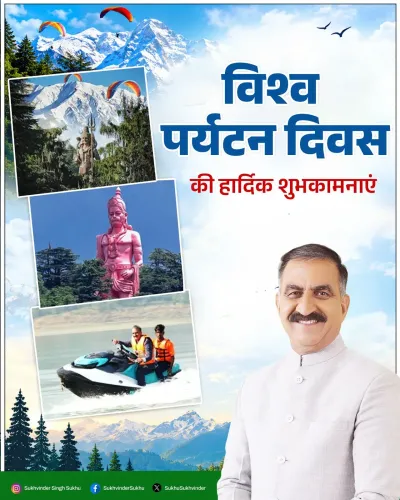
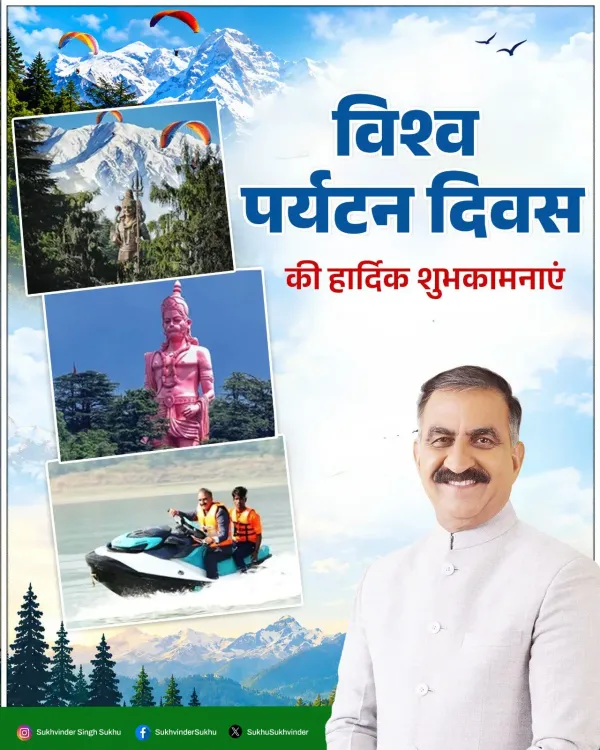
On World Tourism Day 2026, the Chief Minister's Office of Himachal Pradesh celebrated the state's Himalayan identity — snow-capped peaks, deodar forests, and the hospitality that defines its culture — with warm seasonal greetings on X.
Key Takeaways
The Chief Minister's Office of Himachal Pradesh posted World Tourism Day greetings on 27 September 2026 .
World Tourism Day is observed annually on 27 September , established by the UN World Tourism Organization.
The message highlighted Himachal's snowy peaks, deodar forests, beautiful valleys , and signature hospitality as the state's tourism identity.
Himachal Pradesh is among India's most-visited Himalayan destinations, spanning corridors from Shimla and Manali to Spiti and Kinnaur .
The CMO's message leaned on cultural sentiment — peace, belonging, and warmth — rather than policy announcements.
Snow-capped peaks, cedar forests, and valleys that carry the quiet — on World Tourism Day, 27 September 2026, the Chief Minister's Office of Himachal Pradesh reached out to wish everyone and reminded the country exactly what makes the hill state irreplaceable on India's tourism map.
The post, shared on X, offered warm greetings and painted the state's identity in vivid strokes: 'हवा में सुकून है, संस्कृति में अपनापन है' — 'there is peace in the air, and a sense of belonging in the culture.' The message singled out Himachal's snowy summits, deodar forests, and the warmth of its hospitality as the pillars of its distinct appeal.
Why World Tourism Day Matters for a Mountain State
World Tourism Day is observed every year on 27 September, a date set by the UN World Tourism Organization to spotlight tourism's role in economic growth and cultural exchange. For a state whose identity and livelihoods are deeply entwined with footfall from the plains and beyond, the occasion is more than ceremonial — it is an annual moment to restate the pitch to the world.
Himachal Pradesh has long been among India's most-visited Himalayan destinations, drawing trekkers, pilgrims, honeymooners, and nature seekers to corridors stretching from Shimla and Manali in the south to Spiti and Kinnaur in the north. The state's tourism economy hinges on that unique blend the post captures: landscape, culture, and the famed warmth of its people.
Hospitality as Identity — Not Just a Slogan
The CMO's message did not list statistics or announce schemes — it leaned on sentiment and imagery, the language that travel decisions are actually made in. The reference to 'mehmaan-nawaazi' — hospitality — as a 'khas pehchaan', a defining identity, reflects a branding instinct that tourism boards globally have long recognised: travellers choose places that feel welcoming, not merely spectacular.
Indian state governments routinely use World Tourism Day to amplify promotional messaging, but Himachal's natural canvas — deodar canopies, mountain light, the particular stillness of high-altitude valleys — gives such messages a texture that is hard to manufacture elsewhere.
Point of View
Messaging like this lays the cultural groundwork for harder asks that typically follow. The post's Hindi register also signals that the pitch is as much to the domestic traveller as to any international audience.
NationPress
27 Sept 2026
Frequently Asked Questions
When is World Tourism Day celebrated?
World Tourism Day is celebrated every year on 27 September , a date established by the UN World Tourism Organization to highlight tourism's social, cultural, and economic significance.
Why is Himachal Pradesh famous for tourism?
Himachal Pradesh is famous for its snow-capped Himalayan peaks, deodar cedar forests, scenic valleys , and destinations such as Shimla, Manali, Spiti, and Kinnaur , along with a culture of warm hospitality.
What did the Himachal Pradesh CMO post on World Tourism Day 2026?
The Chief Minister's Office of Himachal Pradesh shared greetings on X, celebrating the state's identity through its snowy peaks, forests, valleys, cultural warmth, and hospitality.
What is the significance of World Tourism Day for Himachal Pradesh?
For Himachal Pradesh, whose economy is closely tied to tourism, World Tourism Day is an annual opportunity to showcase the state's natural and cultural assets to domestic and international visitors.
What is deodar and why is it associated with Himachal Pradesh?
Deodar (Cedrus deodara) is the Himalayan cedar, the state tree of Himachal Pradesh, and its dense forests across the mid-hills are among the most iconic images of the state's landscape.