HP CM Office: Rs 2 Cr for Silver, Rs 1 Cr for Bronze in Sports Awards

Synopsis
The Himachal Pradesh CM Office announced Rs 2 crore for silver and Rs 1 crore for bronze medals at international events, pledging that no talented state athlete will be left behind for lack of resources or encouragement.
Key Takeaways
Rs 2 crore prize money announced for athletes from Himachal Pradesh winning a silver medal at international competitions.
Rs 1 crore prize money announced for athletes winning a bronze medal at international competitions.
The Chief Minister's Office of Himachal Pradesh made the announcement on November 2, 2026 .
The stated policy goal is to ensure no promising HP athlete is held back by a shortage of resources or encouragement.
Implementation details — including eligible events, disbursement process, and any gold-medal tier — have not yet been publicly confirmed.
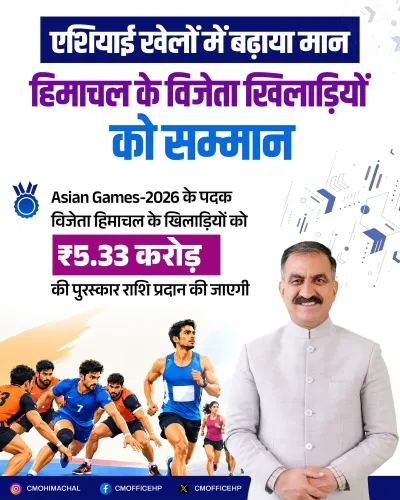
No talented athlete from Himachal Pradesh should be held back by a lack of resources — that is the stated promise now backed by hard numbers. The Chief Minister's Office of Himachal Pradesh announced on Monday, November 2, 2026, that the state will award Rs 2 crore to athletes winning a silver medal and Rs 1 crore to those winning a bronze medal at international competitions.
The announcement, posted on X, states in the original Hindi: 'रजत पदक जीतने पर 2 करोड़ रुपये और कांस्य पदक जीतने पर 1 करोड़ रुपये की पुरस्कार राशि दी जाएगी' — 'A prize of Rs 2 crore will be given for winning a silver medal and Rs 1 crore for winning a bronze medal.' The government added that its goal is to ensure every promising player in the state gets a full opportunity to prove their talent on the international stage.
What the prize structure signals for HP athletes
Cash-incentive frameworks for international medallists have become a well-established tool across Indian states — a direct response to the resource gap that often derails gifted athletes before they reach global platforms. Himachal Pradesh, a predominantly mountainous state with deep talent pools in disciplines such as combat sports, skiing, and athletics, is now formalising its commitment with rupee figures that are hard to ignore.
The two-tier structure — silver and bronze — fills a gap that many state schemes overlook by concentrating rewards only on gold. Acknowledging second and third-place finishes at the international level sends a clear message: the state values the climb, not just the summit. What remains to be announced publicly are the precise competitions that qualify, the disbursement mechanism, and whether a separate gold-medal reward sits above this tier.
Closing the gap between grassroots talent and global ambition
The CM Office framed the incentive explicitly around the word 'encouragement' — protsahan — underscoring that the policy is as much about pipeline-building as it is about rewarding past achievement. States that have linked financial security to international performance typically see a measurable uptick in competitive participation at the junior and sub-junior levels, as families weigh the long-term trade-off of backing a young athlete's career.
For a state government, the announcement is also a statement of intent: Himachal Pradesh is competing in the national race to be seen as a sports-nurturing state. The details of implementation — disbursement timelines, verification process, and coverage of events — will determine whether the promise translates into a genuine structural shift or remains aspirational.
The scoreboard has been set. Now comes the harder part: making sure every village athlete knows the prize exists and has a clear path to claim it.
Point of View
The state signals a pipeline-first philosophy rather than a winner-takes-all model — a subtle but meaningful policy distinction. The real test will be in implementation: transparent disbursement, wide athlete awareness, and coverage across a broad range of international events. Done well, it could position HP as a benchmark for sports governance among smaller Himalayan states.
NationPress
2 Nov 2026
Frequently Asked Questions
How much prize money will Himachal Pradesh give for a silver medal?
The Himachal Pradesh government will award Rs 2 crore to athletes who win a silver medal at international competitions, as announced by the CM Office on November 2, 2026.
What is the prize for a bronze medal under HP's new sports scheme?
Rs 1 crore will be awarded to Himachal Pradesh athletes who win a bronze medal at an international event, according to the CM Office announcement.
Which athletes are eligible for the Himachal Pradesh sports cash award?
The announcement targets athletes from Himachal Pradesh winning medals at international competitions. Full eligibility criteria and the list of qualifying events have not yet been officially detailed.
Why is Himachal Pradesh offering cash prizes for silver and bronze medals?
The CM Office stated the aim is to ensure no talented HP athlete is left behind due to lack of resources or encouragement, giving every player a fair opportunity to prove their talent at the international level.
Does Himachal Pradesh also have a prize for gold medal winners?
The November 2, 2026 announcement covers silver and bronze tiers only. A gold-medal prize amount has not been confirmed in the available official statement.