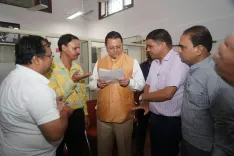
HP CM Office Unveils Rs 10 Lakh Health Cover for 10 Lakh Families
Synopsis
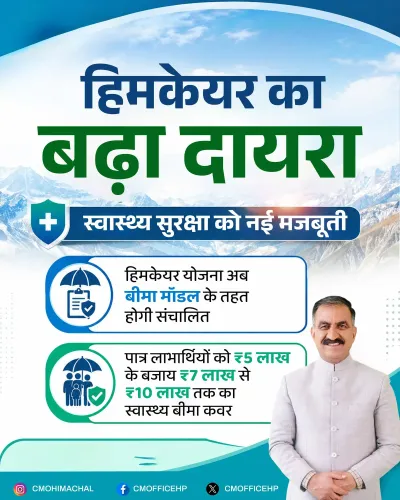
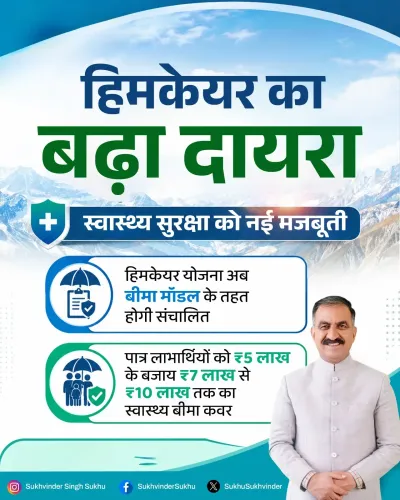
The Chief Minister's Office of Himachal Pradesh announced a health insurance scheme offering up to Rs 10 lakh coverage at low premiums for 10 lakh families — doubling the Ayushman Bharat PM-JAY ceiling and billed as a first-of-its-kind policy in India. Premium rates and eligibility criteria are yet to be released.
Key Takeaways
The Himachal Pradesh government plans to provide health insurance of up to Rs 10 lakh per family at a low premium.
The scheme targets 10 lakh families in the state.
The government describes it as the first health insurance policy of its kind in India — though this claim is unverified.
The coverage ceiling is double the Rs 5 lakh cap under the central Ayushman Bharat PM-JAY scheme launched in 2018.
Specific premium rates, eligibility criteria, hospital empanelment, and implementation timeline have not yet been disclosed .
The announcement was made by the Chief Minister's Office of Himachal Pradesh on 11 August 2026 .
When illness strikes, the last thing a family should face is a financial cliff-edge. The Chief Minister's Office of Himachal Pradesh announced on Tuesday, 11 August 2026 that the state government is moving to provide health insurance of up to Rs 10 lakh per family at a low premium — targeting 10 lakh families across the hill state in what it is calling a first-of-its-kind health insurance policy in the country.
The post, shared in Hindi, captures the government's stated resolve plainly: 'हर परिवार को बेहतर इलाज मिले और बीमारी के समय पैसों की चिंता न हो' — 'Every family should get better treatment and not worry about money during illness.' That single sentence is both the headline and the promise.
Doubling the National Benchmark
The announcement arrives against a well-established national baseline. The Ayushman Bharat Pradhan Mantri Jan Arogya Yojana (PM-JAY), launched in 2018, provides up to Rs 5 lakh in hospitalisation cover to economically vulnerable families. Himachal Pradesh's proposed scheme, if implemented as described, would offer twice that ceiling — a significant step-up for families whose medical bills routinely breach the national scheme's cap during serious illness or surgery.
Several Indian states have already layered state-level top-ups onto PM-JAY to plug exactly this gap. Himachal Pradesh has historically aligned its welfare architecture with central programmes while calibrating benefits to the state's dispersed, largely rural and semi-urban population — a demographic where a single hospitalisation can wipe out months of household income.
What the Scheme Promises — and What Remains to Be Detailed
The government has framed the initiative around three pillars: broader family coverage, a low-premium entry point, and a Rs 10 lakh ceiling. The combination is designed to pull in families who currently fall outside PM-JAY's eligibility criteria or find private insurance unaffordable. Specific premium rates, the eligibility framework, hospital empanelment lists, and the rollout timeline have not yet been made public.
Those details will determine whether the scheme delivers on its headline ambition. Premium affordability for low-income households, the network of empanelled hospitals in Himachal Pradesh's mountainous districts, and the claims-settlement mechanism are the three pressure points analysts and beneficiaries alike will watch closely once guidelines are released.
A State Betting on Health as a Political and Social Dividend
Himachal Pradesh's move reflects a broader competitive dynamic among Indian states: health insurance has become a flagship welfare metric, and the race to expand coverage — in rupees, in families covered, in premium accessibility — is intensifying. A scheme that genuinely reaches 10 lakh families in a state with a total population of roughly 75 lakh would cover a substantial share of Himachal's households.
The kicker is simple: announcing a policy and implementing one are two very different mountains to climb — and in Himachal Pradesh, the mountains are literal. The state's credibility on this pledge will be measured in hospital bills that families never have to pay out of pocket.
Point of View
Particularly where the national PM-JAY ceiling leaves middle and lower-middle income families exposed to catastrophic hospitalisation costs. Doubling the coverage ceiling to Rs 10 lakh is a politically legible signal, but the scheme's real test will come in the fine print — premium affordability, hospital network depth in remote districts, and claims turnaround. If the guidelines hold up, it could set a new benchmark pressure on neighbouring hill states to follow suit.
NationPress
11 Aug 2026
Frequently Asked Questions
What is the Himachal Pradesh health insurance scheme announced in 2026?
The Himachal Pradesh government announced a scheme to provide health insurance of up to Rs 10 lakh per family at a low premium, targeting 10 lakh families across the state. It is described by the government as a first-of-its-kind policy in India.
How does the HP scheme differ from Ayushman Bharat PM-JAY?
Ayushman Bharat PM-JAY offers up to Rs 5 lakh in health cover for eligible families. The Himachal Pradesh scheme proposes to double that ceiling to Rs 10 lakh and aims to extend coverage to families at a low premium, potentially reaching households not covered under the central scheme.
Who is eligible for the Himachal Pradesh Rs 10 lakh health insurance scheme?
Eligibility criteria have not yet been officially released. The government has indicated the scheme targets families who need better access to healthcare without financial stress, but the specific income or demographic thresholds are pending.
What is the premium for the new HP health insurance policy?
The exact premium amount has not been disclosed. The government has described it as a 'low premium' scheme, but the premium structure, payment frequency, and subsidy details are expected to be released with the official scheme guidelines.
When will the Himachal Pradesh health insurance scheme be implemented?
No implementation date has been announced. The scheme is currently at the announcement stage; guidelines covering hospital empanelment, eligibility, and rollout are yet to be made public.