IASV Triveni crew meets IAF Chief after historic 25,500-nautical-mile circumnavigation
Synopsis
Nine women officers from India's Army, Navy, and Air Force sailed 25,500 nautical miles across four oceans in 314 days — rounding Cape Horn, crossing the Drake Passage, and earning the rare Cape Horners distinction. Samudra Pradakshina is not just a record voyage; it is the most visible proof yet that India's tri-service jointness doctrine can move from policy papers to the planet's most hostile waters.
Key Takeaways
Singh met the nine-member crew of IASV Triveni on 29 July 2026 in New Delhi .
The crew sailed 25,500 nautical miles across four oceans in 314 days as part of Samudra Pradakshina — India's first tri-service all-women circumnavigation.
The crew comprised four IAF officers , four Army officers , and one Navy officer .
The expedition was flagged off on 11 September 2025 from Mumbai and flagged in on 22 July 2026 by Defence Minister Rajnath Singh .
The crew earned membership of the prestigious Cape Horners fraternity after transiting the Drake Passage and rounding Cape Horn .
The mission required nearly two years of intensive training and a 24x7 shore-based support network .
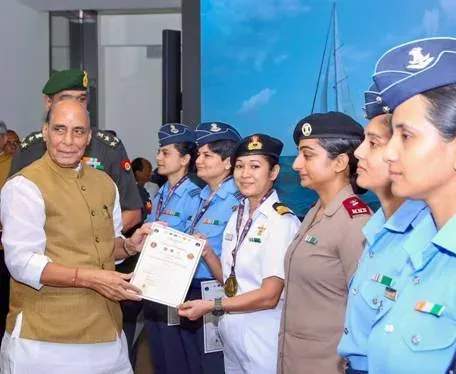
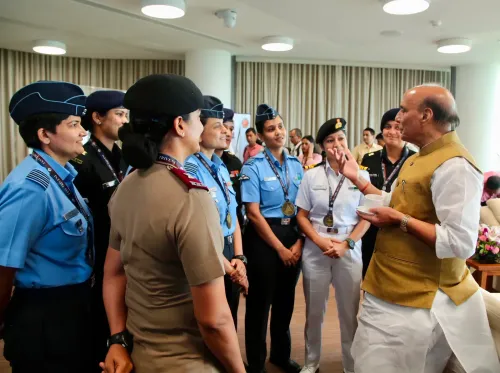
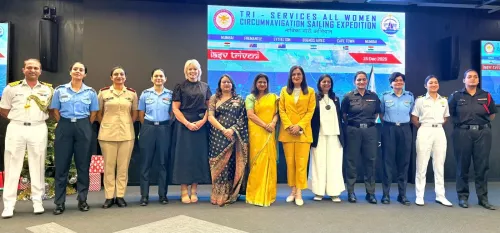
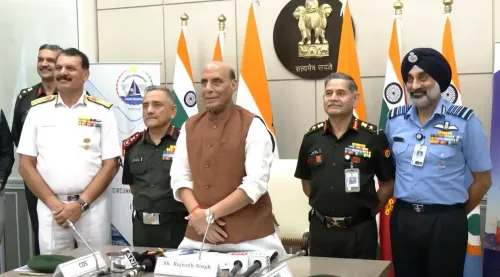
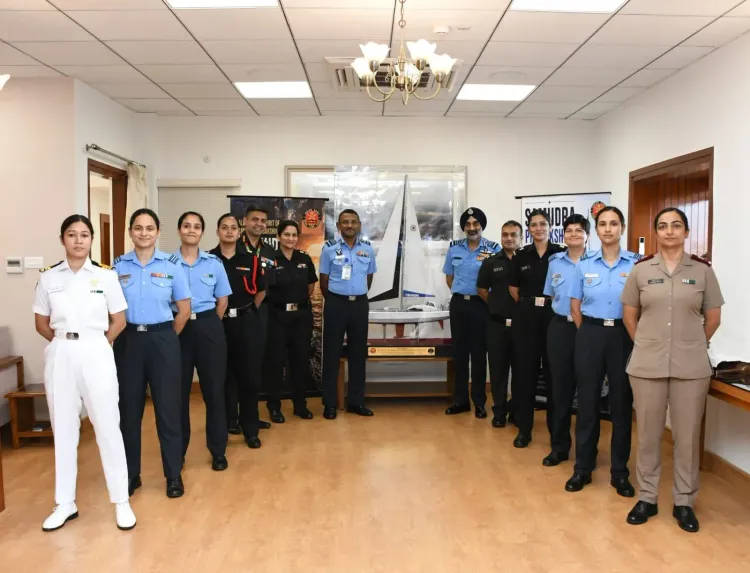
Air Chief Marshal A.P. Singh, Chief of the Indian Air Force (IAF), on Tuesday, 29 July 2026, met the nine-member crew of IASV Triveni in New Delhi, commending their courage, resilience, and professionalism after the crew completed Samudra Pradakshina — India's first tri-service all-women circumnavigation sailing expedition. The crew sailed nearly 25,500 nautical miles across four oceans in 314 days, scripting a landmark chapter in the history of India's armed forces.
The Crew and the Expedition
The nine-member crew comprised four women officers from the IAF, four from the Indian Army, and one from the Indian Navy, making IASV Triveni's voyage a genuine tri-service endeavour. The expedition was virtually flagged off by Defence Minister Rajnath Singh on 11 September 2025 from Mumbai and was flagged in on 22 July 2026 through video conferencing, again by the Defence Minister.
During the interaction, ACM Singh congratulated the crew on their landmark achievement and highlighted their exemplary tri-service spirit — a quality that officials say is increasingly central to India's evolving joint-operations doctrine.
What Made It a True Circumnavigation
The expedition fulfilled all internationally recognised criteria for circumnavigation: crossing every meridian of longitude, crossing the Equator twice, crossing the International Date Line, and rounding the Three Great Capes — Cape Leeuwin, Cape Horn, and the Cape of Good Hope. The successful transit of the formidable Drake Passage and the rounding of Cape Horn earned the crew membership of the prestigious Cape Horners fraternity, an honour reserved exclusively for sailors who conquer one of the world's most demanding maritime passages.
What the Government Said
Defence Minister Rajnath Singh commended the crew's courage and determination, saying the expedition proved that human resolve is greater than any storm. "Ocean waves may rise high, but the spirit of India's daughters soars higher," he said, adding that the mission was a testament to India's Nari Shakti, a symbol of national resolve, proof of tri-service synergy, and a celebration of a 'New India' that overcomes challenges to script history.
The Ministry of Defence noted in an official statement that the crew lived, trained, and sailed together for over ten months, functioning as one cohesive team — demonstrating that jointness is not merely an organisational concept but a force multiplier that enhances operational effectiveness and national capability.
Planning and Support Behind the Mission
The success of Samudra Pradakshina was underpinned by nearly two years of intensive training, meticulous operational planning, and a dedicated 24x7 shore-based support network involving numerous organisations and support agencies. The scale of preparation reflects a broader institutional investment in women's leadership roles within India's defence establishment — a shift that has been gathering pace across all three services in recent years.
What This Means Going Forward
The voyage is being viewed as a proof-of-concept for integrated tri-service operations under shared leadership, with officials indicating that lessons from the expedition's planning and execution will inform future joint-service initiatives. As India's military modernisation accelerates, Samudra Pradakshina stands as a rare instance where jointness was tested not in combat, but across the world's most unforgiving oceans.
Point of View
500 nautical miles is a stronger argument for tri-service integration than most staff college exercises. What mainstream coverage underplays is the institutional investment: two years of training and a round-the-clock shore network do not happen without deliberate policy backing. The harder question is whether this model of shared leadership and seamless interoperability will be institutionalised, or remain a one-off milestone that gets framed as symbolic rather than structural.
NationPress
27 Oct 2026
Frequently Asked Questions
What is Samudra Pradakshina?
Samudra Pradakshina is India's first tri-service all-women circumnavigation sailing expedition, completed by the nine-member crew of IASV Triveni. The crew sailed approximately 25,500 nautical miles across four oceans in 314 days, fulfilling all internationally recognised criteria for a full circumnavigation.
Who were the crew members of IASV Triveni?
The nine-member crew comprised four women officers from the Indian Air Force, four from the Indian Army, and one from the Indian Navy, making it a tri-service mission under shared leadership.
When did the IASV Triveni expedition start and end?
The expedition was virtually flagged off by Defence Minister Rajnath Singh on 11 September 2025 from Mumbai and was flagged in on 22 July 2026 through video conferencing, completing a voyage of 314 days.
What is the Cape Horners fraternity and why does it matter?
The Cape Horners is a prestigious international fraternity of sailors who have successfully rounded Cape Horn — one of the world's most treacherous maritime passages. The IASV Triveni crew earned this distinction after transiting the Drake Passage and rounding Cape Horn during the expedition.
Why is the IASV Triveni circumnavigation historically significant?
It is the first time an all-women crew from India's three armed services has completed a full global circumnavigation, demonstrating tri-service jointness, women's leadership in defence, and India's growing maritime capability. The mission is also being cited as a proof-of-concept for integrated joint-service operations.