Is India Leading Global Trends in Tech-Driven Growth?
Click to start listening
Synopsis
India is undergoing a significant transformation from a traditional economy to an innovation-driven powerhouse, as highlighted by Union Minister Dr. Jitendra Singh at the India International Science Festival. The nation is now leading global trends in tech-driven growth, particularly in biotechnology, space, and nuclear sectors.
Key Takeaways
- India is transitioning to an innovation-driven economy.
- Significant advancements are being made in biotechnology and space technology.
- A new national R&D fund is set to support high-impact innovation.
- India's youth are encouraged to take risks in innovation.
- Digital connectivity is leveling the playing field for aspiring innovators.
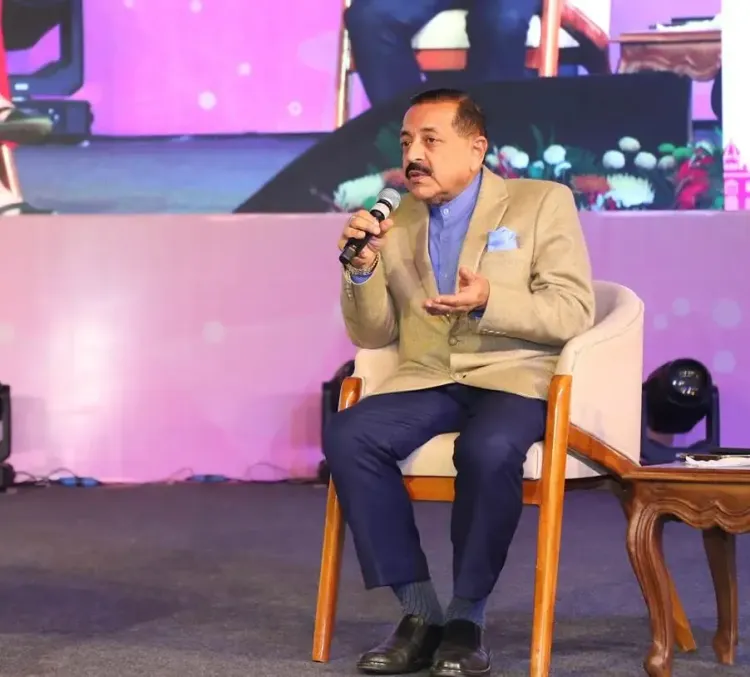
Panchkula (Haryana), Dec 7 (NationPress) India has entered a pivotal stage in its transformation from a conventional economy to an innovation-driven nation, and is now setting global benchmarks in technology-driven growth rather than merely following them, stated Union Minister of State for Science and Technology, Dr. Jitendra Singh, at the ongoing India International Science Festival (IISF) here.
During a special discussion at the four-day IISF event, Singh emphasized that India is currently taking a significant leadership role in various emerging fields, including biotechnology, nuclear innovation, regenerative sciences, and next-generation space technologies.
The minister noted that the last decade has witnessed a fundamental transformation in India's scientific attitude, policy framework, and governance methods. He remarked that India's economic advancement is now distinctly driven by science, technology, research, and innovation, with the global community increasingly recognizing India as a source of fresh governance models, public service delivery, and technology-led growth.
Looking ahead, Singh expressed confidence that space exploration will be an area where India will astonish the world, predicting that an Indian astronaut will land on the Moon within the next 15 to 20 years.
He added that if managed responsibly, artificial intelligence will rapidly revolutionize daily life in India. His straightforward message to young innovators was to take risks, forge strong partnerships with industry, and fully utilize the linkages and support offered by the government.
The minister elaborated on the introduction of a new national R&D fund, describing it as a transformative initiative aimed at unlocking high-risk, high-impact innovation. This fund will bolster research and entrepreneurship in sectors previously inaccessible to private entities, such as space and nuclear energy.
He referred to the initiative as a “catalytic push” intended to help Indian industries develop long-term capabilities through low-interest, long-duration financial assistance, enabling companies to grow confidently before becoming significant contributors to India’s technological advancement.
Reflecting on the liberalization of the space sector, the minister recalled a time when journalists were prohibited from entering the gates of Sriharikota during rocket launches. He noted that the changes introduced under Prime Minister Narendra Modi have led to a remarkable increase in participants, from a handful to nearly 400 space start-ups, many of which now enjoy global recognition.
He stated that India is no longer confining its space accomplishments to rocket launches alone, having established global models for utilizing space technologies in areas such as agriculture, healthcare, drinking water solutions, and disaster management.
Singh mentioned that similar transformations are evident in the nuclear sector, where innovations are now directly benefiting citizens through cancer treatment networks, community water purification systems, and other applications. He asserted that India’s successes in both nuclear and space sectors illustrate how strategic technologies can significantly enhance the quality of life.
The minister further remarked that India’s technological progress is closely linked to the democratization of opportunities across the nation. With improved digital connectivity and affordable information access, youth from smaller towns and rural regions now compete equally with those from major urban centers. He highlighted the changing demographics of UPSC toppers from districts such as Poonch and areas near the Punjab-Haryana belt, showcasing this transformation. He described the rising aspirations from “Bharat” as one of India’s greatest strengths.
When asked how India should evaluate its innovation trajectory, Dr. Singh stated that the true measure is sustainability. Ideas must evolve into viable enterprises with strong industry and market connections. He cited the emergence of profitable agri-start-ups, including lavender-based initiatives founded by professionals who transitioned from high-pressure corporate roles to create businesses that are both meaningful and economically viable.
Point of View
Showcasing how strategic investments in technology can enhance quality of life while democratizing opportunities for youth across the nation.
NationPress
09/12/2025
Frequently Asked Questions
What sectors is India focusing on for tech-driven growth?
India is focusing on biotechnology, nuclear innovation, regenerative sciences, and next-generation space technologies for tech-driven growth.
What is the significance of the new national R&D fund?
The new national R&D fund aims to unlock high-risk, high-impact innovation and support research and enterprise in sectors like space and nuclear energy.
How will artificial intelligence impact India?
If managed responsibly, artificial intelligence is expected to rapidly transform everyday life in India.
What does the future hold for India's space exploration?
Dr. Singh predicts that an Indian astronaut will land on the Moon within the next 15 to 20 years.
How is India democratizing technological opportunities?
Digital connectivity and affordable access to information are enabling youth from smaller towns and rural areas to compete on equal footing with those from major cities.