India eyes $2 trillion export target by 2030-31, Goyal reviews framework
Synopsis
India has set a $2 trillion export target for 2030–31, split equally between merchandise and services, with Commerce Minister Piyush Goyal unveiling a structured monitoring framework, MSME-focused sub-schemes, and a West Asia crisis relief measure — signalling a shift from broad ambition to sector-specific accountability.
Key Takeaways
India targets $2 trillion in total exports by 2030–31 — $1 trillion in merchandise and $1 trillion in services.
Commerce Minister Piyush Goyal unveiled an Export Monitoring Framework with sector-wise action plans across Engineering Goods, Textiles, Electronics, Pharmaceuticals, Chemicals, and Services.
Each sectoral action is assigned to a Nodal Joint Secretary with defined KPIs and short, medium, and long-term timelines.
The Export Promotion Mission (EPM) has operationalised 10 components under sub-schemes Niryat Protsahan and Niryat Disha .
A Relief Scheme under the EPM has been launched to support exporters hit by the West Asia crisis .
Goyal also reviewed strengthening the Government e-Marketplace (GeM) for more transparent public procurement.
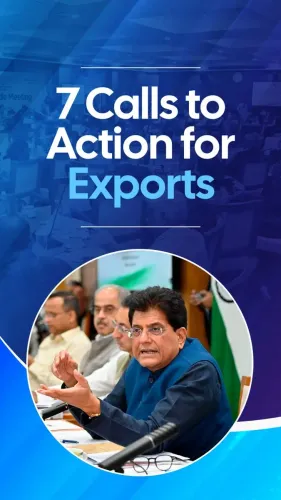
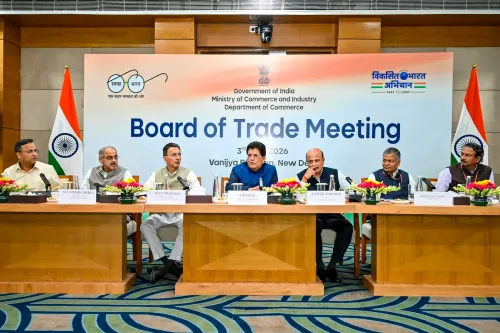
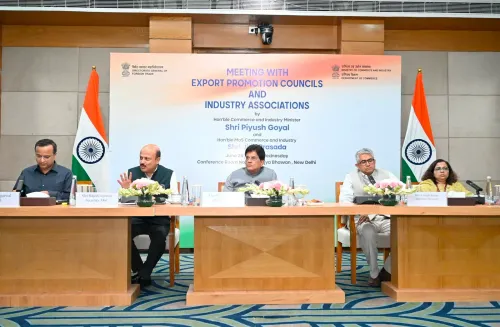
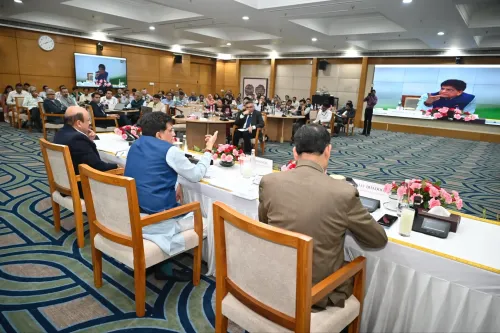
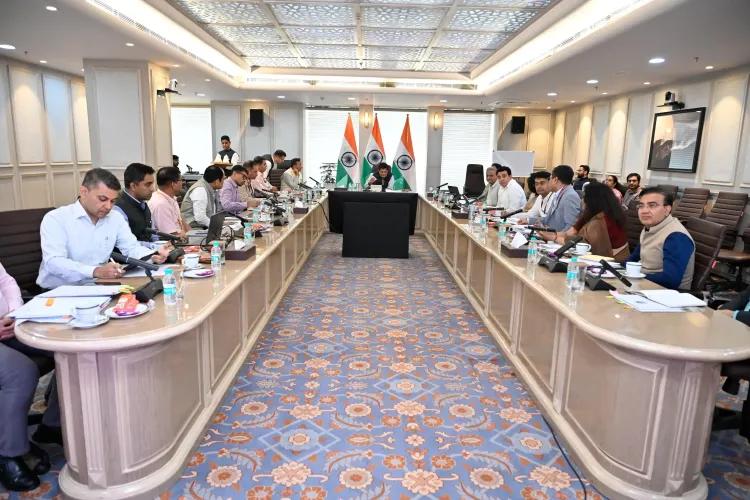
India is targeting $2 trillion in total exports by 2030–31, comprising $1 trillion in merchandise exports and $1 trillion in services exports, Commerce Minister Piyush Goyal announced on Wednesday, 29 April, after chairing a high-level review meeting in New Delhi. The announcement signals one of the most ambitious export roadmaps the Centre has laid out in recent years.
The Export Monitoring Framework
The Department of Commerce has developed a structured Export Monitoring Framework that breaks down the national target into sector-wise action plans across Engineering Goods, Textiles, Electronics, Pharmaceuticals, Chemicals, and Services. Each sectoral action has been assigned to a Nodal Joint Secretary, classified as either supply-side or demand-side, and linked to key performance indicators with short, medium, and long-term timelines.
Goyal also directed the establishment of an IT-enabled monitoring platform to facilitate regular progress tracking, with an automated escalation mechanism for review at the levels of Secretary and Minister. He further called for inter-departmental coordination, with supporting Ministries and Departments identified for each task to ensure effective resolution of exporter-related issues.
Three Pillars of the Strategy
According to Goyal, achieving the $2 trillion target rests on three key pillars: clearly defined and actionable points with timelines; robust inter-departmental coordination; and a technology-driven monitoring platform. The Minister additionally directed that priority sectors be identified — in consultation with line Ministries — where a clearly defined import substitution strategy can be pursued alongside export promotion efforts.
Export Promotion Mission and MSME Focus
Goyal reviewed the implementation of the Export Promotion Mission (EPM), a flagship MSME-focused initiative aimed at addressing key bottlenecks faced by exporters and enabling broad-based, inclusive, and sustainable export growth. The EPM is being implemented through two integrated sub-schemes: 'Niryat Protsahan', focused on access to trade finance, and 'Niryat Disha', focused on market access.
A total of ten components under the EPM have been operationalised, including Interest Subvention, Alternative Trade Finance (Export Factoring), Credit Assistance for E-Commerce Exporters, Collateral Support for Export Credit, Risk Sharing for Emerging Export Opportunities, Support for Testing, Inspection and Certification, Market Access Support, Support for Export Warehousing and Logistics, Support for Inland Transport and Handling, and Support for Trade Facilitation and Intelligence.
West Asia Crisis Relief and Brand India
Goyal also took note of a Relief Scheme launched under the EPM to support exporters affected by the ongoing West Asia crisis. He underscored the importance of strengthening 'Brand India' as an overarching umbrella for India's export promotion efforts across sectors and global markets.
Separately, Goyal held a meeting with department officials to explore ways to strengthen the Government e-Marketplace (GeM) as a catalyst for transparent, competitive, and inclusive public procurement.
What's Next
With sectoral action plans now assigned to nodal officers and an automated escalation mechanism in the pipeline, the government's immediate focus will be on operationalising the monitoring platform and finalising import substitution strategies for priority sectors. How effectively the Centre coordinates across Ministries will be the defining test of whether the $2 trillion goal moves beyond ambition into measurable outcomes.
Point of View
If it holds, is the attempt to institutionalise accountability: nodal officers, KPI linkages, and an automated escalation mechanism are structural improvements over past frameworks. But the critical gap remains political will at the inter-ministerial level, where turf battles have historically stalled export-friendly reforms. The inclusion of an import substitution mandate alongside export promotion is also worth watching — the two goals can pull in opposite directions if not carefully sequenced, as India's experience with electronics tariffs has shown.
NationPress
16 Sept 2026
Frequently Asked Questions
What is India's export target for 2030-31?
India is targeting $2 trillion in total exports by 2030–31, comprising $1 trillion in merchandise exports and $1 trillion in services exports, as announced by Commerce Minister Piyush Goyal on 29 April 2025.
What is the Export Monitoring Framework announced by Piyush Goyal?
The Export Monitoring Framework is a structured plan developed by the Department of Commerce that breaks the $2 trillion national target into sector-wise action plans across Engineering Goods, Textiles, Electronics, Pharmaceuticals, Chemicals, and Services. Each action is assigned to a Nodal Joint Secretary with defined KPIs and timelines.
What is the Export Promotion Mission (EPM) and how does it work?
The Export Promotion Mission is a flagship MSME-focused initiative aimed at removing key bottlenecks for Indian exporters. It operates through two sub-schemes — Niryat Protsahan (trade finance access) and Niryat Disha (market access) — and has operationalised 10 components including interest subvention, export factoring, and logistics support.
How does the West Asia crisis affect Indian exporters?
The ongoing West Asia crisis has disrupted trade routes and market access for several Indian exporters. The government has launched a Relief Scheme under the EPM specifically to support exporters affected by this crisis.
What is the role of Brand India in the export strategy?
Brand India is envisioned as an overarching umbrella identity for India's export promotion efforts across all sectors and global markets, aimed at improving the perception and competitiveness of Indian goods and services internationally.