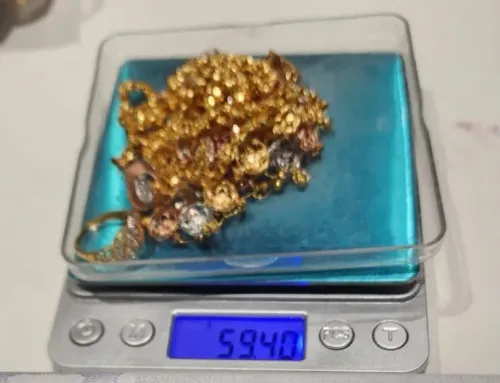
Gold smuggling at Ahmedabad airport: ₹65.69 lakh seized from Gujarat man's body

Synopsis
A 24-year-old from Godhra allegedly swallowed gold paste worth ₹65.69 lakh and flew in from Jeddah — only to be flagged by Ahmedabad Customs profiling. It is the third body-concealment gold seizure at SVPIA since March, pointing to a structured smuggling pipeline on Gulf and Southeast Asia routes that authorities are still working to unravel.
Key Takeaways
Ahmedabad Customs arrested a 24-year-old man from Godhra, Panchmahal on 9 August for allegedly smuggling gold paste inside his body.
The recovered paste was processed into a 422.83-gram, 24-carat gold bar valued at ₹65,69,087 .
The passenger arrived on Qatar Airways flight QR-534 from Jeddah via Doha and was flagged through passenger profiling.
On 29 July , a woman from Dubai was intercepted at the same airport with 244.16 grams of gold worth ₹35.84 lakh .
In March , a woman from Kuala Lumpur was arrested with 553.07 grams of gold valued at ₹83.29 lakh — also concealed internally.
Authorities have not confirmed whether any of the three cases are linked to a wider smuggling network.
Ahmedabad Customs officials arrested a 24-year-old man from Godhra, Panchmahal district, on 9 August after recovering gold paste allegedly concealed inside his body at Sardar Vallabhbhai Patel International Airport (SVPIA), Ahmedabad. The recovered paste was processed into a 24-carat gold bar weighing 422.83 grams, assessed at a market value of ₹65,69,087.
How the Smuggling Was Detected
The Air Intelligence Unit (AIU) of Ahmedabad Customs flagged the passenger through routine profiling after he arrived on Qatar Airways flight QR-534 from Jeddah via Doha. A subsequent physical examination revealed 467.09 grams of gold paste concealed inside his body. The paste was later processed and refined to yield a 422.83-gram bar of 24-carat purity.
The gold bar was seized under the Customs Act, 1962, and the passenger was arrested under the same legislation. Investigation is ongoing, according to officials.
Part of a Wider Pattern at SVPIA
This seizure is not an isolated incident. On 29 July, Customs officials intercepted a woman arriving from Dubai and recovered 244.16 grams of 24-carat gold valued at ₹35.84 lakh, also concealed internally in paste form.
Earlier, in March, a woman arriving from Kuala Lumpur was arrested after officials found two capsules containing a chemical paste mixed with gold inside her body. That haul yielded 553.07 grams of 24-carat gold of 999 purity, valued at ₹83.29 lakh. She too was arrested under the Customs Act, 1962.
What Authorities Have Disclosed
Officials have not revealed the intended recipient of the gold or whether the arrested passenger is linked to a larger smuggling network. The concealment method — gold in paste form, smuggled internally — is increasingly being used to evade standard baggage screening at Indian airports, according to customs officials.
What Happens Next
The case is under active investigation by Ahmedabad Customs. The repeated use of body-concealment techniques at SVPIA suggests a structured supply chain, though authorities have yet to confirm any network links across the three cases. Customs agencies have intensified passenger profiling on Gulf and Southeast Asia routes in response to the trend.
Point of View
Exploiting the limits of conventional baggage X-ray. What is missing from official disclosures is any indication of network-level investigation: each arrest is presented in isolation, with no named recipients, no syndicate links, no follow-up on prior cases. If Customs is connecting these dots internally, it is not saying so publicly — and that silence raises questions about whether enforcement is disrupting supply chains or merely intercepting individual couriers.
NationPress
24 Sept 2026
Frequently Asked Questions
What was seized at Ahmedabad airport on 9 August 2025?
Ahmedabad Customs officials seized a 24-carat gold bar weighing 422.83 grams, valued at ₹65,69,087, after recovering gold paste allegedly concealed inside the body of a 24-year-old passenger from Godhra, Gujarat. The passenger had arrived from Jeddah via Doha on Qatar Airways.
How did Customs detect the gold smuggling?
The Air Intelligence Unit of Ahmedabad Customs flagged the passenger through passenger profiling before conducting a physical examination. The examination revealed 467.09 grams of gold paste concealed inside his body, which was subsequently processed into a refined gold bar.
Is this an isolated case at Ahmedabad airport?
No. This is the third body-concealment gold seizure at Sardar Vallabhbhai Patel International Airport since March 2025. A woman from Dubai was intercepted on 29 July with 244.16 grams of gold worth ₹35.84 lakh, and a woman from Kuala Lumpur was arrested in March with 553.07 grams of gold valued at ₹83.29 lakh.
What law was used to arrest the passenger?
The passenger was arrested under the provisions of the Customs Act, 1962, the same legislation applied in the two earlier body-concealment cases at SVPIA this year. The gold bar was also seized under the same Act.
Have authorities identified a smuggling network behind these cases?
Not publicly. Officials have not disclosed the intended recipient of the gold or confirmed whether the three cases at Ahmedabad airport are linked to a wider smuggling syndicate. Investigation in the latest case is described as ongoing.