How Has India's Agriculture Sector Flourished Under PM Modi's Leadership?
Click to start listening
Synopsis
Discover the transformative journey of India's agriculture sector under PM Modi's governance. From a remarkable surge in sugarcane production to innovative farming techniques, this article sheds light on the strategies that promise to enhance agricultural productivity and sustainability for future generations.
Key Takeaways
- 44% increase in sugarcane production since 2014.
- Integrated farming models are essential for small landholdings.
- Balanced fertilizer use is crucial to prevent soil degradation.
- Adopting advanced technologies can revolutionize productivity.
- Collaboration among farmers, policymakers, and industry leaders is key.
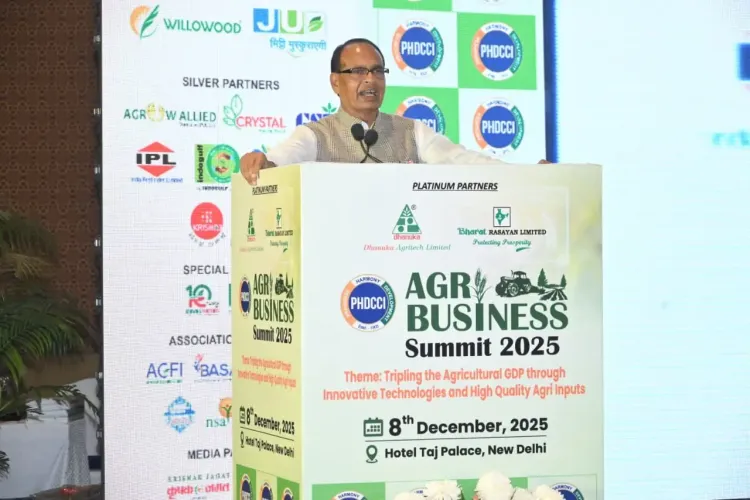
New Delhi, Dec 8 (NationPress) The agricultural sector in India has made significant strides under the leadership of Prime Minister Narendra Modi, with a notable 44% increase in sugarcane production since 2014, according to Union Minister Shivraj Singh Chouhan.
Speaking at the 'Agribusiness Summit 2025' in New Delhi, Chouhan emphasized the importance of integrated farming practices tailored for small landholdings, which average less than 1 hectare. He advocated for value addition, diversification into fisheries and livestock, and stringent regulations on bio-inputs, which have decreased from 30,000 to just 8,000 compliant producers. He also called for a balanced approach to fertilizer application to prevent soil degradation and secure the prosperity of future generations.
Ramesh Chand, a member of NITI Aayog, reiterated that enhancing both 'utpadan' (production) and 'utpadakta' (productivity) is crucial, highlighting that while India's agricultural workforce is deeply engaged in cultivation, it necessitates improved output per acre.
Chand drew a comparison with China's $5 trillion economy, illustrating how Chinese farmers operate as gardeners, innovators, and meticulous land managers. He noted that they achieve higher yields through intensive farming practices, particularly in fertilizer usage, from which India could glean insights to optimize management and minimize negative impacts while maximizing benefits.
RG Agarwal, chair of the agribusiness committee at PHDCCI, emphasized that while farmers have consistently contributed to the nation, it is now our turn to support them by providing access to the best technologies, knowledge, and resources to boost their productivity and income.
Rahul Dhanuka, managing director of Dhanuka Agritech Limited, pointed out that India has one of the lowest usages of agricultural medicines globally, according to FAO data, with recent studies indicating further declines, although misuse persists in certain areas.
The summit commenced with a strong focus on "Tripling Agricultural GDP by Utilizing New Technology and Quality Agricultural Inputs", uniting industry leaders, policymakers, innovators, and farmers to explore and promote advanced technologies and superior agricultural inputs that could transform productivity and sustainability within the sector.
Point of View
It's clear that the advancements in India's agricultural sector reflect a commitment to supporting farmers and boosting productivity. The integration of technology and sustainable practices is fundamental to ensuring the long-term viability of agriculture in India, making this an essential topic for national discourse.
NationPress
09/12/2025
Frequently Asked Questions
What has been the growth percentage in sugarcane production under PM Modi?
Sugarcane production has witnessed a remarkable increase of 44% since 2014 under PM Modi's administration.
What are some strategies proposed for improving agricultural productivity?
Strategies include integrated farming models, diversification into fish and cattle, and balanced fertilizer usage to protect soil health.
Who emphasized the importance of production and productivity in agriculture?
Ramesh Chand from NITI Aayog emphasized the need to enhance both production and productivity within the agricultural sector.