India's first indigenous Coast Guard hovercrafts take shape in Goa
Synopsis
India is building its first indigenously fabricated hovercrafts for the Coast Guard at a Goa shipyard — with 50% local content and designs licensed from the UK's Griffon Hoverwork. With girder laying for three more ACVs completed on 11 May and the first unit nearing delivery, this is a concrete step in India's Aatmanirbhar Bharat defence push.
Key Takeaways
The Ministry of Defence signed a contract with Chowgule & Company, Goa on 24 October 2024 for six Air Cushion Vehicles (ACVs) for the Indian Coast Guard.
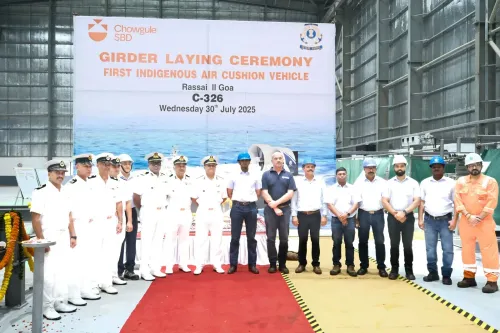
Girder laying for the fourth, fifth, and sixth ACVs was held on 11 May 2025 at the Rassaim Yard , Goa.
The first ACV is expected to be delivered shortly, officials confirmed.
The hovercrafts carry nearly 50% indigenous content — the highest for any hovercraft operating in India.
Designs are sourced from Griffon Hoverwork, UK , but construction is entirely indigenous at Chowgule Shipyard.
The ACVs will be deployed for coastal patrolling, maritime reconnaissance, search and rescue, and interdiction missions.
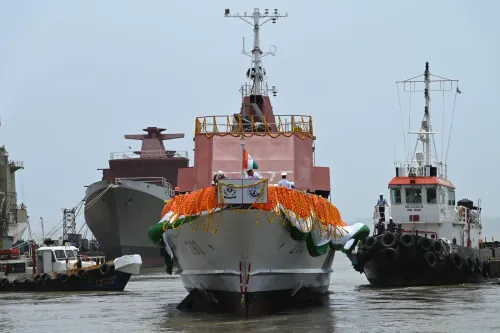
The construction of the first-ever indigenously built Air Cushion Vehicles (ACVs) for the Indian Coast Guard is progressing rapidly at Chowgule & Company Private Limited in Goa, officials said on Monday, 11 May 2025. The project marks a significant milestone in India's push for self-reliance in defence manufacturing under the Aatmanirbhar Bharat initiative.
Key Milestone: Girder Laying for Three More ACVs
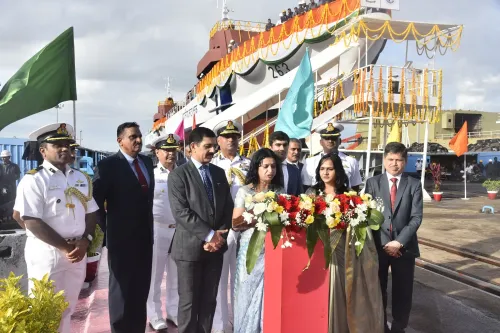
In a significant development, the girder laying ceremony for the fourth, fifth, and sixth ACVs was held on 11 May at the Rassaim Yard of Chowgule Shipyard in Goa. The ceremony was attended by Deputy Inspector General Vinod Sakharkar, serving as Chief Staff Officer (Technical) at the Coast Guard Regional Headquarters. Officials confirmed that the first ACV under the project is expected to be delivered shortly.
Contract Background and Programme Scope
The Ministry of Defence signed a contract with Chowgule & Company on 24 October 2024 for the construction of six Air Cushion Vehicles for the Coast Guard. The ACVs are based on designs from Griffon Hoverwork of the United Kingdom, but are being constructed entirely at the Rassaim Yard in Goa. Critically, the vehicles carry nearly 50 per cent indigenous content — making them the first hovercrafts operating in India with such a high level of local manufacturing and integration.
What the Coast Guard Said
In an official statement, the Coast Guard described the project as a landmark achievement.
Point of View
Not a rhetorical claim. That said, the design dependency on UK-based Griffon Hoverwork means India has not yet achieved full sovereign capability in hovercraft technology. The real test will be whether subsequent batches push that indigenous content threshold higher, and whether the Coast Guard's operational feedback shapes a fully home-grown next-generation design. For now, this is a credible start — but the finish line for true self-reliance in this niche is still some distance away.
NationPress
24 Sept 2026
Frequently Asked Questions
What are the Air Cushion Vehicles being built for the Indian Coast Guard?
Air Cushion Vehicles (ACVs), commonly known as hovercrafts, are being built by Chowgule & Company in Goa for the Indian Coast Guard under a contract signed on 24 October 2024. Six such vehicles are being constructed with nearly 50% indigenous content, making them the first hovercrafts in India with such a high level of local manufacturing.
Where are India's indigenous Coast Guard hovercrafts being built?
The ACVs are being constructed at the Rassaim Yard of Chowgule Shipyard in Goa. The facility is the site of all six vehicles under the current Ministry of Defence contract.
When will the first indigenous Coast Guard hovercraft be delivered?
Officials have stated that the first ACV under the project is expected to be delivered shortly, though a specific date has not been announced publicly.
What roles will the new Coast Guard hovercrafts perform?
The ACVs are designed for high-speed coastal patrolling, maritime reconnaissance in shallow waters, marshlands and deep-sea regions, interception and interdiction missions, and search and rescue operations. They will be capable of day and night operations across diverse maritime terrains.
Are the hovercrafts fully indigenous in design?
The ACVs are based on designs from Griffon Hoverwork in the United Kingdom, but are being constructed indigenously in India with nearly 50% local content. The Coast Guard has described this as a significant step toward self-reliance in hovercraft technology.