Is India Ready to Lead at the G20 Summit in Johannesburg?
Synopsis
India, as the fastest-growing major economy, is set to lead the G20 Summit in Johannesburg in November 2025, focusing on sustainable solutions amid global challenges. This pivotal role emphasizes India's commitment to inclusive growth, climate resilience, and reforming global governance, showcasing its capability to bridge the gap between developed and developing nations.
Key Takeaways
India is the fastest-growing major economy .
Projected growth rate of 7.8% for 2025 .
Focus on equitable growth and digital transitions .
Commitment to climate-resilient agriculture .
Advocacy for reforming multilateral institutions .
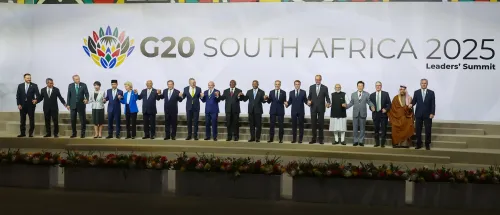
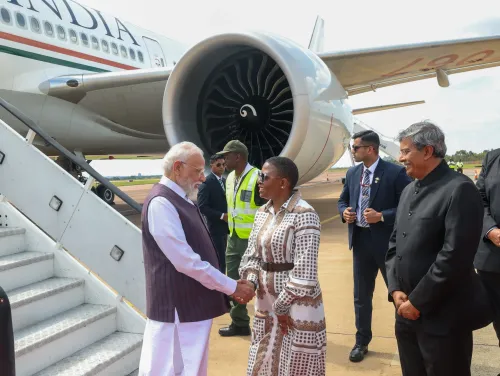
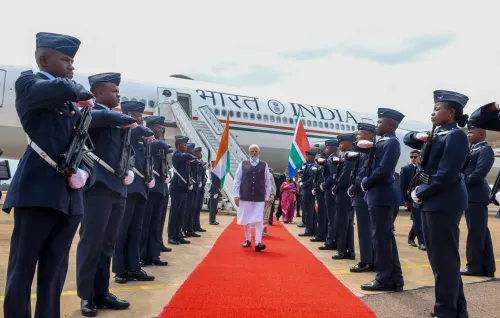
New Delhi, Nov 2 (NationPress) As the fastest-growing major economy globally, India is set to assume a pivotal role in guiding the upcoming G20 Summit in Johannesburg in November 2025, focusing on realistic and inclusive solutions in light of the global economic slowdown and trade disputes, as highlighted in an article from Kenya's Capital News.
India's economy has demonstrated remarkable resilience, with a projected growth rate of 7.8 percent for the April-June 2025 quarter. This momentum is supported by robust domestic demand, increasing service exports, digital innovations, and ongoing infrastructure investments.
This solid growth foundation empowers India to advocate for developing nations striving for stability and opportunity. Being a significant emerging market, with strengths in both industrial and agricultural sectors, India can effectively bridge the interests of advanced and transitional economies, according to the article.
Under South Africa's presidency, the G20 agenda prioritizes inclusion, fairness, and sustainability, aligning closely with the aspirations of the Global South.
This theme resonates with India’s developmental philosophy of Vasudhaiva Kutumbakam -- viewing the world as one family. India can embody these principles through three key interventions: fostering equitable growth, facilitating green and digital transitions, and advocating for global governance reforms.
The foremost challenge in Johannesburg will be revitalizing growth and job creation. With global output anticipated to be around 2.5 percent in 2025 — insufficient for developmental goals — India can propose a pragmatic agenda that focuses on small and medium enterprises, digital trade, and skills development.
Climate transitions will also take center stage at the summit. Following Indonesia (2022), India (2023), and Brazil (2024), the agenda for 2025 will again emphasize climate finance and its implementation.
India’s LiFE (Lifestyle for Environment) initiative — championing sustainable living — could evolve into a collaborative framework that combines South-South technology exchanges with renewable energy financing and biodiversity partnerships. India's leadership in the International Solar Alliance and its commitment to sourcing half of its electricity from non-fossil sources by 2030 bolsters its credibility.
Food security will be another crucial agenda item. The interplay between climate risks, agricultural productivity, and global supply chains necessitates systemic reforms. As the world’s second-largest food producer, India can advocate for climate-resilient agriculture — focusing on efficient irrigation, resilient seeds, and technology-enabled crop monitoring — while promoting diversified energy partnerships to alleviate the impacts of fluctuating oil and grain prices.
India’s initiatives regarding green hydrogen and critical-minerals supply chains could also inspire G20 projects that connect African resource-rich economies with Asian manufacturing hubs.
Reforming multilateral institutions is long overdue. The governance and voting power at the IMF and World Bank remain skewed towards advanced economies, while the BRICS-led New Development Bank reflects the demand for a fairer financial system.
India can leverage its position within both the G20 and BRICS to advocate for more equitable, performance-based decision-making, favoring cooperation over rivalry among current and new lenders, the article further elaborates.
Artificial intelligence is also expected to play a significant role under South Africa’s presidency. India's digital public infrastructure serves as a practical model for AI-driven public services with integrated safeguards.
As global growth decelerates and inequality expands, India’s unique combination of technological advancement and social inclusivity can assist the G20 in transitioning from mere communiqués to tangible cooperation, the article concludes.
Point of View
Our commitment to national interests aligns with India's strategic positioning in global forums like the G20. With its economic strength and inclusive development agenda, India is well-positioned to advocate for the Global South and ensure that the voices of developing nations are heard on the international stage.
NationPress
26 Sept 2026
Frequently Asked Questions
What is India's role in the upcoming G20 Summit?
India is set to lead the G20 Summit in Johannesburg, focusing on realistic and inclusive solutions to global challenges.
How is India's economy performing?
India's economy is projected to grow by 7.8 percent in the April-June 2025 quarter, driven by strong domestic demand and digital innovation.
What are the key themes of the G20 Summit?
The summit will prioritize inclusion, fairness, sustainability, and climate transitions, aligning with the aspirations of the Global South.
What initiatives will India promote at the summit?
India will advocate for equitable growth, green transitions, food security, and reforms in global governance.
How does India plan to address climate change?
India aims to promote sustainable living through its LiFE initiative and enhance climate-resilient agriculture and energy partnerships.