Joshi Congratulates Prof. Nagaraja on Rajya Sabha Election
Synopsis
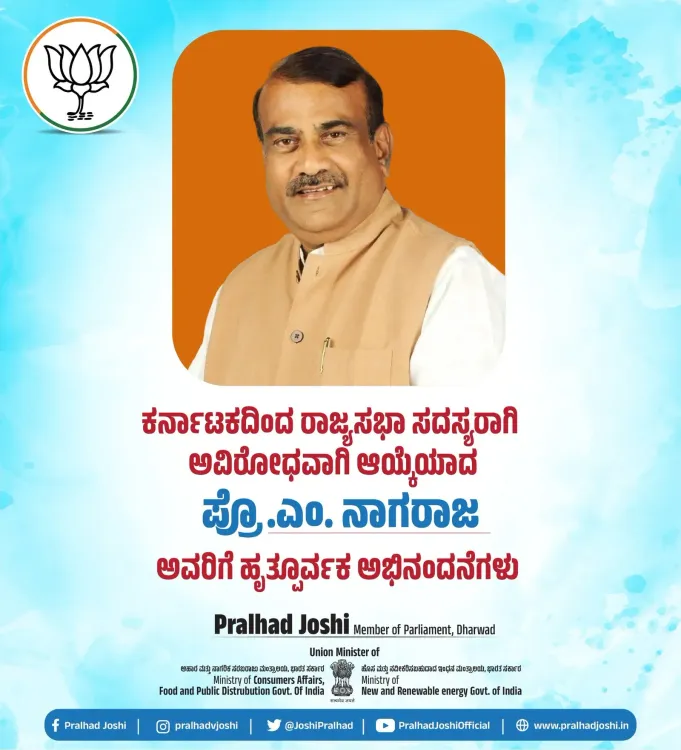
Union Consumer Affairs Minister Pralhad Joshi congratulated Prof. M. Nagaraja on being unanimously elected to the Rajya Sabha from Karnataka on June 11, 2026, expressing hope that his academic expertise would contribute to national development under PM Modi's guidance.
Key Takeaways
Nagaraja was unanimously elected to the Rajya Sabha from Karnataka , meaning no contest was required among state legislators.
Union Minister Pralhad Joshi publicly congratulated Nagaraja via X (formerly Twitter) on June 11, 2026 .
Joshi expressed hope that Nagaraja's experience and 'people-oriented thinking' would serve national development under PM Narendra Modi .
Rajya Sabha members from states are elected by state legislative assemblies and serve six-year terms under India's constitutional framework.
Nagaraja's academic background is expected to shape his committee assignments and contributions in the upper house.
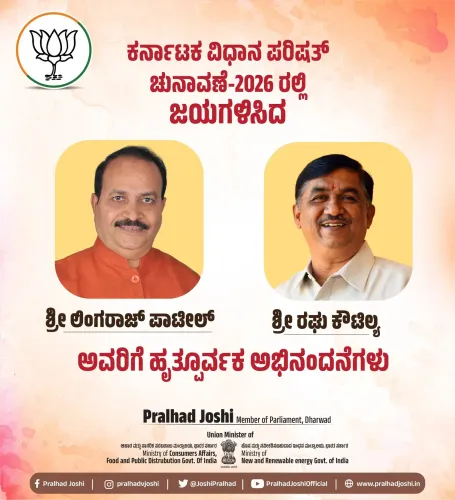
Union Consumer Affairs Minister Pralhad Joshi on Thursday, June 11, 2026 congratulated Prof. M. Nagaraja on being unanimously elected to the Rajya Sabha from Karnataka, expressing hope that the new member's experience and knowledge would contribute to national development under Prime Minister Narendra Modi's guidance.
Context
Writing in Kannada, Minister Joshi extended what he called hrudyapoorvaka abhinandanegalu ('heartfelt congratulations') to Prof. Nagaraja, who secured the Rajya Sabha seat from Karnataka unopposed. Joshi wished that Nagaraja's 'experience, knowledge, and people-oriented thinking' (anubhava, jnana mattu janapara chintane) would serve the nation's progress.
Unanimous elections to the Rajya Sabha occur when political parties in a state legislature reach consensus on a candidate, avoiding a contested vote. The development signals a degree of cross-party or within-coalition agreement among Karnataka legislators on Prof. Nagaraja's candidacy.
Policy Backdrop
Under India's constitutional framework, Rajya Sabha members from states are elected by their respective state legislative assemblies — not directly by voters. Members serve six-year terms, with one-third of the upper house retiring every two years, creating periodic vacancies that are filled through these assembly elections.
Karnataka has periodically sent members from both political and professional backgrounds to the upper house. The election of an academic figure such as Prof. Nagaraja follows a broader pattern of parties nominating domain experts to the Rajya Sabha to bring specialised knowledge to parliamentary deliberations.
Stakeholders and Impact
The academic community and education-policy watchers will closely track Prof. Nagaraja's committee assignments and legislative contributions once he takes his seat. Rajya Sabha members with academic credentials have historically contributed to debates on education, research funding, and social development legislation.
For the BJP and its allies in Karnataka, the uncontested election represents a smooth parliamentary transition, reinforcing the party's organisational footprint in the state ahead of future electoral cycles. Minister Joshi, himself a senior Karnataka leader, publicly anchoring the congratulations underscores the political significance of the appointment to the state unit.
What's Next
Prof. Nagaraja is expected to be formally sworn in at the Rajya Sabha before the next session of Parliament. Observers will watch for any committee postings — particularly in education, science, or public welfare — that reflect his academic background.
His entry into the upper house also adds to Karnataka's representation in Parliament at a time when the state remains a key political battleground between the ruling Congress government at the state level and the BJP-led central government, making his legislative positioning a point of continued attention.
Point of View
Where domain expertise can carry legislative weight. Minister Joshi's prompt, public congratulations — in Kannada — is as much a signal to the Karnataka electorate as it is a personal courtesy, reinforcing the party's connect with the state's political and professional classes. The invocation of PM Modi's guidance in the congratulatory message is consistent with the BJP's centralised communication architecture, framing all parliamentary milestones within the Prime Minister's leadership narrative. This appointment will be worth watching for how it shapes debates on education and development policy in upcoming Rajya Sabha sessions.
NationPress
26 Oct 2026
Frequently Asked Questions
Who is Prof. M. Nagaraja elected to Rajya Sabha from Karnataka?
Prof. M. Nagaraja is an academic who was unanimously elected to the Rajya Sabha from Karnataka in June 2026, with Union Minister Pralhad Joshi publicly congratulating him on the achievement.
How are Rajya Sabha members elected in India?
Rajya Sabha members representing states are elected by the elected members of each state's legislative assembly, not by the general public directly. They serve six-year terms under India's constitutional framework.
What does unanimous election to Rajya Sabha mean?
A unanimous or uncontested Rajya Sabha election means all parties or legislators in the state assembly agreed on the candidate, so no formal vote was required — the candidate is declared elected without a contest.
Why did Pralhad Joshi congratulate Prof. Nagaraja?
Pralhad Joshi, a senior BJP leader and Union Minister from Karnataka, congratulated Prof. Nagaraja as a fellow Kannadiga entering Parliament, expressing hope that his knowledge would contribute to national development under PM Modi's guidance.
How many Rajya Sabha seats does Karnataka have?
Karnataka sends multiple members to the Rajya Sabha, with seats filled in phases as terms expire every two years. The exact number of seats filled in any given election depends on the vacancies arising that year.