Pralhad Joshi Pays Tribute to Maharishi Valmiki on Jayanti
Synopsis
Union Minister Pralhad Joshi marked Valmiki Jayanti on 26 October 2026 with a bilingual English-Kannada tribute to Maharishi Valmiki, the Adi Kavi credited with composing the Ramayana and shaping India's civilisational and literary heritage.
Key Takeaways
Pralhad Joshi , Union Minister of Consumer Affairs and New and Renewable Energy, paid tribute to Maharishi Valmiki on his Jayanti, 26 October 2026 .
Joshi described the Ramayana as 'a cornerstone of India's civilisational heritage' and Valmiki's ideals of dharma, righteousness and compassion as a guide for generations.
The tribute was bilingual — English and Kannada — and included a classical Sanskrit verse honouring Valmiki as 'lion among sages and lord of poets.' Valmiki Jayanti falls on the full moon of the Hindu month of Ashwin and is observed nationally with cultural programmes and community prayers.
Maharishi Valmiki, revered as Adi Kavi , is traditionally credited with composing the Ramayana in approximately 24,000 verses , pioneering the Sanskrit shloka metre.
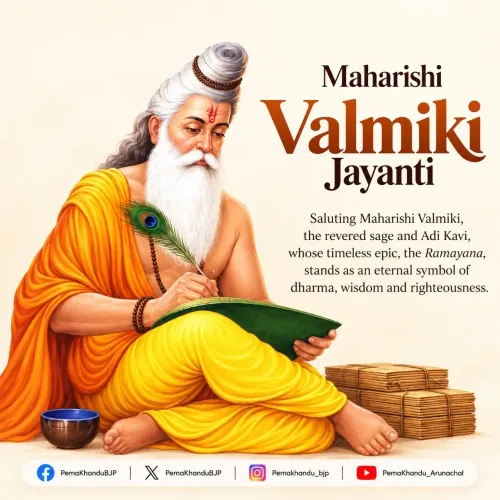
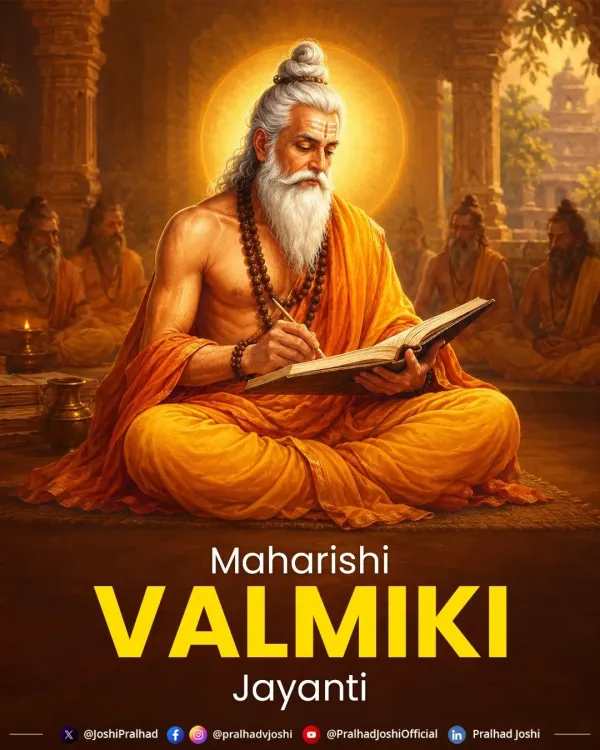
On the full-moon observance of Valmiki Jayanti, Union Consumer Affairs Minister Pralhad Joshi offered a reverent tribute to Maharishi Valmiki — the ancient sage revered across India as Adi Kavi, the first poet — honouring his enduring legacy on Monday, 26 October 2026.
Joshi's tribute carried both an English salutation and a Kannada verse, reflecting his Karnataka roots. He quoted the classical Sanskrit shloka: ವಾಲ್ಮೀಕಿರ್ಮುನಿಸಿಂಹಾನಾಂ ಕವೀನಾಂ ಕವಿತಾಪತಿಃ — 'Valmiki, lion among sages and lord of poets' — before adding in Kannada that Valmiki's thoughts on truth, dharma, duty and an ideal life 'remain a guiding light for us even today.'
The Adi Kavi and the epic that shaped a civilisation
Maharishi Valmiki is traditionally credited as the composer of the Ramayana, one of the two great Sanskrit epics of ancient India. Spanning roughly 24,000 verses, the Ramayana traces the life of Lord Rama and is regarded as the foundational text of classical Sanskrit literature. Valmiki's title Adi Kavi — literally 'the original poet' — reflects the belief that he pioneered the shloka metre, the lyrical unit that became the bedrock of Sanskrit poetry.
His work has permeated Indian art, dance, theatre, music, and moral philosophy for millennia, crossing linguistic and regional frontiers to shape literary traditions in Kannada, Tamil, Telugu, Bengali, and dozens of other languages. For millions of Hindu devotees, the Ramayana is not merely literature — it is a living ethical guide.
Valmiki Jayanti and its place in the public calendar
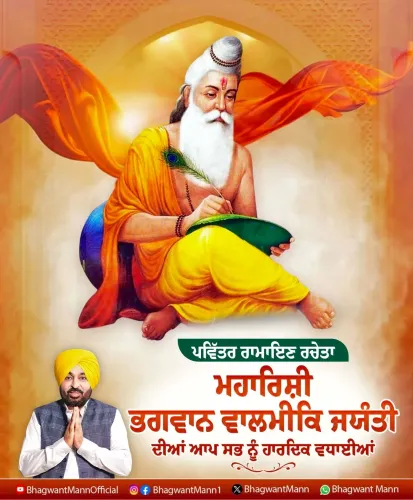
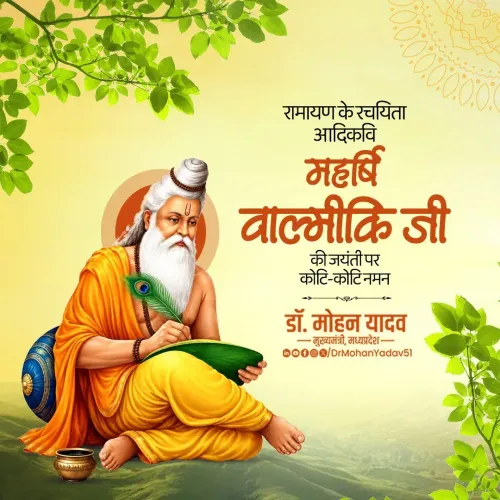
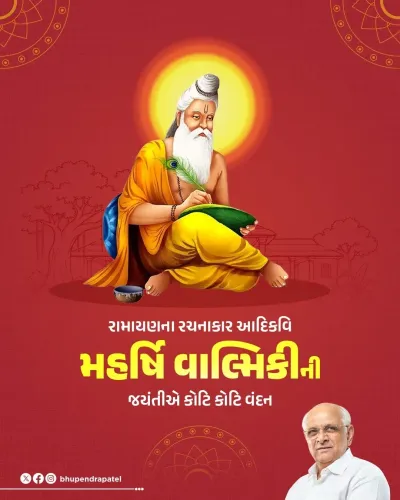
Valmiki Jayanti falls on the full moon (Purnima) of the Hindu month of Ashwin each year. The day sees processions, community prayers, and cultural programmes across India, with particularly vibrant observances in states with large communities that revere Valmiki as a spiritual ancestor and patron saint. Political leaders from across the spectrum customarily issue public tributes on this day, underlining the occasion's broad cultural resonance beyond any single party or region.
Joshi's post — bilingual in English and Kannada — is consistent with that tradition, while also signalling a personal connection to Karnataka's own rich Valmiki-reverence culture.
Across centuries of change, one thing has not wavered: the Ramayana's place at the heart of India's civilisational identity — and Valmiki Jayanti's role in renewing that conversation, year after year.
Point of View
But Joshi's bilingual English-Kannada post underscores a deliberate cultural signalling: invoking both a pan-Indian civilisational narrative and a Karnataka-specific reverence for the Adi Kavi. For a senior BJP leader from a state where Valmiki-community identity carries electoral weight, the gesture sits at the intersection of genuine cultural expression and political outreach. The broader pattern — leaders across parties posting Valmiki tributes — reflects how classical heritage anniversaries increasingly serve as soft-power moments in India's culture-politics interface.
NationPress
26 Oct 2026
Frequently Asked Questions
What is Valmiki Jayanti and when is it celebrated?
Valmiki Jayanti is the birth anniversary of Maharishi Valmiki, the author of the Ramayana, observed on the full moon (Purnima) of the Hindu month of Ashwin. In 2026 it falls on 26 October.
Who is Maharishi Valmiki?
Maharishi Valmiki is the ancient sage and poet traditionally credited with composing the Ramayana, one of Hinduism's two great Sanskrit epics. He is revered as Adi Kavi — the first or original poet — for pioneering the shloka metre in Sanskrit literature.
What did Pralhad Joshi say on Valmiki Jayanti 2026?
Pralhad Joshi described the Ramayana as 'a cornerstone of India's civilisational heritage' and praised Valmiki's wisdom on dharma, righteousness and compassion. He also posted a Kannada tribute calling Valmiki's thoughts on truth, duty and an ideal life a guiding light even today.
Why is Valmiki called Adi Kavi?
Valmiki is called Adi Kavi, meaning 'the first poet,' because he is believed to have composed the Ramayana and in doing so pioneered the shloka metre that became the foundation of classical Sanskrit poetry.
How is Valmiki Jayanti observed in India?
Valmiki Jayanti is marked across India with processions, community prayers, cultural programmes, and public tributes. The occasion holds special significance for communities that revere Valmiki as a spiritual ancestor, and political leaders from across parties customarily honour the day.