Nadda hails Kapil Parmar's historic Para Judo bronze
Synopsis
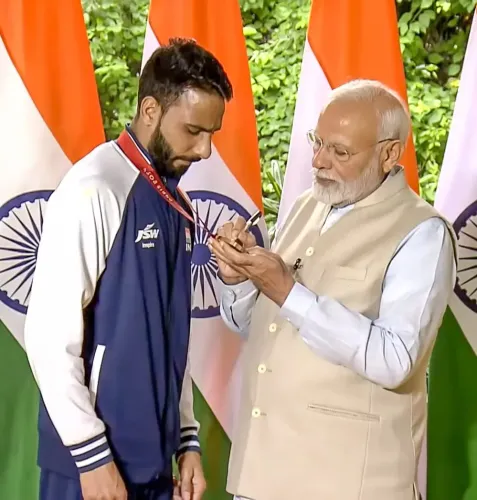
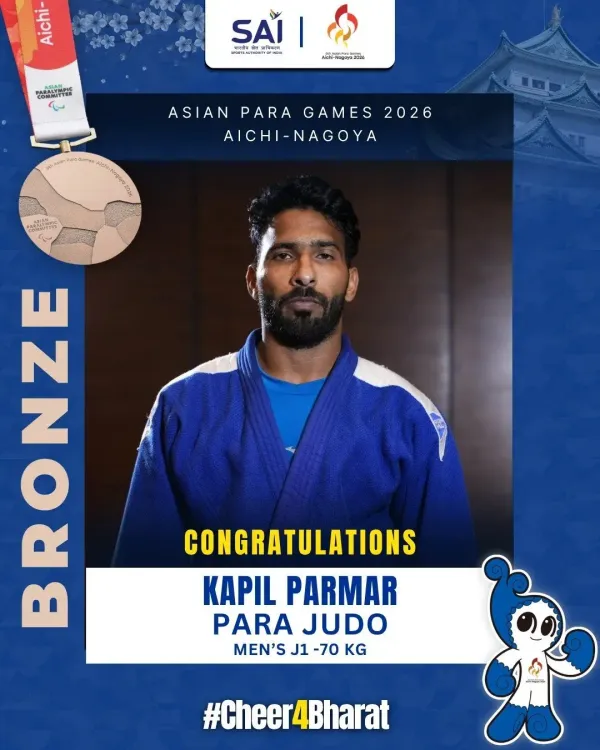
Judoka Kapil Parmar clinched a bronze medal in the Para Judo Men's 60kg J1 event at the Asian Para Games 2026, securing India's first-ever judo medal at the continental para-sport Games. Union Health Minister J. P. Nadda hailed the feat as a landmark for Indian para sports.
Key Takeaways
Kapil Parmar won a bronze medal in the Para Judo Men's 60kg J1 event at the Asian Para Games 2026 .
The medal is India's first-ever judo medal at the Asian Para Games.
The J1 category is for athletes with visual impairment , requiring competitors to rely on grip, balance, and spatial awareness.
Union Health Minister J.
Nadda congratulated Parmar on 19 October 2026 , calling it a 'new benchmark for excellence in sports.' India's para-sport growth has been backed by schemes such as the Target Olympic Podium Scheme (TOPS) and the Khelo India programme since the 2016 Rio Paralympics .
The breakthrough opens a new chapter for visually impaired judokas seeking future Asian Para Games and Paralympic qualification.
India's para-sport story just gained a landmark chapter. Union Health Minister J. P. Nadda on Monday, 19 October 2026 congratulated judoka Kapil Parmar for winning a bronze medal in the Para Judo Men's 60kg J1 event at the Asian Para Games 2026 — a feat that marks India's first-ever judo medal at the Asian Para Games.
India's maiden judo medal at the Asian Para Games
Judo has long been one of the quieter corners of India's para-sport calendar — a discipline where the country had reached continental competitions but never stood on the podium. Kapil Parmar changed that on Monday, stepping off the mat in the J1 category (visual impairment) with a bronze that no Indian judoka had managed before at this level. The Asian Para Games, held every four years under the Asian Paralympic Committee, is the continent's premier multi-sport showcase for athletes with disabilities, making the moment all the more significant.
Para sports push that built the foundation
Parmar's breakthrough did not emerge from a vacuum. Since the 2016 Rio Paralympics, India has steadily expanded support for para athletes through the Target Olympic Podium Scheme (TOPS) and the Khelo India programme, channelling funding, coaching, and international exposure to disciplines that once ran on shoestring budgets. Athletics and shooting grabbed the early headlines, but the infrastructure quietly extended into combat and precision sports — and judo is now reaping that dividend.
The broader pattern is clear: India's para-sport medal tally at regional events has grown in a near-straight line over the past decade. A bronze in a category as technically demanding as J1 judo — where competitors rely on grip, balance, and spatial memory rather than sight — signals that the pipeline of talent is deepening beyond the better-known events.
What Parmar's bronze means going forward
Firsts matter in sport not just for the record books but for the athletes who come after. Every young visually impaired judoka in India now has proof that a continental podium finish is achievable. With the squad's sights already turning to future Asian Para Games cycles and Paralympic qualification windows, Kapil Parmar's bronze is less a destination than a starting line — and the wider para judo community will be watching closely to see how the federation and government back it up.
As Nadda put it, Parmar's 'dedication and perseverance have brought glory to our nation and set a new benchmark for excellence in sports.' For a discipline waiting decades for its first continental medal, that benchmark could not have arrived soon enough.
Point of View
And a first continental podium finish immediately elevates its profile and funding prospects. For the BJP-led government, which has leaned heavily on sports diplomacy and para-athlete success stories as governance wins, Nadda's swift, warm congratulation fits a deliberate pattern of associating the party with breakthrough moments in Indian sport. The longer-term question is whether this isolated first becomes a trend: that depends on whether TOPS and Khelo India resources now flow more deliberately toward combat para sports, or whether judo remains a footnote to the better-funded athletics and shooting pipelines.
NationPress
19 Oct 2026
Frequently Asked Questions
Who is Kapil Parmar?
Kapil Parmar is an Indian para judoka who competes in the Men's 60kg J1 category, representing athletes with visual impairments. He made history at the Asian Para Games 2026 by winning India's first-ever judo medal at the continental para-sport event.
What is the J1 category in para judo?
J1 is a classification in para judo for athletes with total or near-total visual impairment. Competitors cannot rely on sight and instead use grip, balance, and physical cues to execute techniques.
What are the Asian Para Games?
The Asian Para Games is a multi-sport event for athletes with disabilities held every four years across Asia, organised by the Asian Paralympic Committee. It serves as a key qualifying and ranking platform between Paralympic cycles.
How does India support para athletes?
India supports para athletes primarily through the Target Olympic Podium Scheme (TOPS) and the Khelo India programme, both of which were expanded after the 2016 Rio Paralympics to fund training, coaching, and international competition exposure across a wider range of disciplines.
Why is Kapil Parmar's medal historically significant?
Parmar's bronze is India's first-ever judo medal at the Asian Para Games, making it a landmark in a discipline where India had previously not reached the continental podium in para competition.