CM Shivakumar Unveils Karnataka's AI Capital Roadmap
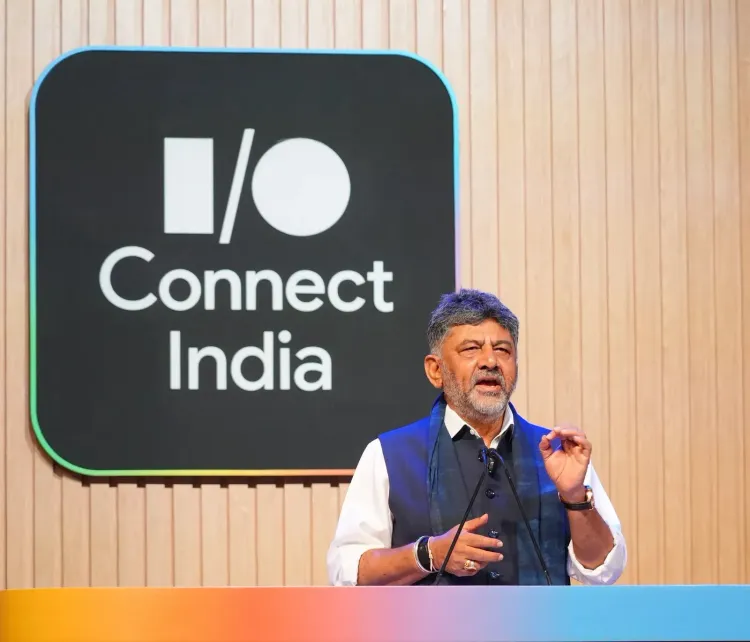
Synopsis
Chief Minister D K Shivakumar has unveiled Karnataka's roadmap to become India's AI Capital, anchored by the country's first AI University on a 100-acre Bengaluru campus, a dedicated AI Hub and state AI Policy, AI schooling from Class VI, and two Green Data Centres.
Key Takeaways
Karnataka CM D K Shivakumar announced a comprehensive AI roadmap on 14 July 2026 to make the state India's AI Capital.
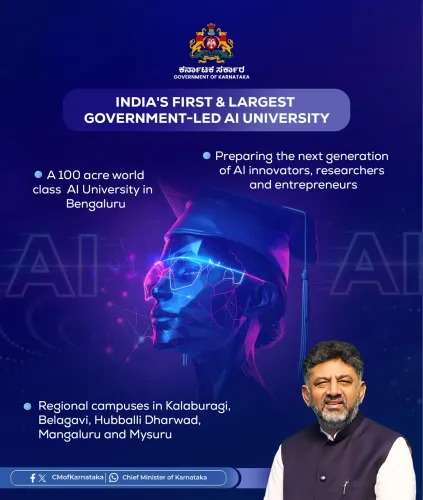
India's first and largest AI University will be built on a 100-acre campus in Bengaluru , with regional campuses in Kalaburagi, Belagavi, Hubballi-Dharwad, Mangaluru and Mysuru.
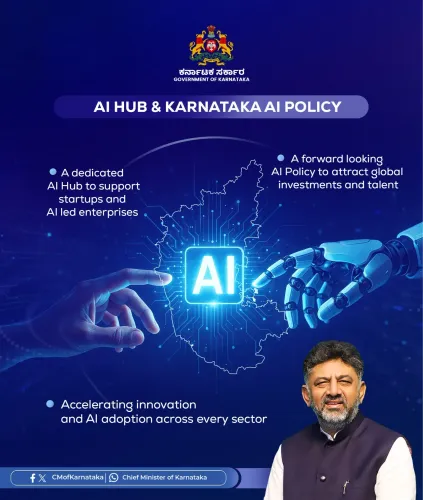
A dedicated AI Hub and a new Karnataka AI Policy will anchor the state's strategy to attract investment and support AI startups.
AI education will begin from Class VI , embedding foundational AI skills into school curricula across Karnataka.
Two next-generation Green Data Centres — one in a coastal district and one near Bengaluru — will underpin the state's AI and digital infrastructure.
The initiative mirrors a national trend of states competing for AI talent and capital under the umbrella of India's broader digital technology missions.
The Chief Minister's Office of Karnataka, on behalf of Chief Minister D K Shivakumar, on Tuesday, 14 July 2026, announced a sweeping roadmap to position Karnataka as India's AI Capital, unveiling plans for the country's first dedicated AI university, a state AI policy, AI education from middle school, and two green data centres.
Context
The announcement, made through the official Chief Minister's Office account on X, lays out four interlocking pillars: a flagship AI university in Bengaluru, a dedicated AI Hub and Karnataka AI Policy, AI curriculum integration from Class VI onwards, and two next-generation Green Data Centres. Shivakumar's office described the package as Karnataka's 'roadmap to become India's AI Capital,' signalling that the state intends to extend its decades-long lead in information technology into the artificial intelligence era.
Bengaluru, already India's primary IT hub and home to the country's largest concentration of technology multinationals and startups, is the natural anchor for the initiative. The main AI university campus will be built on a 100-acre, world-class campus in the city, with regional campuses planned for Kalaburagi, Belagavi, Hubballi-Dharwad, Mangaluru and Mysuru, spreading the initiative's footprint across the state.
Policy Backdrop
Karnataka's move builds on a national foundation: NITI Aayog released India's National Strategy for Artificial Intelligence in 2018, establishing a framework for AI research, adoption and governance across the country. The state's announcement reflects an acceleration of that agenda at the sub-national level, with Karnataka seeking to translate federal ambition into concrete infrastructure and human capital.
The Karnataka AI Policy, announced alongside the university, is designed to create a 'globally competitive AI ecosystem,' attract investments and support AI startups. A dedicated AI Hub co-located with the university is intended to serve as the operational nerve centre for this ecosystem, linking academia, industry and government in a single precinct. This model mirrors international AI cluster strategies seen in cities such as London, Singapore and Toronto.
The emphasis on Green Data Centres — one in a coastal district and one near Bengaluru — is notable. As AI workloads are among the most energy-intensive in modern computing, the state's insistence on sustainable infrastructure signals awareness of the environmental costs of large-scale AI deployment, a concern that has grown sharply across Indian policy circles in recent years.
Stakeholders and Impact
The initiative targets several distinct groups. AI startups stand to benefit from the Hub's support structures and the policy framework's investment incentives. School students from Class VI onwards will encounter AI as a foundational subject, a significant curricular shift that could reshape the pipeline of domestic AI talent over the next decade. Tech investors, both domestic and international, are the third key audience, with the state signalling that land, policy certainty and infrastructure will be available at scale.
The regional campus model — spanning Kalaburagi in the north, Belagavi and Hubballi-Dharwad in the northwest, Mangaluru on the coast and Mysuru in the south — is also a deliberate equity play, distributing AI education beyond the Bengaluru metropolitan area and into districts that have historically had less access to premium higher education.
What's Next
Observers will watch closely for rollout timelines on the Class VI AI curriculum, and for land acquisition or construction milestones for the university campuses and data centres. The initiative's potential linkage with the central government's IndiaAI Mission — which channels federal funding toward AI compute, datasets and skilling — could become a focal point at future investor summits or state budget presentations. How quickly Karnataka can move from announcement to ground-breaking will determine whether the 'AI Capital' label translates into durable competitive advantage or remains an aspirational marker in an increasingly crowded field of state-level AI ambitions.
Point of View
Combining education reform, purpose-built infrastructure and a dedicated policy framework in a single package rather than piecemeal announcements. By anchoring the initiative in Bengaluru while extending campuses to five other cities, the state is simultaneously defending its technology brand and making an equity argument that could broaden political support. The Green Data Centre commitment is a shrewd addition, pre-empting the sustainability critique that has followed large AI infrastructure projects globally. The critical test will be execution speed: in a field where peer states and rival global cities are moving fast, the gap between announcement and operational reality will define whether Karnataka's 'AI Capital' claim holds.
NationPress
12 Oct 2026
Frequently Asked Questions
What is Karnataka's AI Capital plan announced by CM Shivakumar?
Chief Minister D K Shivakumar announced a roadmap on 14 July 2026 to make Karnataka India's AI Capital, comprising India's first AI University in Bengaluru on a 100-acre campus, a dedicated AI Hub, a Karnataka AI Policy, AI education from Class VI, and two Green Data Centres.
Where will India's first AI University be located?
The main campus of India's first and largest AI University will be in Bengaluru on a 100-acre world-class campus, with regional campuses in Kalaburagi, Belagavi, Hubballi-Dharwad, Mangaluru and Mysuru.
From which class will AI education start in Karnataka schools?
Under the new plan, AI education will begin from Class VI, equipping students with foundational AI skills as part of the school curriculum across Karnataka.
What are the Green Data Centres announced for Karnataka?
Two next-generation Green Data Centres are planned — one in a coastal district of Karnataka and another near Bengaluru — to strengthen the state's AI and digital infrastructure sustainably.
How does Karnataka's AI Policy aim to support startups?
The Karnataka AI Policy, announced alongside the AI University and Hub, is designed to build a globally competitive AI ecosystem, attract domestic and international investments, and provide structured support to AI startups.