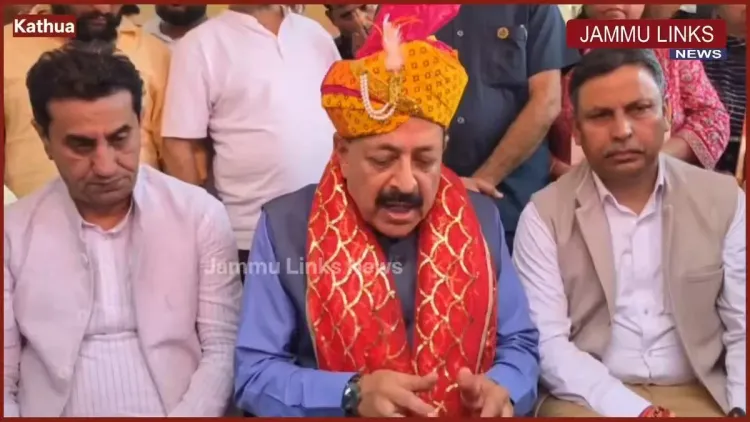
Dr. Jitendra Singh: Kathua to Get Corridor, Gas Line, Homeopathy College
Synopsis
Union Minister Dr. Jitendra Singh announced on June 19, 2026 that Kathua district in Jammu and Kashmir will receive an express corridor, a gas pipeline, and North India's first homeopathy college, marking a major infrastructure push for the border district.
Key Takeaways
Jitendra Singh announced three major infrastructure projects for Kathua , Jammu and Kashmir, on June 19, 2026 .
The projects include an express corridor , a gas pipeline , and North India's first homeopathy college .
The announcement was made under the hashtag #12YearsOfSeva , marking twelve years of the minister's service.
Kathua is a border district in the Jammu division , near the Punjab border and the international boundary.
The projects align with post- 2019 central government infrastructure packages for Jammu and Kashmir and the AYUSH Ministry's push to expand specialised medical education.
Formal project sanctions and timelines are yet to be confirmed by the relevant central ministries.
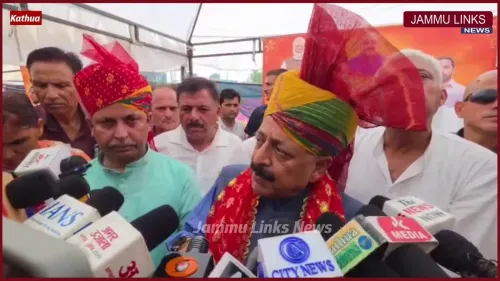
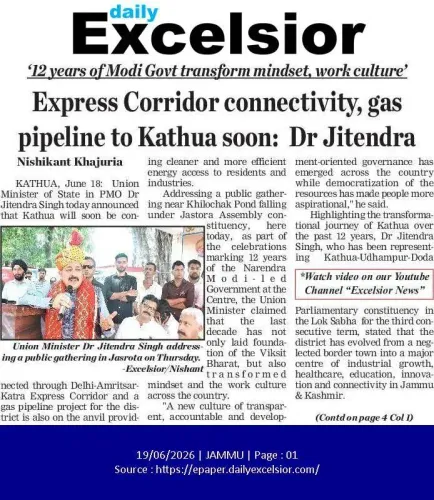
Union Science and Technology Minister Dr. Jitendra Singh on Friday, June 19, 2026, announced that Kathua, a district in the Jammu division of Jammu and Kashmir, is set for a significant infrastructure push encompassing an express corridor, a gas pipeline, and what he described as North India's first homeopathy college.
Context
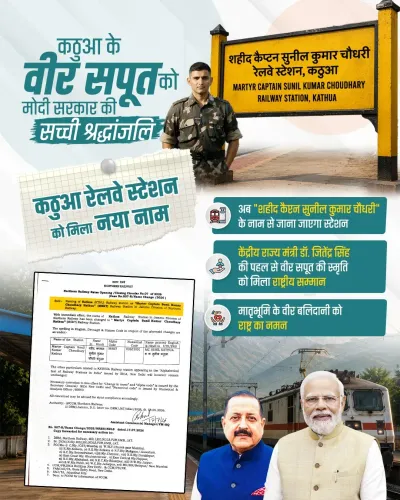
Dr. Singh made the announcement on X (formerly Twitter) under the hashtag #12YearsOfSeva — marking twelve years of service — framing the Kathua projects as part of a broader record of constituency and regional development. The post highlights three distinct infrastructure pillars: physical connectivity through an express corridor, energy access through a gas pipeline, and specialised medical education through a homeopathy college.
Kathua is strategically located near the Punjab border and the international boundary, making it a district of both logistical and security significance. Historically, border-adjacent districts in Jammu and Kashmir have lagged in large-scale infrastructure investment compared to more accessible urban centres.
Policy Backdrop
Following the reorganisation of Jammu and Kashmir into a Union Territory in 2019, the central government announced multiple infrastructure packages targeting road, power, and pipeline connectivity across the region. The National Gas Grid expansion, initiated around 2018–2020, included plans to extend pipeline networks toward northern states, with Jammu and Kashmir identified as a priority corridor.
On the education front, the AYUSH Ministry has since 2014 promoted the establishment of new homeopathy and Ayurveda colleges in underserved regions, aiming to decentralise specialised healthcare education. A homeopathy college in Kathua would align with this national push and, if confirmed as North India's first, would mark a notable milestone for the AYUSH sector in the region.
Express corridor projects connecting border districts to national highway networks have also been part of the integrated development approach applied to peripheral regions, improving both civilian mobility and strategic access.
Stakeholders and Impact
Residents of Kathua and surrounding districts stand to benefit most directly. A gas pipeline would improve energy access for households and local industry, reducing dependence on costlier fuel alternatives. The express corridor, once operational, would cut travel times and open new economic corridors linking Kathua to larger markets in Punjab and beyond.
For aspiring students in the AYUSH stream across Jammu and Kashmir and neighbouring states, a homeopathy college in Kathua would reduce the need to travel to distant institutions for specialised education. The combination of transport, energy, and medical education assets mirrors integrated development strategies deployed in other border districts of India.
What's Next
Detailed project sanctions, funding allocations, and land acquisition timelines are expected to be reflected in forthcoming Jammu and Kashmir budget documents or infrastructure ministry releases. Observers will watch for formal approvals from the relevant central ministries — including Road Transport and Highways, Petroleum and Natural Gas, and AYUSH — to gauge implementation schedules.
If the projects advance as outlined, Kathua could emerge as a model for integrated border-district development, combining connectivity, energy, and education in a single policy package — a template that may be replicated across other districts of the Union Territory.
Point of View
Bundling connectivity, energy, and education into a single political narrative. Framing the projects under '#12YearsOfSeva' signals that Dr. Singh is positioning this infrastructure push as a personal accountability milestone ahead of any electoral cycle. The homeopathy college claim — 'North India's first' — is the most politically potent detail, as it would give Kathua a distinction that resonates with the AYUSH policy agenda championed by the ruling establishment since 2014. Pending formal sanctions, the announcement currently functions as a statement of intent, and its credibility will be tested by the speed of bureaucratic follow-through.
NationPress
20 Sept 2026
Frequently Asked Questions
What infrastructure projects are planned for Kathua in Jammu and Kashmir?
Union Minister Dr. Jitendra Singh announced that Kathua is set to receive an express corridor, a gas pipeline, and North India's first homeopathy college, as stated in his post on June 19, 2026.
Where will North India's first homeopathy college be located?
According to Dr. Jitendra Singh's announcement, North India's first homeopathy college is planned for Kathua district in Jammu and Kashmir.
What is the #12YearsOfSeva hashtag about?
The hashtag #12YearsOfSeva marks twelve years of service by Dr. Jitendra Singh, under which he is highlighting development milestones including the Kathua infrastructure projects.
Has the Kathua gas pipeline and express corridor been officially sanctioned?
As of the announcement on June 19, 2026, formal project sanctions, funding details, and implementation timelines have not been confirmed by the relevant central ministries.
Why is Kathua significant for infrastructure development in Jammu and Kashmir?
Kathua is a strategically located border district in the Jammu division, near the Punjab border and the international boundary, making it a priority area for connectivity and development under post-2019 central government packages for Jammu and Kashmir.