Khattar Hails Men's Kabaddi Gold at Asian Games 2026
Synopsis
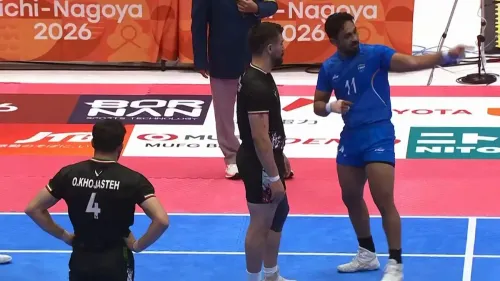
Union Minister Manohar Lal Khattar congratulated the Indian men's kabaddi team on winning gold at Asian Games 2026, defeating Iran. He celebrated the win alongside the women's team's earlier gold, calling it a proud moment for India.
Key Takeaways
The Indian men's kabaddi team won the gold medal at Asian Games 2026 by defeating Iran .
Union Power Minister Manohar Lal Khattar posted a congratulatory message on X on 26 September 2026 .
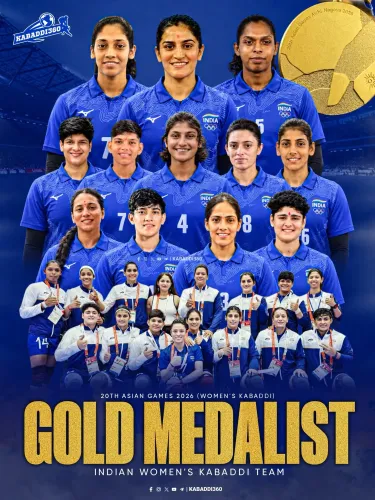
Both the men's and women's kabaddi teams claimed gold at the same edition of the Asian Games.
Kabaddi has been part of the Asian Games programme since 1990 , with India consistently among the top performers.
Khattar highlighted the team's discipline, skilled play, and teamwork as key factors behind the achievement.
After the Indian women's kabaddi team raised the tricolour, the men followed — and Union Power Minister Manohar Lal Khattar made sure the country heard about it. On Saturday, 26 September 2026, the Minister took to X to congratulate the Indian men's kabaddi team on clinching the gold medal at the Asian Games 2026, defeating Iran in what he described as a display of discipline, skill, and outstanding teamwork.
Writing in Hindi, Khattar declared: 'बेटियों के बाद बेटों ने भी कबड्डी में भारत का परचम लहराया' — 'After the daughters, the sons too have hoisted India's flag in kabaddi.' The phrase captures the moment precisely: both the men's and women's sides delivered gold at the same edition of the Games, a twin triumph for an indigenous sport that India has made its own on the continental stage.
India's Kabaddi Dynasty at the Asian Games
Kabaddi entered the Asian Games programme in 1990, and India has competed — and dominated — at every edition since. The men's team's record at the Games is among the most consistent in Indian sporting history, making each gold a defence of a legacy rather than a surprise. Iran has long been the closest challenger in the men's draw, making victory over them the stiffest possible test on this stage.
The sport's roots run deep in the subcontinent — played in open fields long before it had structured rules or a continental podium. That cultural weight is precisely why ministers, fans, and federations treat every Asian Games kabaddi result as something larger than a sporting result. It is a statement of cultural ownership.
The Women's Gold That Set the Stage
Khattar's post references the women's team's earlier gold — 'बेटियों के बाद' — framing the men's win as the completion of a double. The back-to-back achievement across both squads at a single Games edition amplifies the significance of the moment, turning two individual victories into a single national narrative.
Senior cabinet ministers routinely post congratulatory messages after major international sporting results. What gives this particular message texture is the explicit acknowledgement of both teams in a single breath — a nod to the symmetry of the achievement and, notably, to the women's success as the opener of that narrative.
India's kabaddi gold medals have historically sparked conversations around sport infrastructure, grassroots development, and the future of the Pro Kabaddi League — the domestic franchise tournament that has professionalised the game and deepened its talent pool over the past decade. Whether this Asian Games double accelerates any such policy conversation remains to be seen — but the achievement itself is unambiguous.
Two golds, one Games, one sport. India's kabaddi story just added another chapter.
Point of View
Then sons' situates both golds inside a single national achievement narrative, adding rhetorical weight beyond a standard sports shoutout. For the BJP, whose messaging frequently weaves together cultural pride and sporting success, a double kabaddi gold in an indigenous sport is a politically convenient moment that reinforces 'New India' optics at minimal cost. The broader policy signal — whether the double gold accelerates any institutional investment in kabaddi infrastructure or the Pro Kabaddi League ecosystem — is the real story to track beyond the celebration.
NationPress
26 Sept 2026
Frequently Asked Questions
Did India win gold in kabaddi at Asian Games 2026?
Yes. The Indian men's kabaddi team won the gold medal at Asian Games 2026, defeating Iran in the final.
Who congratulated the Indian kabaddi team after the Asian Games 2026 win?
Union Power Minister Manohar Lal Khattar posted a congratulatory message on X, praising the team's discipline and teamwork.
Did the Indian women's kabaddi team also win gold at Asian Games 2026?
According to Minister Khattar's post, the Indian women's kabaddi team also won gold at the same Games, with his message celebrating both achievements together.
When did kabaddi become part of the Asian Games?
Kabaddi was included in the Asian Games programme in 1990, and India has competed — and won medals — at every edition since.
Which country did India defeat to win kabaddi gold at Asian Games 2026?
India defeated Iran to claim the gold medal in men's kabaddi at Asian Games 2026, according to Minister Khattar's post.