Kishan Reddy shares Telugu audio of Modi's 138th Mann Ki Baat
Synopsis
Union Coal and Mines Minister G. Kishan Reddy shared a full Telugu audio translation of PM Modi's 138th Mann Ki Baat episode on 27 September 2026, covering national defence, indigenous innovation, and welfare schemes.
Key Takeaways
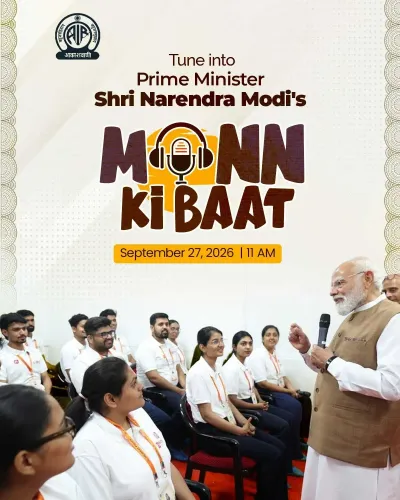
PM Narendra Modi addressed the nation through the 138th episode of Mann Ki Baat on 27 September 2026 .
The episode covered national defence, indigenous technology, and public welfare schemes.
PM Modi praised innovative ideas from ordinary citizens succeeding across India.
Kishan Reddy , BJP Telangana state president, shared a full Telugu-language audio translation of the episode.
Mann Ki Baat has been running since October 2014 , now in its 12th year .
Regional language translations are a recurring feature of the programme's outreach strategy.
Every month, Prime Minister Narendra Modi speaks directly to the nation — and on Sunday, 27 September 2026, the 138th episode of Mann Ki Baat carried his message on national defence, indigenous technology, and public welfare schemes. Union Coal and Mines Minister G. Kishan Reddy, also the BJP's Telangana state president, moved quickly to amplify that message in the language millions of Telugus speak at home, sharing a full Telugu-language audio translation on X.
Reddy's post noted that the Prime Minister had addressed citizens through the episode on themes of 'desa rakshana, swadeshi parijnanam, praja sankshema karyakramalu' — national security, indigenous knowledge, and public welfare programmes — and had praised innovative ideas from ordinary citizens succeeding across the country. He linked to a live YouTube broadcast carrying the complete Telugu translation, making the episode accessible to non-Hindi speakers in Telangana and beyond.Mann Ki Baat's decade-long reach into regional India
Mann Ki Baat has run since October 2014, making it one of the longest-running direct-communication platforms a sitting Indian Prime Minister has maintained with citizens. What began as a Hindi radio address has steadily expanded its footprint through regional translations, allowing the programme's themes — from defence indigenisation to grassroots innovation — to travel into every linguistic corner of the country.
The 138th episode followed the programme's established pattern: spotlighting citizen-driven success stories alongside the government's core policy messages on security and welfare. Regional leaders like Kishan Reddy have consistently used such episodes as an opportunity to reinforce those messages within their own constituencies and language communities.
Why a Telugu translation matters for Telangana's BJP
For Kishan Reddy, sharing the Telugu audio is as much a political act as a civic one. As the BJP's Telangana state president, extending the Prime Minister's reach into Telugu-speaking audiences directly serves the party's long-running effort to deepen its footprint in a state where it remains a challenger. The translation lowers the language barrier for millions who might otherwise miss the programme's content entirely.
The broader pattern is deliberate: regional translation drives engagement in non-Hindi-belt states and signals that the Centre's communication strategy is not narrowly aimed at a Hindi-speaking core. For a programme now in its 12th year, that inclusivity is part of its institutional identity.
Point of View
Where the party is working to expand its base. The move fits a broader pattern in which the party's state leadership uses the Prime Minister's high-visibility communication platform to stay relevant and visible between election cycles. Mann Ki Baat's regional language strategy has, over 12 years, become a soft-power tool that complements harder electoral ground work. Whether it shifts voting behaviour in Telangana remains debatable, but as a sustained presence-building exercise, the calculus is clear.
NationPress
28 Sept 2026
Frequently Asked Questions
What was discussed in PM Modi's 138th Mann Ki Baat?
The 138th Mann Ki Baat episode, aired on 27 September 2026, covered national defence, indigenous technology, public welfare schemes, and innovative ideas from citizens succeeding across India.
What is Mann Ki Baat?
Mann Ki Baat is a monthly radio and digital programme launched by Prime Minister Narendra Modi in October 2014, where he addresses citizens directly on governance, development, and national issues.
Why did G. Kishan Reddy share a Telugu translation of Mann Ki Baat?
As BJP's Telangana state president, Kishan Reddy shared the Telugu audio translation to make PM Modi's address accessible to Telugu-speaking audiences who may not follow the Hindi broadcast.
How many episodes of Mann Ki Baat have there been?
The 27 September 2026 broadcast was the 138th episode of Mann Ki Baat, a programme that has run since October 2014.
Where can I listen to the Telugu translation of the 138th Mann Ki Baat?
Union Minister G. Kishan Reddy shared the YouTube link to the full Telugu audio translation of the 138th Mann Ki Baat in his post on X on 27 September 2026.