KTR Thanks Kanimozhi in Cross-Party Gesture
Synopsis
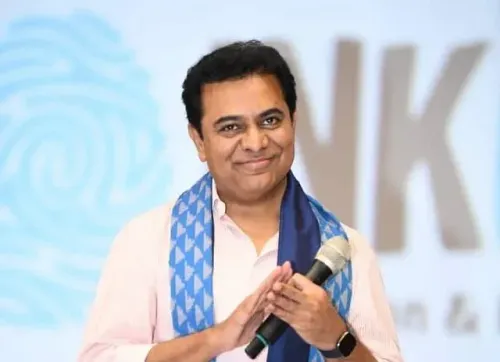
BRS working president K. T. Rama Rao publicly thanked DMK Rajya Sabha MP Kanimozhi Karunanidhi on 24 July 2026, in a brief X post that underscores ongoing cross-party courtesies between southern regional formations on shared federal concerns.
Key Takeaways
KTR posted a public thank-you to Kanimozhi Karunanidhi on 24 July 2026 .
The honorific 'Garu' used by KTR reflects Telugu conventions of respect toward the DMK leader.
BRS and DMK share overlapping positions on federalism , state resource rights, and language policy.
Kanimozhi is a Rajya Sabha MP from Tamil Nadu and daughter of late DMK chief M.
The precise context of the gesture prompting the thank-you was not disclosed in the post.
Observers will watch for substantive follow-up between BRS and DMK on joint political positions.
BRS working president K. T. Rama Rao on Friday, 24 July 2026 publicly thanked DMK Rajya Sabha MP Kanimozhi Karunanidhi in a brief but pointed post on X, signalling a courteous exchange between two prominent southern regional formations.
Context
The post, addressed to Kanimozhi Garu — the honorific 'Garu' reflecting Telugu conventions of respect — followed what appears to be a gesture or statement from the Dravida Munnetra Kazhagam leader directed at KTR or his party. The precise trigger for the acknowledgement was not detailed in the post itself.
Kanimozhi, daughter of the late DMK patriarch M. Karunanidhi, is a Rajya Sabha MP from Tamil Nadu known for forceful interventions on federal rights, language policy, and cultural autonomy — themes that resonate with BRS's own political positioning on state sovereignty.
Policy Backdrop
Both BRS and DMK have historically championed federalism, state resource rights, and resistance to perceived centralisation. Telangana and Tamil Nadu share concerns over river water sharing, tax devolution under the Finance Commission framework, and the protection of regional languages — issues that have periodically drawn the two parties into informal solidarity.
Cross-party courtesies of this nature among non-BJP, non-Congress regional formations have become a regular feature of India's evolving federal political landscape, especially as opposition coordination across southern states gains salience ahead of electoral cycles.
Stakeholders and Impact
The exchange is significant for observers tracking alignment between Dravidian and Telangana-based political blocs. KTR, as working president of BRS, has been one of the party's most active voices on national platforms since the party's transition from Telangana Rashtra Samithi to its current identity in 2022.
For Kanimozhi, such gestures reinforce DMK's standing as a bridge-builder among regional parties, a role the party has cultivated carefully in the post-2024 Lok Sabha environment. Regional party-to-party diplomacy of this kind can lay groundwork for coordinated positions on parliamentary business or future electoral strategy.
What's Next
Political watchers will look for any substantive follow-up — a joint statement, a shared platform, or aligned positions on pending federal issues — that might give this exchange policy weight beyond a social-media courtesy. The coming months, with state assembly calendars and potential parliamentary sessions in view, will test whether this goodwill translates into coordinated political action between BRS and DMK.
Point of View
Who has been working to expand BRS's national footprint beyond Telangana, cultivating ties with a powerful Dravidian voice like Kanimozhi fits a broader pattern of positioning the party as a credible player in non-BJP, non-Congress federal politics. The exchange also reflects the DMK's consistent strategy of maintaining warm relationships across the regional spectrum. Whether this remains a courtesy or deepens into a policy alliance will depend on the legislative agenda and electoral pressures of the coming months.
NationPress
24 Jul 2026
Frequently Asked Questions
Why did KTR thank Kanimozhi on X?
KTR posted a public thank-you to DMK MP Kanimozhi Karunanidhi on 24 July 2026 , though the specific gesture or statement that prompted his acknowledgement was not detailed in the post itself.
Who is Kanimozhi Karunanidhi?
Kanimozhi Karunanidhi is a Rajya Sabha MP from Tamil Nadu , a senior DMK leader, and the daughter of the late DMK patriarch M. Karunanidhi . She is known for her interventions on federal rights and cultural policy.
What is the relationship between BRS and DMK?
BRS and DMK are both regional parties that share positions on federalism , state resource rights, and language autonomy. They have exchanged gestures of solidarity on issues of common concern, particularly around Finance Commission devolution and state sovereignty.
What does 'Garu' mean in KTR's post?
'Garu' is a Telugu honorific roughly equivalent to 'respected' or 'ji' in Hindi. KTR 's use of it toward Kanimozhi signals respect and warmth in keeping with southern Indian social conventions.
Is BRS part of any national opposition alliance?
BRS has maintained a position broadly outside the main national coalition blocs, engaging selectively with regional and opposition parties on specific federal and policy issues rather than committing to a formal national alliance.