Mandaviya Jabs Congress Over Ballot-Era Poll Losses
Synopsis
Union Minister Mansukh Mandaviya challenged Congress on X with a pointed rhetorical question — what happened to the party even when paper ballots were used — reigniting India's recurring EVM-versus-ballot debate under the hashtag #SaveDemocracyRemoveAnarchy.
Key Takeaways
Mansukh Mandaviya posted a Hindi rhetorical question on 30 October 2026 asking what happened to Congress even in the paper-ballot era.
The post used the hashtag #SaveDemocracyRemoveAnarchy , signalling coordinated BJP counter-messaging.
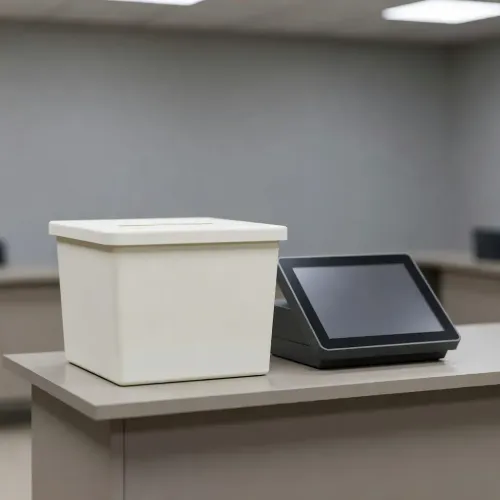
The Election Commission of India introduced EVMs from 1998 , completing nationwide use by 2004 — Congress suffered setbacks both before and after the transition.
Congress and other opposition parties have periodically demanded a return to paper ballots or expanded VVPAT verification.
The post included a video, amplifying the rhetorical argument beyond text alone.
The exchange fits a recurring partisan pattern ahead of upcoming state and national election cycles.
A sharp political jab landed on Friday afternoon when Union Labour and Sports Minister Mansukh Mandaviya turned a long-running opposition argument on its head — asking, via a pointed Hindi question on X, what happened to the Indian National Congress when elections were held with paper ballots. The post, tagged #SaveDemocracyRemoveAnarchy, carried a video and arrived in the middle of a familiar Indian political storm: the debate over electronic voting machines versus the old ballot system.
In Hindi, Mandaviya's question translates directly: 'Baillot se voting hone ke baad bhi Congress ka kya hua?' — 'What happened to Congress even when voting was done by ballot?' The rhetorical point is a well-worn BJP counter-punch: if Congress alleges that Electronic Voting Machines are rigged against them, how do they explain the defeats they suffered in the pre-EVM era when paper ballots were the only system in use?
The EVM Argument Congress Keeps Losing
The Election Commission of India began phasing in Electronic Voting Machines from 1998 onward, completing nationwide rollout by the 2004 general elections. For years before that, paper ballots were the universal medium — and Congress endured significant electoral reverses in that period too. That historical record is precisely what the BJP has weaponised every time EVM tampering allegations resurface.
Opposition parties, including Congress, have periodically demanded a return to paper ballots or expanded VVPAT slip verification. The demand tends to spike ahead of high-stakes state or national elections, making Mandaviya's timing — with state assembly cycles always on the horizon — pointed rather than coincidental.
A Hashtag That Frames the Fight
The choice of #SaveDemocracyRemoveAnarchy signals that this is coordinated BJP messaging, not a solo remark. The hashtag flips the 'save democracy' framing that opposition campaigns often use against the ruling party — recasting Congress's EVM protests themselves as the source of democratic disruption. Mandaviya, as a senior cabinet minister and BJP stalwart, gives the message institutional weight beyond a backbencher's tweet.
The post includes a video — the contents of which, by the nature of the medium, are likely to amplify the rhetorical impact with archival footage or graphics. Whether the clip adds new factual detail or simply reinforces the text's argument remains the story to watch as the political cycle heats up.
In Indian electoral politics, the EVM debate has proven impossible to fully settle — not because the machines are genuinely in doubt, but because it has become a ritual proxy war for broader questions of electoral trust. Mandaviya just served the latest volley.
Point of View
' the party attempts to seize the moral high ground on electoral integrity. The coordination implied by the hashtag suggests this is a planned messaging cycle, likely timed to pre-empt or respond to a fresh opposition push on voting technology. Historically, this BJP counter-argument has proven effective at muddying the opposition's narrative without requiring a technical defence of EVMs.
NationPress
30 Oct 2026
Frequently Asked Questions
What did Mansukh Mandaviya post about Congress and ballots?
He posted a Hindi rhetorical question asking what happened to Congress even when elections were held with paper ballots, implying the party lost under that system too — countering EVM tampering claims.
What is the #SaveDemocracyRemoveAnarchy hashtag about?
It is a BJP messaging campaign hashtag that reframes Congress's 'save democracy' language by characterising the opposition's EVM protests as a source of political anarchy rather than a democratic demand.
When did India switch from paper ballots to EVMs?
The Election Commission of India began phasing in Electronic Voting Machines from 1998 onward, achieving nationwide use by the 2004 general elections.
Why does BJP bring up the ballot era when Congress raises EVM concerns?
The BJP's standard counter-argument is that Congress suffered significant electoral losses even under the paper-ballot system, undermining the claim that EVMs specifically disadvantage the opposition.
Has Congress officially demanded a return to paper ballots?
Congress and other opposition parties have periodically demanded either a return to paper ballots or expanded VVPAT slip verification, particularly ahead of major state or national elections.