MEA rejects Pannun's US lawsuit against Indian officials as 'frivolous'
Synopsis
India's MEA has flatly rejected Gurpatwant Singh Pannun's US civil lawsuits against Indian officials, calling them 'frivolous' and warning that any judicial summons must pass through the Ministry of Law and Justice. The rebuff — coming amid reports of a Khalistan Army announcement and training videos on Canadian soil — signals New Delhi's refusal to treat the suit as a legitimate legal proceeding.
Key Takeaways
The MEA on 10 November rejected lawsuits filed by proscribed terrorist Gurpatwant Singh Pannun in a US court as 'frivolous.' Spokesperson Randhir Jaiswal said judicial documents for India can only be served via the Ministry of Law and Justice , India's designated central authority.
Pannun had earlier announced plans to form a 'Khalistan Army' and 'Sikh Homeland Security' force; videos of armed training on Canadian soil were flagged as alarming.
Canadian intelligence has previously identified Khalistani extremists as a national security threat, according to reports.
The development comes amid broader India-Canada diplomatic tensions over Khalistani activism.
India's Ministry of External Affairs (MEA) on Tuesday, 10 November firmly rejected civil lawsuits filed by proscribed terrorist and Sikhs for Justice (SFJ) chief Gurpatwant Singh Pannun in a US court, calling them 'frivolous' and denouncing what it described as 'fabricated and malicious attacks' on senior Indian officials. The rejection came in response to reports that the US State Department had reportedly attempted to serve summonses to the Government of India in connection with the case.
India's Official Position
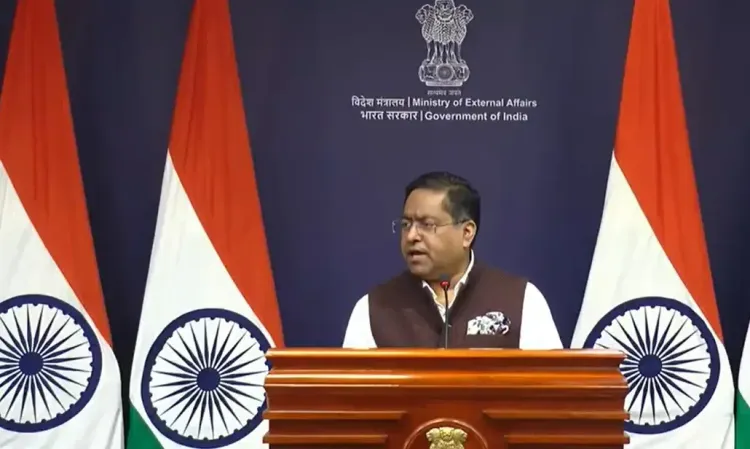
Speaking at a bi-weekly media briefing in New Delhi, MEA spokesperson Randhir Jaiswal stated: 'We reject the fabricated and malicious attacks on our high officials. As also, we reject the frivolous lawsuits.' Jaiswal further clarified that any request for the service of judicial documents in India must be routed exclusively through India's designated central authority — the Ministry of Law and Justice — and cannot be transmitted through any other channel.
Background: Pannun's Escalating Provocations
The lawsuit controversy is the latest episode in a series of provocations attributed to Pannun, who is designated a terrorist under Indian law. In August, reports surfaced of Pannun announcing plans to establish a so-called 'Khalistan Army' and a 'Sikh Homeland Security' force, with videos allegedly showing Sikh men training with semi-automatic rifles on Canadian soil — footage described in reports as 'deeply alarming' and potentially catastrophic for the Sikh community itself.
Pannun also released a video urging diaspora Sikhs to participate in a so-called Khalistan 'Referendum' in Indianapolis, the capital of the US state of Indiana. Last month, reacting to reports of a similar 'Khalistan referendum' held in Canada, the MEA had reiterated New Delhi's condemnation of all anti-India activities abroad.
The Radicalisation Concern
Analysis published by Khalsa Vox warned that Pannun's rhetoric carries real-world consequences for vulnerable Sikh youth in North America. According to the report, his messaging 'romanticizes defiance and externalizes every failure onto India,' supplying a ready-made narrative that, critics argue, shortens the distance from online extremism to real-world violence.
'These are not abstract political arguments. They are calculated provocations aimed at restless young men already navigating the pressures of migration, identity, and easy money,' the report stated. It further noted that a small minority of Sikh youth in the United States and Canada have been drifting toward drugs, illegal firearms, and gang activity — harming their own communities in the process.
Canadian Intelligence Signals
According to the same report, Canadian intelligence has previously identified Khalistani extremists as a national security concern. The pattern of inflammatory videos followed by public displays of force is, the report noted, unlikely to be coincidental. This comes amid already strained India-Canada relations, which deteriorated sharply following Ottawa's allegations — denied by New Delhi — linking Indian agents to the killing of a Khalistani figure on Canadian soil in 2023.
What Happens Next
India's insistence that judicial summonses must pass through the Ministry of Law and Justice effectively signals that New Delhi does not recognise the US civil suit as a legitimate channel for legal process against Indian officials. Legal observers note this position aligns with standard sovereign immunity arguments. The case is likely to remain a flashpoint in the broader India-US-Canada triangle as diplomatic tensions over Khalistani activism continue to simmer.
Point of View
Invoking sovereign process rights rather than engaging on the merits. What mainstream coverage underplays is the broader pattern: each Pannun provocation — the Khalistan Army announcement, the training videos, now a civil suit — tests how far Western governments will allow SFJ to operate before India's bilateral leverage kicks in. With Canada relations already fractured and the US quietly nudging both sides, the real question is whether Washington will push back on the suit's procedural manoeuvring, or let it run as domestic politics demands. India's insistence on routing summonses through the Ministry of Law and Justice is a legally defensible but politically pointed move that keeps the pressure squarely on Washington to manage its own legal ecosystem.
NationPress
10 Nov 2026
Frequently Asked Questions
What did India's MEA say about Pannun's lawsuit against Indian officials?
The MEA rejected the lawsuit as 'frivolous' and denounced what it called 'fabricated and malicious attacks' on senior Indian officials. Spokesperson Randhir Jaiswal stated that any request to serve judicial documents in India must be routed exclusively through the Ministry of Law and Justice, India's designated central authority.
Who is Gurpatwant Singh Pannun?
Gurpatwant Singh Pannun is the chief of Sikhs for Justice (SFJ), an organisation proscribed as a terrorist entity under Indian law. He is based in North America and has repeatedly called for a Khalistan referendum and, more recently, announced the formation of a so-called Khalistan Army.
What is the Khalistan Army that Pannun announced?
In August, Pannun announced plans to establish a 'Khalistan Army' and a 'Sikh Homeland Security' force. Reports, including from Khalsa Vox, cited videos allegedly showing Sikh men training with semi-automatic rifles on Canadian soil, which were described as deeply alarming and potentially dangerous for the Sikh community itself.
Why does India say US summonses cannot be directly served on the government?
India maintains that requests to serve judicial documents must pass through its designated central authority — the Ministry of Law and Justice — in line with established legal conventions around sovereign process. This effectively signals New Delhi's non-recognition of the US civil suit as a legitimate channel for proceedings against Indian officials.
How does this case fit into broader India-Canada tensions?
The lawsuit emerges against a backdrop of severely strained India-Canada relations following Ottawa's 2023 allegations — denied by New Delhi — linking Indian agents to the killing of a Khalistani figure on Canadian soil. Canadian intelligence has previously flagged Khalistani extremists as a national security concern, adding another layer of complexity to the diplomatic standoff.