MP CM Yadav pitches air connectivity as growth engine

Synopsis
The Chief Minister's Office of Madhya Pradesh has amplified CM Dr. Mohan Yadav's vision of expanded air connectivity as a catalyst for trade, tourism, and economic progress, framing stronger flight links as the backbone of a 'empowered Madhya Pradesh.'
Key Takeaways
The Chief Minister's Office of Madhya Pradesh posted on August 9, 2026 , promoting expanded air connectivity as a growth driver for the state.
Mohan Yadav , in office since December 2023 , has positioned aviation infrastructure as central to the state's economic strategy.
Madhya Pradesh operates key airports at Bhopal and Indore , with regional airports at Jabalpur , Gwalior , and Khajuraho expanding routes.
The state's aviation push aligns with the central government's UDAN scheme (launched 2016 ), which subsidises regional air connectivity to underserved cities.
Trade, tourism, and logistics are the three sectors the state aims to accelerate through better flight links.
Upcoming UDAN route approvals and airport project milestones will be the concrete measure of whether the vision translates into delivery.
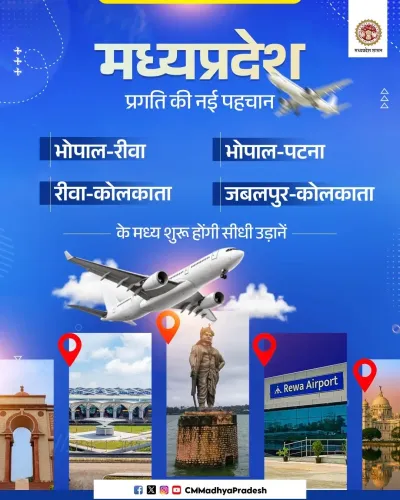
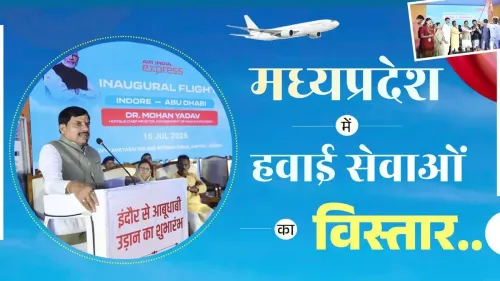
Madhya Pradesh is staking its economic future on the sky. The Chief Minister's Office of Madhya Pradesh posted on Sunday, August 9, 2026, amplifying Chief Minister Dr. Mohan Yadav's vision of expanded air connectivity as the central lever for turning the state into a hub of trade, tourism, and progress.
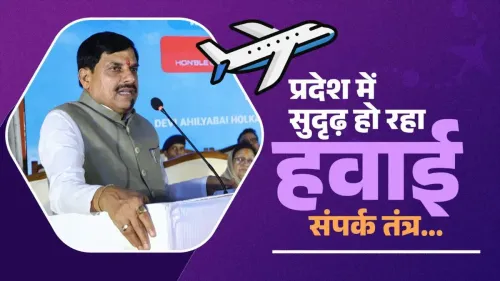
The post, shared under the hashtag #CMMadhyaPradesh, declared: 'Majboot hawai sampark, sashakt Madhya Pradesh' — 'Strong air connectivity, empowered Madhya Pradesh' — framing better flight links not as a convenience but as a statement of ambition. The message is pointed: connectivity is infrastructure, and infrastructure is destiny.
From landlocked heartland to aviation crossroads
Madhya Pradesh sits at the geographic centre of India — a fact that has historically made it a transit zone rather than a destination. That calculus is shifting. The state already operates airports at Bhopal and Indore, the latter emerging as one of central India's busiest air hubs, with regional airports in cities like Jabalpur, Gwalior, and Khajuraho steadily adding routes.
Under CM Dr. Mohan Yadav, who took office in December 2023, the state has aligned its infrastructure push with the central government's UDAN (Ude Desh ka Aam Naagrik) scheme — launched in 2016 — which subsidises regional air routes to connect underserved tier-2 and tier-3 cities. For a state with heritage tourism anchors like Khajuraho, Sanchi, and Orchha, direct flight access is the difference between a day-trip and a no-show.
Trade and tourism: the twin engines Yadav is betting on
The economic logic is straightforward. Better air links compress travel time for business delegations, reduce logistics friction for perishable and high-value goods, and make Madhya Pradesh's tourism circuit accessible to international visitors who will not sit through a six-hour road transfer. Indian states that have paired airport investment with investor summits — Uttar Pradesh, Gujarat, Telangana — have seen measurable upticks in industrial commitments.
Madhya Pradesh has been running a parallel track: the state has hosted investor conclaves and positioned its agri-processing, textile, and pharmaceutical sectors as investment targets. Faster air connectivity ties these threads together, giving the pitch to global and domestic investors a hard infrastructure backbone rather than a promise on paper.
What the next milestones will reveal
The real test lies in execution. Watchers will track whether new UDAN route approvals land in the state's favour in upcoming civil aviation ministry announcements, whether greenfield or upgraded airport projects hit their timelines, and whether passenger traffic numbers at Indore's Devi Ahilya Bai Holkar Airport and Bhopal's Raja Bhoj Airport continue their upward curve. Political rhetoric around connectivity is easy; terminal capacity and airline commitments are harder to fake.
If the routes follow the vision, Madhya Pradesh's central geography stops being a footnote and starts being a feature — the state that every flight path crosses finally becoming one that travellers choose to land in.
Point of View
The BJP government in Bhopal is attempting to compete directly with more industrialised states for investor attention. The alignment with the central UDAN scheme also lets the state government share political credit with New Delhi, a familiar coalition dynamic. The credibility of this narrative, however, will hinge on verifiable route additions and passenger growth numbers — metrics that are difficult to spin if they disappoint.
NationPress
23 Sept 2026
Frequently Asked Questions
What is Madhya Pradesh's air connectivity expansion plan?
Madhya Pradesh is working to expand its airport network and add new flight routes, leveraging the central government's UDAN scheme to connect tier-2 and tier-3 cities and boost trade and tourism across the state.
Which airports are operational in Madhya Pradesh?
Madhya Pradesh has major airports at Bhopal (Raja Bhoj Airport) and Indore (Devi Ahilya Bai Holkar Airport), with regional airports operating at Jabalpur , Gwalior , and Khajuraho .
What is the UDAN scheme and how does it help Madhya Pradesh?
UDAN — Ude Desh ka Aam Naagrik — is a central government scheme launched in 2016 that subsidises regional air routes to underserved cities. It helps Madhya Pradesh add affordable flight connections to smaller towns, supporting tourism and business travel.
Who is the Chief Minister of Madhya Pradesh in 2026?
Dr. Mohan Yadav is the Chief Minister of Madhya Pradesh. He took office in December 2023 and has made infrastructure-led growth, including aviation connectivity, a key pillar of his administration.
How does better air connectivity help Madhya Pradesh's tourism sector?
Direct flights to heritage destinations like Khajuraho , Sanchi , and Orchha make them accessible to domestic and international tourists who would otherwise skip long road journeys, directly boosting footfall and tourism revenue.