MP CM Yadav Grants Compassionate Jobs to 950+ Families
Synopsis
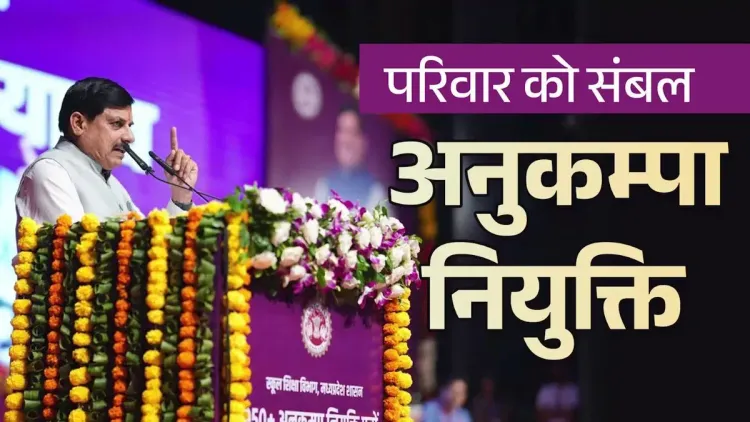
Madhya Pradesh Chief Minister Dr. Mohan Yadav granted compassionate appointments to more than 950 dependents of deceased government employees in a single-day mass drive on October 21, 2026, providing immediate financial relief to bereaved families across the state.
Key Takeaways
More than 950 compassionate appointments were issued simultaneously in Madhya Pradesh on October 21, 2026 .
Mohan Yadav personally oversaw the mass drive, framing timely appointments as financial and emotional support for grieving families.
Compassionate appointment ( anukampa niyukti ) allows one dependent of a government employee who dies in service to receive a government job, bypassing standard recruitment.
The policy has roots in 1970s-80s central and state service rules and is a standard welfare mechanism across Indian states.
Conducting appointments en masse is a deliberate strategy to clear pending backlogs and deliver relief faster to waiting families.
When a government employee dies in service, the family loses not just a loved one but the household's only income. Madhya Pradesh Chief Minister Dr. Mohan Yadav moved to close that gap on Wednesday, October 21, 2026, presiding over a mass drive that handed compassionate appointments (anukampa niyuktiyaan) to more than 950 individuals in a single day — delivering both a pay cheque and a measure of certainty to families who had been waiting.
Speaking at the event, CM Dr. Yadav framed the exercise in human terms: 'Receiving a compassionate appointment on time gives families economic support and new hope for the future.' The line captures what the policy is really about — not a bureaucratic transaction, but a lifeline extended before a bereaved household sinks into crisis.
What Anukampa Niyukti actually means for a family
Compassionate appointment is a long-standing provision in Indian government service rules, with roots going back to the 1970s and 1980s. When a state government employee dies 'in harness' — while still in active service — one dependent family member becomes eligible for a government job, bypassing the standard competitive recruitment process. The rationale is speed: a family that has just lost its breadwinner cannot wait years for an open examination cycle.
Madhya Pradesh operates its own service rules aligned with central government guidelines, and the state has periodically conducted mass drives to clear the backlog of pending cases. Getting more than 950 appointments issued simultaneously signals a deliberate push to reduce that backlog in one concentrated effort.
The weight of a single-day drive
Mass drives like this one matter because delay is itself a form of hardship. A pending application means a family managing on a meagre pension — or nothing at all — while the case moves through departmental queues. Clearing cases in bulk, rather than trickling them through individual departments, is a governance choice that translates directly into how quickly a family's finances stabilise.
The families of deceased government employees represent a constituency that rarely makes headlines but whose needs are immediate and non-negotiable. For each of the 950-plus appointees, today's order is a first salary and a formal place in the state's workforce.
Point of View
High-visibility welfare signal — they require no new legislation, draw on existing service rules, and produce tangible beneficiaries who can be counted and photographed. For the Yadav government, clearing 950-plus cases in a single event reinforces its pitch as an administration that converts entitlements into actual delivery rather than letting backlogs accumulate. The exercise also fits a broader pattern of Indian state governments using periodic bulk-clearance drives to demonstrate administrative momentum on social welfare. The real policy question going forward is whether eligibility criteria will be widened or the pendency period shortened, which would be a structural improvement rather than a one-day headline.
NationPress
21 Oct 2026
Frequently Asked Questions
What is anukampa niyukti in Madhya Pradesh?
Anukampa niyukti, or compassionate appointment, is a Madhya Pradesh government policy that gives a dependent family member of a state employee who dies in service a government job without going through normal competitive recruitment.
Who is eligible for compassionate appointment in MP?
Dependents — typically a spouse, son, or daughter — of a Madhya Pradesh government employee who dies while in active service ('in harness') are eligible, subject to specific service rules and departmental approvals.
How many compassionate appointments did MP grant in October 2026?
The Chief Minister's Office announced that more than 950 compassionate appointments were granted in a single drive on October 21, 2026.
Why does Madhya Pradesh conduct mass appointment drives?
Mass drives allow the state to clear accumulated backlogs of pending compassionate appointment cases quickly, so bereaved families receive financial relief without waiting years for individual departmental processing.
When did compassionate appointment rules begin in India?
Compassionate appointment provisions for government employees were established in most Indian states from the 1970s and 1980s, aligned with central government guidelines for employees dying in harness.