Nadda condoles Lucknow fire tragedy, prays for swift recovery
Synopsis
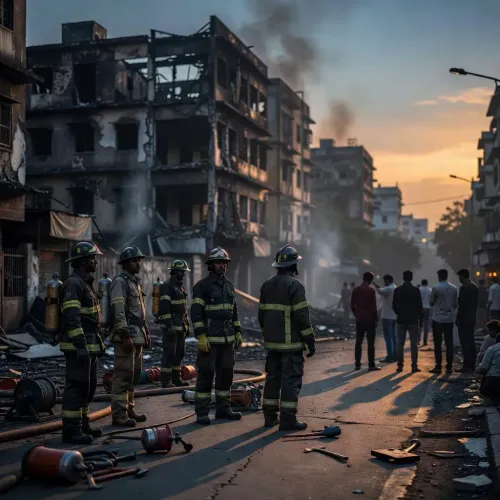
Union Health Minister and BJP president J. P. Nadda on 22 June 2026 condoled the devastating fire in Lucknow, Uttar Pradesh, that left several people dead or injured. He noted that the local administration was engaged in relief operations and prayed for the swift recovery of the wounded.
Key Takeaways
A serious fire broke out in Lucknow, Uttar Pradesh , resulting in multiple casualties.
Union Health Minister J.
Nadda expressed deep condolences on 22 June 2026 via X.
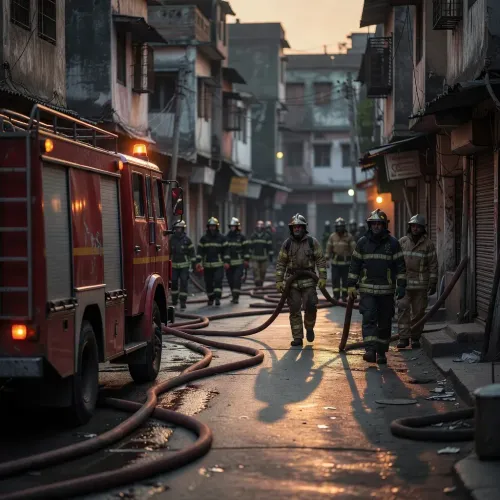
Nadda confirmed the local administration was conducting relief and rescue operations with 'complete alertness.' He conveyed sympathies to bereaved families and prayed for the speedy recovery of the injured.
India's disaster response is governed by the Disaster Management Act, 2005 , which mandates coordinated state and central relief efforts.
Official casualty figures and the cause of the fire are pending confirmation from Uttar Pradesh authorities.
Union Health Minister J. P. Nadda on Monday, 22 June 2026, expressed deep condolences over a devastating fire incident in Lucknow, Uttar Pradesh, that resulted in multiple casualties, and said he was praying for the speedy recovery of the injured.
Posting on X, Nadda wrote: 'उत्तर प्रदेश के लखनऊ में हुई भीषण आगजनी में कई लोगों के हताहत होने का समाचार अत्यंत दुःखद है' ('The news of several people being killed and injured in a devastating fire in Lucknow, Uttar Pradesh, is extremely saddening'). He added that the local administration was fully engaged in relief and rescue operations and conveyed his deepest sympathies to the bereaved families.
Context
A serious fire broke out in Lucknow, the capital of Uttar Pradesh, leading to casualties among residents. The exact cause and the full scale of the incident are subject to an ongoing assessment by local authorities. Nadda, in his post, acknowledged that the administration had mobilised swiftly, stating that rescue and relief work was being carried out with 'complete alertness' (पूरी तत्परता).
The minister also offered a prayer, writing: 'मैं ईश्वर से घायलों के शीघ्र स्वास्थ्य लाभ की प्रार्थना करता हूँ' ('I pray to God for the speedy recovery of the injured').
Policy Backdrop
India's disaster response framework is anchored in the Disaster Management Act, 2005, which established the National Disaster Management Authority (NDMA) and corresponding state-level bodies to coordinate relief, rescue, and rehabilitation during emergencies including fires. Uttar Pradesh, as India's most populous state, maintains its own State Disaster Management Authority, which works in tandem with district administrations during such incidents.
The Union Ministry of Health and Family Welfare plays a direct role in disaster response by overseeing medical relief, hospital preparedness, and the deployment of health resources to affected areas. Nadda's dual charge — health as well as chemicals and fertilizers — places him at the centre of both medical and industrial safety oversight at the national level.
Stakeholders and Impact
The immediate stakeholders are the fire victims, their families, and the residents of the affected locality in Lucknow. Local hospitals and emergency services are expected to bear the primary burden of medical care for the injured. Central expressions of concern from senior BJP leaders such as Nadda — who also serves as BJP national president — typically signal coordination between the Union government and the state administration, both governed by the same party.
Urban fires in densely populated localities of Uttar Pradesh have periodically tested the capacity of local fire brigades and emergency medical services. National leaders issuing prompt statements underscores political accountability and can accelerate the mobilisation of additional state or central resources for affected communities.
What's Next
The Uttar Pradesh government is expected to release official figures on casualties and the cause of the fire following the completion of preliminary investigations. Any decision on additional central assistance — whether financial relief, medical supplies, or hospital support — will likely follow an assessment by state authorities in consultation with the Union government.
A formal inquiry into the fire's origin and the adequacy of fire-safety infrastructure in the affected area may also be initiated, consistent with standard post-incident protocol under the Disaster Management Act.
Point of View
Reinforcing the optics of a unified and responsive administration. As BJP national president, his voice carries both governmental and organisational weight, signalling to state party units and local administrations that the incident is being watched at the highest level. The statement's emphasis on the local administration's 'complete alertness' is a deliberate framing choice — it pre-empts criticism of slow response while deflecting accountability to the state tier. The absence of specific casualty figures in his post reflects standard political caution when official numbers are still being verified.
NationPress
22 Jun 2026
Frequently Asked Questions
What happened in Lucknow on 22 June 2026?
A devastating fire broke out in Lucknow, Uttar Pradesh, resulting in multiple casualties. The local administration launched relief and rescue operations immediately, though official figures and the cause of the fire are pending confirmation.
What did JP Nadda say about the Lucknow fire?
J. P. Nadda expressed deep sorrow over the casualties, confirmed that the local administration was engaged in rescue operations, conveyed sympathies to bereaved families, and prayed for the speedy recovery of the injured.
How does India respond to urban fire disasters?
India's disaster response is governed by the Disaster Management Act, 2005, which established the National Disaster Management Authority and state-level bodies. Local administrations coordinate relief and rescue, while the Union government can provide additional medical and financial support.
Will the Centre provide assistance for the Lucknow fire victims?
Any central assistance would follow an assessment by Uttar Pradesh authorities in consultation with the Union government. The Ministry of Health and Family Welfare may coordinate medical relief support depending on the scale of casualties.