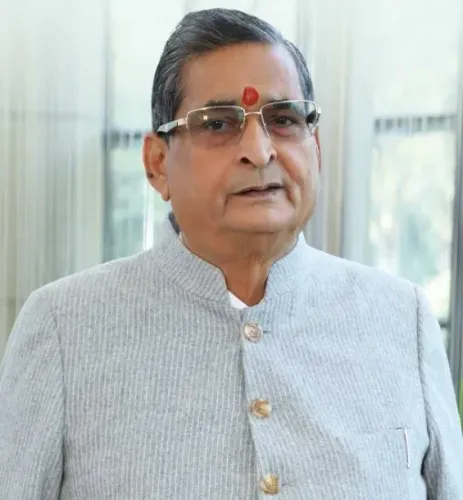
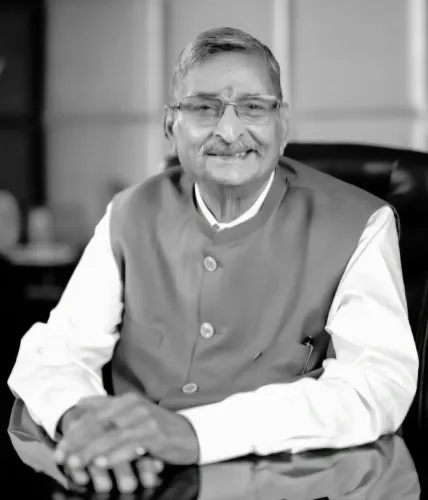
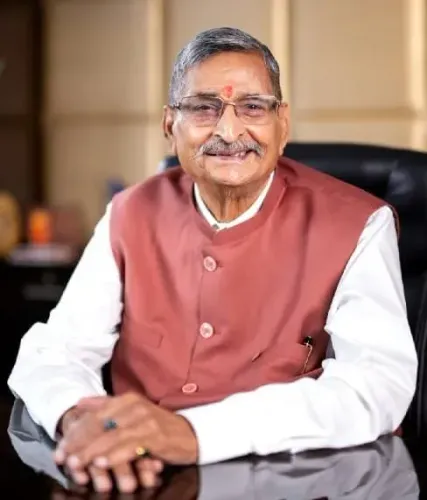
Nadda mourns BJP veteran R. K. Sinha's passing

Synopsis
BJP National President J. P. Nadda paid tribute to R. K. Sinha, a senior Jan Sangh and BJP leader and former Rajya Sabha MP, calling his contribution to party organisation and public welfare unforgettable following his passing on 30 October 2026.
Key Takeaways
Sinha , a senior leader of both Jan Sangh and the BJP and a former Rajya Sabha MP , passed away.
BJP National President and Union Health Minister J.
Nadda posted a formal condolence on 30 October 2026 .
Nadda described Sinha's role in strengthening party organisation as 'unforgettable' and praised his public-welfare work in the Rajya Sabha.
Sinha's political career spanned the Jan Sangh era and continued after the BJP's formation in 1980 .
The tribute reflects the BJP's institutional practice of honouring leaders from its Jan Sangh founding generation.
A pillar of the Bharatiya Janata Party's organisational history is gone. Union Health Minister and BJP National President J. P. Nadda on Friday, 30 October 2026, expressed deep grief over the passing of R. K. Sinha, a senior leader who served both the Jan Sangh and the BJP across decades of party-building and parliamentary service.
In his condolence post, Nadda wrote — 'जनसंघ एवं भारतीय जनता पार्टी के वरिष्ठ नेता... का निधन अत्यंत दुःखद है' — ('The passing of a senior leader of Jan Sangh and the Bharatiya Janata Party is deeply saddening') — and described Sinha's contribution to party organisation and public welfare as 'unforgettable.' He conveyed heartfelt condolences to the bereaved family and prayed that the departed soul find peace at the feet of the divine. The post closed with the Sanskrit invocation Om Shanti.
From Jan Sangh to Rajya Sabha: Sinha's journey through BJP's foundational decades
R. K. Sinha was a figure whose political identity stretched back to the Jan Sangh, the ideological precursor that gave birth to the Bharatiya Janata Party when the latter was formally established in 1980. That lineage matters. The men and women who built the party before it held a single state government are increasingly rare — and their passing marks a quiet but real thinning of a founding generation.
As a Rajya Sabha MP, Sinha carried that organisational experience into the upper house of Parliament, consistently prioritising public-interest work. Nadda specifically noted that Sinha 'always advanced causes of public welfare' during his parliamentary tenure — a tribute to a career defined by institutional service rather than electoral spectacle.
What Nadda's tribute signals inside the BJP
When the party's national president personally posts a condolence message, it is not incidental. The BJP has a well-established practice of publicly honouring leaders from its Jan Sangh era, both as genuine tribute and as an assertion of organisational continuity — a living chain from the party's ideological roots to its present dominance. Sinha's death adds to a list of departures from that founding cohort.
Nadda's message is expected to be echoed by other senior office-bearers in the hours and days ahead, with details of last rites likely to follow from the party and Sinha's family.
An era of the party's early architects grows shorter. The tributes will multiply — but figures like R. K. Sinha, who laid the unglamorous groundwork of organisation before the cameras arrived, are the ones who cannot simply be replaced.
Point of View
A thread the party has consistently woven into its identity narrative. The tribute is also a reminder that the founding cohort of organisational builders — those who worked without electoral reward during the party's lean years — is steadily diminishing. For the BJP, publicly honouring these figures is both genuine grief and institutional memory-keeping. As that generation fades, the party's connection to its pre-1980 roots becomes a more consciously constructed heritage rather than a lived one.
NationPress
30 Oct 2026
Frequently Asked Questions
Who was R. K. Sinha?
R. K. Sinha was a senior leader of the Jan Sangh and the Bharatiya Janata Party who also served as a Rajya Sabha MP, known for his contributions to party organisation and public welfare initiatives.
What did J. P. Nadda say about R. K. Sinha's death?
Nadda called Sinha's passing deeply saddening, described his contribution to party organisation and public welfare as 'unforgettable,' and conveyed condolences to his bereaved family.
What is the connection between Jan Sangh and the BJP?
The Bharatiya Janata Party was founded in 1980 as the successor organisation to the Jan Sangh, and many of its early leaders, including R. K. Sinha, had roots in the Jan Sangh.
When did R. K. Sinha pass away?
J. P. Nadda's condolence post was published on 30 October 2026, indicating Sinha passed away around that date, though the exact timing has not been officially confirmed beyond the tribute.
What is J. P. Nadda's current position?
J. P. Nadda is currently the Union Minister of Health and Family Welfare, Minister of Chemicals and Fertilizers, and the National President of the Bharatiya Janata Party.