JP Nadda at PGIMER convocation: Compassion must remain soul of healthcare
Synopsis
At PGIMER's 39th convocation, Union Health Minister JP Nadda told 682 new doctors that AI and telemedicine can reshape medicine but can never replace human empathy — a pointed message as India doubles its medical colleges to 820 and races to add 75,000 more seats in five years.
Key Takeaways
JP Nadda addressed the 39th convocation of PGIMER, Chandigarh on 30 April 2025 , where 682 graduates received degrees and 95 medals were awarded.
India's medical colleges have grown from 387 to 820 ; undergraduate seats from 51,000 to 1,26,000 , with 75,000 more seats targeted in five years.
Postgraduate medical seats have expanded from 31,000 to 85,000 .
PGIMER has delivered over 40 lakh free tele-consultations via eSanjeevani since 2016.
Under Ayushman Bharat , PGIMER has utilised nearly ₹650 crore to treat more than 2.5 lakh patients .
PGIMER deployed doctors during Operation Sindoor , underscoring its role in national preparedness.
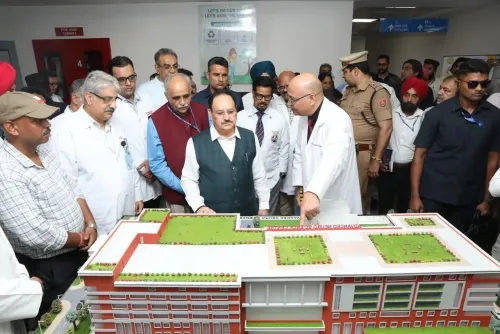
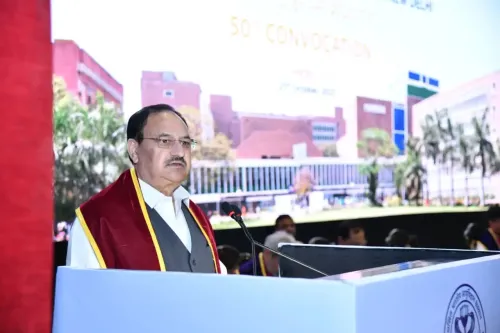
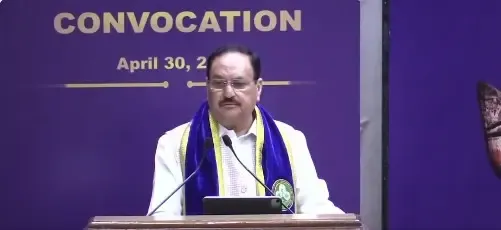
Union Minister for Health and Family Welfare J.P. Nadda on Thursday, 30 April urged 682 graduating doctors at the Post Graduate Institute of Medical Education and Research (PGIMER), Chandigarh to ensure that the future of medicine remains driven by innovation, guided by humanity, and rooted in compassion. Addressing the institute's 39th convocation, Nadda said that while artificial intelligence and telemedicine are reshaping healthcare, nothing can replace the healing power of human touch and empathy.
Key Highlights from Nadda's Address
Speaking at the convocation where 682 graduates were conferred degrees across multiple medical disciplines and 95 medals were awarded, Nadda struck a clear note on the limits of technology in medicine. "Technology will shape the future of medicine, but compassion must remain the soul of healthcare. Artificial intelligence, telemedicine, and precision medicine can advance treatment, yet nothing can replace the healing power of human touch and empathy," he said.
Nadda also reminded the graduating class of the broader social contract underlying medical education. "Medical education is not merely a personal achievement; it is a privilege nurtured by society and supported by the nation. Every young doctor must carry forward this responsibility with humility, compassion, and commitment to give back to society," he said.
India's Medical Education Transformation
The Union Minister highlighted a significant expansion in India's medical education infrastructure over the past decade. He noted that the number of medical colleges has grown from 387 to 820, while undergraduate seats have risen from 51,000 to 1,26,000. The government has set a target to add 75,000 more undergraduate and postgraduate seats over the next five years, of which 28,000 have already been added in the past two years. Postgraduate seats have similarly expanded from 31,000 to 85,000.
Praising PGIMER's role in India's healthcare ecosystem, Nadda said, "The PGIMER continues to strengthen its position as a premier centre of medical education, patient care, and research excellence. With over 850 ongoing extramural research projects and more than 100 intramural projects, the institute reflects a strong culture of innovation, scientific inquiry, and evidence-based medicine."
PGIMER's National Role and Outreach
PGIMER Director Vivek Lal highlighted the institute's achievements and national impact at the ceremony. He noted that PGIMER's telemedicine initiative, inaugurated by the Union Health Minister in 2016, has delivered more than 40 lakh tele-consultations free of cost through the eSanjeevani platform, significantly reducing the travel burden on patients and improving access to specialists across the country.
Director Lal also referenced PGIMER's role during Operation Sindoor, stating that the institute demonstrated national responsibility through the timely deployment of doctors and healthcare professionals. "Medical institutions are not only centres of healing but also pillars of national preparedness," he said.
On the impact of Ayushman Bharat, Lal said nearly ₹650 crore has been utilised for patient care at PGIMER, treating more than 2.5 lakh patients to date. Treatments that cost ₹10–15 lakh elsewhere have been made accessible at a fraction of the cost through the scheme.
Distinguished Attendees
Punjab Governor Gulab Chand Kataria attended the ceremony as chief guest, while Vinod K. Paul, former NITI Aayog member, joined as guest of honour. R.K. Ratho, Dean (Academics), also shared the dais among other dignitaries.
Closing Message to Graduates
Concluding his address, Nadda urged the graduating class to uphold PGIMER's institutional values. "A medical degree is not merely an academic achievement; it is a lifelong responsibility towards humanity. Carry forward the values of compassion, ethics, humility and excellence that institutions like PGIMER have upheld for decades," he said. With India's medical education sector undergoing rapid expansion, the onus now falls on this generation of doctors to translate institutional training into equitable, compassionate care at scale.
Point of View
But quantity and quality are not the same thing — faculty shortages, urban concentration of new colleges, and uneven clinical training standards remain unresolved. The eSanjeevani tele-consultation numbers are impressive, yet rural last-mile connectivity still limits who can actually access them. PGIMER's invocation of Operation Sindoor as proof of institutional readiness is notable: it signals that India's premier medical institutions are increasingly being positioned not just as centres of excellence but as instruments of national security infrastructure — a framing worth watching as defence and health budgets intersect.
NationPress
19 Sept 2026
Frequently Asked Questions
What happened at the PGIMER convocation on 30 April 2025?
The Post Graduate Institute of Medical Education and Research (PGIMER) in Chandigarh held its 39th convocation on 30 April 2025, where 682 graduates received degrees across multiple medical disciplines and 95 medals were awarded. Union Health Minister JP Nadda delivered the convocation address, urging graduates to combine technological advancement with compassion.
What did JP Nadda say about AI and technology in medicine?
Nadda said that while artificial intelligence, telemedicine, and precision medicine can advance treatment, they cannot replace the healing power of human touch and empathy. He emphasised that compassion must remain the soul of healthcare even as technology shapes its future.
How has India expanded its medical education infrastructure?
According to Nadda, India's medical colleges have grown from 387 to 820 over the past decade, undergraduate seats from 51,000 to 1,26,000, and postgraduate seats from 31,000 to 85,000. The government targets 75,000 additional seats in the next five years, with 28,000 already added in the past two years.
What is PGIMER's role in telemedicine and Ayushman Bharat?
PGIMER has delivered over 40 lakh free tele-consultations through the eSanjeevani platform since 2016, and has utilised nearly ₹650 crore under Ayushman Bharat to treat more than 2.5 lakh patients. Treatments costing ₹10–15 lakh elsewhere have been made accessible at a fraction of the cost.
What was PGIMER's role during Operation Sindoor?
According to PGIMER Director Vivek Lal, the institute deployed doctors and healthcare professionals in a timely manner during Operation Sindoor, demonstrating that medical institutions serve not only as centres of healing but also as pillars of national preparedness.