Bihar Congress, RJD protest in Patna over SIR; police fire water cannons
Synopsis
Bihar Congress and RJD took to the streets in Patna on Friday demanding CEC Gyanesh Kumar's resignation over the SIR of electoral rolls — and police responded with water cannons. The protests follow a report alleging that two Election Commissioners raised objections at least 14 times in 10 months over decisions taken without their knowledge, a claim the ECI has denied. The confrontation signals a deepening Opposition offensive against the poll body ahead of future elections.
Key Takeaways
Bihar Congress and RJD staged protests in Patna on 25 September 2026 against CEC Gyanesh Kumar over the Special Intensive Revision (SIR) of electoral rolls.
Police deployed water cannons after protesters attempted to march toward the State Election Commission office from R-Block .
Congress leaders demanded the resignation and arrest of CEC Gyanesh Kumar ; BPCC president Rajesh Ram linked the protest to Rahul Gandhi's queries about voter lists.
A media report alleged Election Commissioners Sukhbir Singh Sandhu and Vivek Joshi raised formal objections at least 14 times over 10 months on SIR-related decisions.
The Election Commission rejected the dissent narrative, asserting all decisions were taken unanimously by all three commissioners.
Protests are part of a broader nationwide Opposition campaign against the ECI's management of electoral rolls.
Bihar Congress and the Rashtriya Janata Dal (RJD) staged separate demonstrations in Patna on Friday, 25 September 2026, against Chief Election Commissioner (CEC) Gyanesh Kumar over the Special Intensive Revision (SIR) of electoral rolls, with police deploying water cannons to stop protesters from marching toward the State Election Commission office. The protests are part of a wider Opposition campaign questioning the Election Commission's handling of voter lists across India.
How the Protest Unfolded
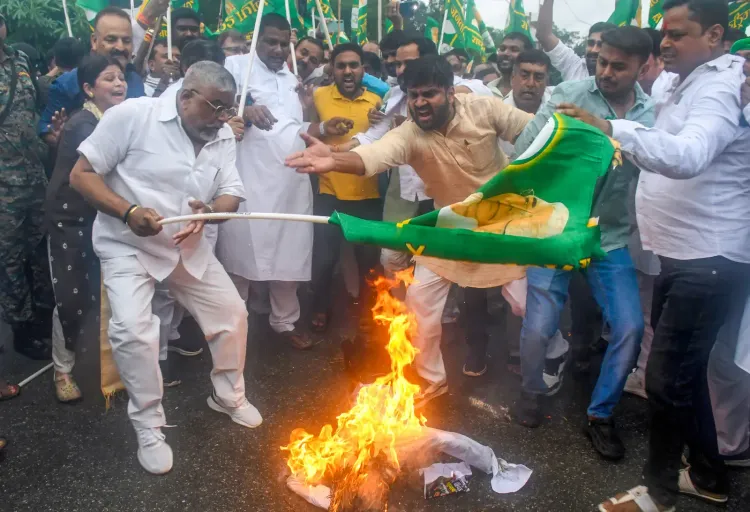
The Congress march began at R-Block and was directed toward the State Election Commission office. A large number of Congress leaders and workers participated, raising slogans against the Election Commission of India (ECI) and demanding the resignation of CEC Gyanesh Kumar. Tension escalated when some protesters climbed barricades while carrying an effigy of the CEC, triggering a stand-off between demonstrators and police personnel. Officers subsequently deployed water cannons to disperse the crowd.
The RJD, a key constituent of the Mahagathbandhan, held a parallel demonstration in Patna, with party leaders and workers raising questions over the ECI's functioning — particularly its management of electoral-roll revision and the SIR process.
What Congress Leaders Said
Bihar Pradesh Congress Committee president Rajesh Ram said the protest was directly linked to concerns being raised by Congress leader Rahul Gandhi about the electoral process and voter lists. Ram alleged that 'governments in Bihar, Haryana, and Maharashtra were formed through vote theft' and accused the Election Commission of not responding to Gandhi's queries. These are the Congress party's political positions and have not been established as facts by the Election Commission or any court.
Purnea MP Rajesh Ranjan, also known as Pappu Yadav, also weighed in, alleging: 'They have committed an injustice against 13 crore people in Bengal, Bihar, and Assam. How can they simply be allowed to get away with it?'
The Internal Dissent Report and Its Context
The protests come amid a recent report by a national English daily newspaper alleging that Election Commissioners Sukhbir Singh Sandhu and Vivek Joshi had formally recorded objections at least 14 times over a period of 10 months regarding decisions and procedures of the poll panel. The reported objections reportedly covered voter registration and deletion, restoration of names, changes to Form 6, new voter additions, electoral-roll data management, and the centralisation of database controls.
Some of the objections reportedly concerned decisions that the two commissioners stated had been taken without their knowledge or approval — a claim the ECI has disputed.
Election Commission's Response
The Election Commission of India has firmly rejected the suggestion that the reported objections indicate a lack of consensus within the three-member panel. According to the Commission, all decisions — including those related to the SIR — had the approval of all three Election Commissioners and were reached unanimously. The ECI stated that highlighting individual internal notes without the full context of the panel's broader decision-making process presents an incomplete picture.
What Comes Next
With Opposition parties intensifying pressure over the SIR and the functioning of the ECI, the controversy is unlikely to subside in the near term. Demands for CEC Gyanesh Kumar's removal continue to grow within the Mahagathbandhan and Congress ranks, setting up a sustained political confrontation ahead of any future electoral exercise in the affected states. How the Election Commission responds to Opposition pressure — and whether it releases further clarifications on the SIR process — will be closely watched.
Point of View
While technically consistent with how final votes are recorded, does not address why formal dissent notes exist in the first place. With state elections on the horizon, a perception of a fractured or partisan Election Commission — regardless of its factual basis — is corrosive to electoral legitimacy. The Commission needs a more robust public disclosure framework, not just rebuttals.
NationPress
25 Sept 2026
Frequently Asked Questions
Why are Bihar Congress and RJD protesting against the Election Commission?
Bihar Congress and RJD are protesting against Chief Election Commissioner Gyanesh Kumar over concerns about the Special Intensive Revision (SIR) of electoral rolls. They allege irregularities in voter list management and are demanding the CEC's resignation, framing the action as part of a broader Opposition campaign led by Rahul Gandhi questioning the ECI's functioning.
What is the Special Intensive Revision (SIR) of electoral rolls?
The Special Intensive Revision (SIR) is a process conducted by the Election Commission of India to review, update, and correct voter registration lists. Opposition parties have alleged that the SIR process has been used to manipulate voter rolls, a charge the Election Commission has denied.
What did the report about Election Commissioners Sandhu and Joshi allege?
A national English daily newspaper reported that Election Commissioners Sukhbir Singh Sandhu and Vivek Joshi formally recorded objections at least 14 times over 10 months regarding ECI decisions and procedures, including on voter registration, deletion, and the SIR process. The Election Commission denied these objections indicated any lack of consensus, maintaining all decisions were taken unanimously.
What was the Election Commission's official response to the protests and dissent reports?
The Election Commission rejected claims of internal discord, stating that all decisions — including those related to the SIR — were approved unanimously by all three commissioners. The ECI argued that selectively highlighting internal notes without context misrepresents its decision-making process.
Who are the key political figures involved in the Bihar protests?
Bihar Pradesh Congress Committee president Rajesh Ram led the Congress protest, linking it to Rahul Gandhi's queries about the electoral process. Purnea MP Rajesh Ranjan, also known as Pappu Yadav, also voiced criticism. The RJD, a Mahagathbandhan ally, held a separate demonstration with its own leaders and workers in Patna.