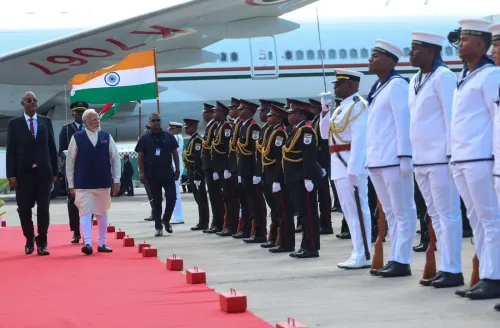
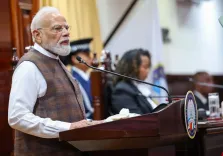
PM Modi, Seychelles President share vision for Indian Ocean security

Synopsis
Prime Minister Narendra Modi and Seychelles President Patrick Herminie have articulated a joint vision for the Indian Ocean, calling it a shared home whose security, sustainability, and prosperity are a collective responsibility — deepening India's Indian Ocean diplomacy.
Key Takeaways
PM Modi and Seychelles President Patrick Herminie jointly declared the Indian Ocean a 'shared home' with shared responsibilities.
The post was written in Seychellois Creole , underscoring India's people-to-people diplomatic outreach.
The shared vision links maritime security with economic prosperity and sustainable use of ocean resources.
The statement aligns with India's longstanding SAGAR (Security and Growth for All in the Region) doctrine.
Seychelles is a key Indian Ocean partner for India, with cooperation spanning defence, blue economy, and connectivity.
The vision is expected to inform engagement at forums such as the Indian Ocean Rim Association (IORA) .
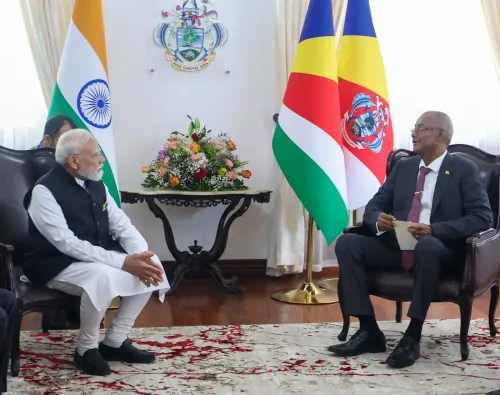
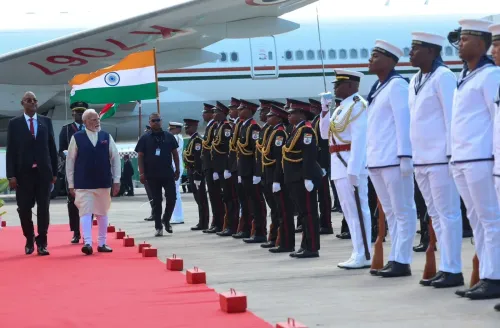
Prime Minister Narendra Modi on Sunday, 28 June 2026 shared a joint vision with Seychelles President Patrick Herminie for the Indian Ocean, affirming that the ocean is a shared home and that its security, sustainability, and prosperity are a shared responsibility.
Context
The post, written in Seychellois Creole (Kreol Seselwa), reflects the depth of engagement between India and Seychelles — a Small Island Developing State in the western Indian Ocean. By communicating directly in the local language, PM Modi signalled a people-to-people connect that goes beyond formal diplomatic exchange. The statement attributed to President Herminie reads: 'The Indian Ocean is our shared home and therefore its security, sustainability and prosperity are our shared responsibility.'
The post outlines a shared vision for an Indian Ocean where maritime security advances alongside economic prosperity, and where partnerships are built on mutual benefit.
Policy Backdrop
India has long regarded the Indian Ocean Region (IOR) as central to its foreign and security policy. PM Modi's SAGAR doctrine — Security and Growth for All in the Region — first articulated in 2015 during a visit to Mauritius, frames India's engagement with Indian Ocean island nations as one of cooperative security and shared development rather than dominance.
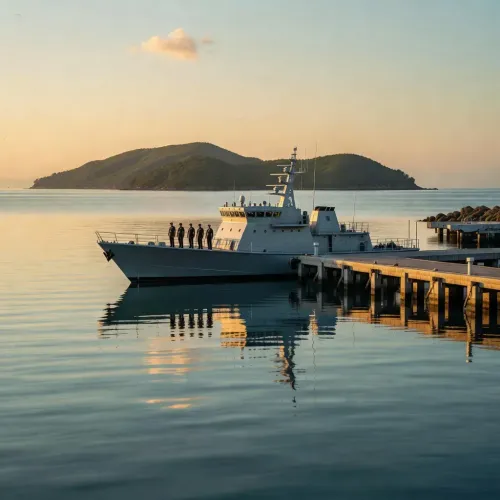
Seychelles, an archipelago of 115 islands with a vast Exclusive Economic Zone (EEZ), is a critical partner in India's maritime neighbourhood. India has historically assisted Seychelles with coast guard training, patrol vessels, and infrastructure, including the development of facilities on Assumption Island. The bilateral relationship covers defence cooperation, blue economy initiatives, and connectivity.
Stakeholders and Impact
The vision articulated jointly by PM Modi and President Herminie has direct implications for Indian Ocean littoral states, particularly Small Island Developing States that depend on maritime routes for trade and on ocean resources for their economies. A stable, rules-based Indian Ocean benefits India's trade lanes — roughly 80 per cent of India's oil imports and a significant share of its merchandise trade transits the ocean.
For Seychelles, deeper partnership with India translates into tangible support for maritime domain awareness, fisheries protection, and climate resilience — all of which are existential concerns for a low-lying island nation. The emphasis on 'sustainability' in the joint framing also points to the blue economy and environmental stewardship as pillars of the partnership.
What's Next
The articulation of this shared vision is expected to provide a guiding framework for bilateral cooperation in the months ahead, potentially feeding into multilateral forums such as the Indian Ocean Rim Association (IORA) and the Colombo Security Conclave. India's active diplomacy across Indian Ocean island states — Maldives, Mauritius, Sri Lanka, and Seychelles — suggests a coordinated effort to consolidate a network of like-minded partners committed to a free, open, and secure Indian Ocean. How this vision translates into concrete agreements and capability-building programmes will be closely watched by regional observers.
Point of View
Communicated in Seychellois Creole, is a deliberate act of diplomatic symbolism — signalling that India's Indian Ocean outreach is as much about cultural proximity as strategic interest. It reinforces the SAGAR framework at a time when competition for influence among Indian Ocean island states has intensified. The emphasis on 'sustainability' alongside security is notable, reflecting a broadening of the partnership beyond traditional defence cooperation into the blue economy and climate resilience. Taken together, this positions India as a partner of choice for small island states seeking a development-oriented security architecture.
NationPress
28 Jun 2026
Frequently Asked Questions
What did PM Modi and Seychelles President Patrick Herminie say about the Indian Ocean?
They jointly declared the Indian Ocean a 'shared home' and stated that its security, sustainability, and prosperity are a shared responsibility of all nations in the region.
What is India's SAGAR doctrine and how does it relate to Seychelles?
SAGAR stands for 'Security and Growth for All in the Region,' a framework PM Modi introduced in 2015 to guide India's cooperative engagement with Indian Ocean island nations, including Seychelles, on security and development.
Why did PM Modi post in Seychellois Creole?
Posting in Seychellois Creole (Kreol Seselwa) was a gesture of people-to-people diplomacy, demonstrating respect for Seychelles' local language and culture beyond formal diplomatic protocol.
What is the significance of India-Seychelles maritime cooperation?
Seychelles holds a vast Exclusive Economic Zone in the Indian Ocean and is a critical partner for India in maritime domain awareness, coast guard capacity, and blue economy initiatives.
Which multilateral forums could be influenced by this India-Seychelles vision?
The shared vision is expected to inform India's engagement at the Indian Ocean Rim Association (IORA) and the Colombo Security Conclave, among other regional platforms.