Dharmendra Pradhan Pays Tribute to Odia Lexicographer Gopal Chandra Praharaj
Synopsis
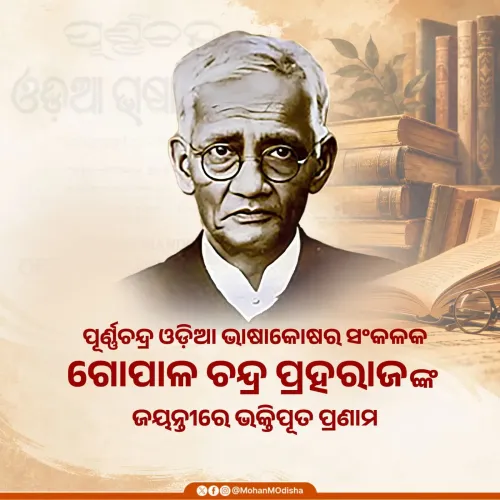
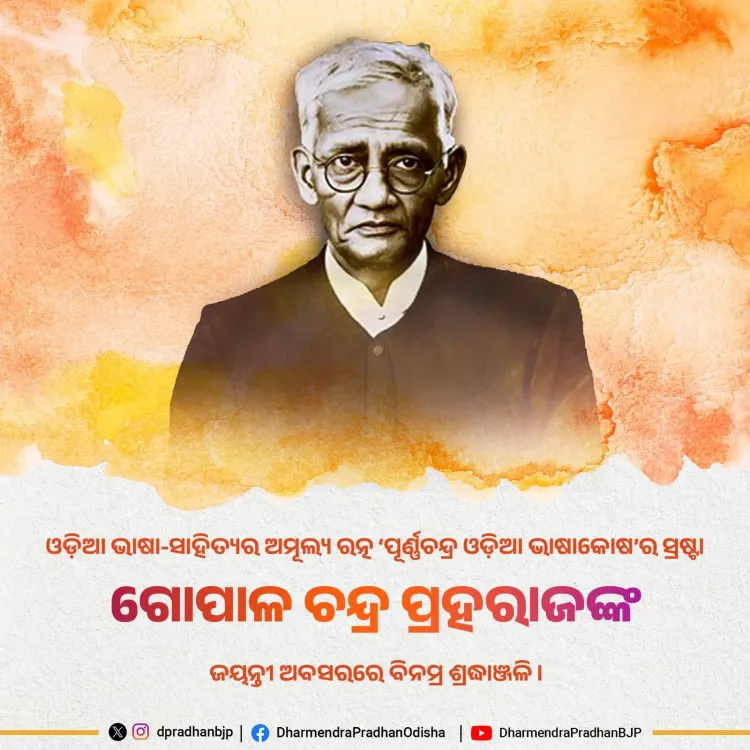
Union Education Minister Dharmendra Pradhan paid tribute to Gopal Chandra Praharaj on his birth anniversary, honouring the compiler of the Purnachandra Odia Bhashakosha — the most comprehensive dictionary of the Odia language — as an invaluable gem of Odia literature.
Key Takeaways
Dharmendra Pradhan offered tribute to Gopal Chandra Praharaj on his birth anniversary on September 27, 2026 .
Praharaj is celebrated as the compiler of the Purnachandra Odia Bhashakosha , a landmark multi-volume Odia dictionary completed in the early 20th century.
Pradhan described Praharaj as an 'invaluable gem of Odia language and literature' in his post on X, written in the Odia language.
The tribute reflects a broader national emphasis on India's linguistic diversity, consistent with the National Education Policy 2020 's promotion of regional languages.
Praharaj's lexicon remains one of the most authoritative references for the Odia literary community.
On the birth anniversary of one of Odia literature's most enduring contributors, Union Education Minister Dharmendra Pradhan offered homage to Gopal Chandra Praharaj — the scholar who gifted the Odia language its most comprehensive dictionary — on Sunday, September 27, 2026.
Posting in Odia on X, the Minister described Praharaj as an 'invaluable gem of Odia language and literature' (ଓଡ଼ିଆ ଭାଷା-ସାହିତ୍ୟର ଅମୂଲ୍ୟ ରତ୍ନ) and paid tribute on the occasion of his birth anniversary, specifically honouring his monumental work, the 'Purnachandra Odia Bhashakosha'.
The Dictionary That Defined a Language
The Purnachandra Odia Bhashakosha is no ordinary reference work. Compiled by Gopal Chandra Praharaj in the early 20th century, this multi-volume lexicon is widely regarded as the most exhaustive and authoritative dictionary of the Odia language ever assembled. It documented the breadth and depth of Odia vocabulary at a time when systematic linguistic scholarship for regional Indian languages was rare — and the effort required was immense. For the Odia literary community, it remains a foundational text, a cornerstone of linguistic identity.
Why an Education Minister's Tribute Carries Weight
Pradhan, a senior BJP leader who represents Odisha and has long championed the state's cultural legacy, choosing to mark this anniversary in the Odia language itself is deliberate. As Education Minister, his tribute arrives within a broader national push to celebrate India's linguistic diversity — a thread that runs through the National Education Policy 2020's strong emphasis on mother-tongue instruction and the promotion of classical and regional languages. Paying respects to a lexicographer is, in this context, also a policy statement: that the roots of a language matter as much as its future.
Tributes of this kind from public figures — especially those holding the education portfolio — serve as cultural anchors, reminding younger generations of the scholars who laboured, often without state support, to preserve and codify what millions speak every day.
Point of View
A state the party has worked hard to consolidate electorally. For an Education Minister, honouring a dictionary-maker is never purely ceremonial: it reinforces the NEP 2020 narrative that India's linguistic roots are policy priorities, not just cultural footnotes. The tribute also quietly positions the Centre as a guardian of Odia heritage at a time when regional identity and pride remain potent political currencies in eastern India.
NationPress
27 Sept 2026
Frequently Asked Questions
Who was Gopal Chandra Praharaj?
Gopal Chandra Praharaj was a pioneering Odia lexicographer best known for compiling the Purnachandra Odia Bhashakosha, the most comprehensive multi-volume dictionary of the Odia language, completed in the early 20th century.
What is the Purnachandra Odia Bhashakosha?
The Purnachandra Odia Bhashakosha is a landmark multi-volume dictionary of the Odia language compiled by Gopal Chandra Praharaj. It is considered the most exhaustive and authoritative reference work for Odia vocabulary and literature.
Why did Dharmendra Pradhan pay tribute to Gopal Chandra Praharaj?
Union Education Minister Dharmendra Pradhan paid tribute on the occasion of Gopal Chandra Praharaj's birth anniversary, honouring his contribution to Odia language and literature through the Purnachandra Odia Bhashakosha.
What did Dharmendra Pradhan post about Gopal Chandra Praharaj?
Pradhan posted in Odia on X, calling Praharaj an 'invaluable gem of Odia language and literature' and offering tribute on his birth anniversary, specifically acknowledging his creation of the Purnachandra Odia Bhashakosha.
What is Dharmendra Pradhan's connection to Odisha?
Dharmendra Pradhan is a senior BJP leader from Odisha who has held multiple Union Cabinet portfolios including Education and Petroleum. He regularly engages with Odia cultural and literary heritage in his public communications.