Pralhad Joshi fires back at Rahul Gandhi's Chicago remarks
Synopsis
Union Minister Pralhad Joshi rebutted Rahul Gandhi's Chicago statements on November 20, contesting claims that Gandhi is barred from universities and that every Indian university has an RSS head, invoking Swami Vivekananda's 1893 Chicago address as a counter-image.
Key Takeaways
Union Minister Pralhad Joshi posted a point-by-point rebuttal of Rahul Gandhi 's remarks made in Chicago on November 20, 2026 .
Joshi disputed Gandhi's claim of being 'not allowed' inside Indian universities, citing Gandhi's own social media videos at Delhi University and JNU .
Joshi countered the claim that 'every' Indian university has an RSS head, noting India has 1,100-plus universities including state, private, and minority institutions.
Joshi invoked Swami Vivekananda 's 1893 Chicago address as a symbolic contrast to Gandhi's remarks.
Joshi argued the constitutional post of Leader of Opposition 'demands responsibility, not reckless propaganda on foreign soil.' The precise details of Gandhi's Chicago statements remain unverified; Congress had not formally responded as of publication.
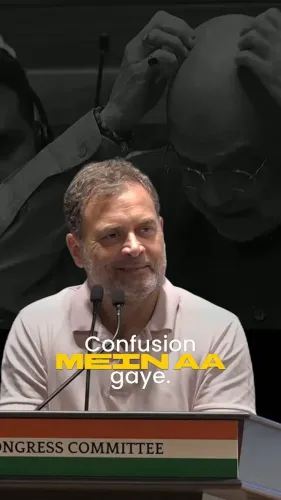
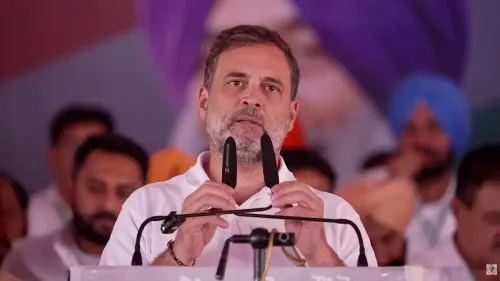
When Swami Vivekananda stood in Chicago in 1893 and addressed the Parliament of the World's Religions, he carried India's name to a global stage with dignity. On Friday, November 20, 2026, Union Consumer Affairs Minister Pralhad Joshi invoked that same city — and that same contrast — to deliver a sharp rebuttal to Congress leader and Leader of Opposition Rahul Gandhi, who made statements in Chicago that Joshi called 'shameless lies against our nation.'
The two claims Joshi zeroed in on
Joshi's post dismantled two specific assertions attributed to Gandhi. The first: that Gandhi is 'not allowed' inside Indian universities. Joshi's counter was blunt — Gandhi's own social media, he said, is 'full of videos' from repeated visits to Delhi University and Jawaharlal Nehru University (JNU), making the claim self-refuting. The second: that 'every' Indian university has a Rashtriya Swayamsevak Sangh (RSS) head. Joshi pushed back with scale — India has 1,100-plus universities, spanning state, private, and minority institutions, led by 'merit-selected academicians, not ideological appointees.'
The numbers matter here. A claim that every single one of over a thousand universities — including institutions run by minority communities and state governments — answers to a single ideological body stretches credibility on its face, and Joshi leaned hard into that arithmetic.
The 'foreign soil' argument — and why BJP keeps using it
The more politically charged line in Joshi's post wasn't the fact-check — it was the framing around geography. 'Holding the constitutional post of Leader of Opposition demands responsibility, not reckless propaganda on foreign soil,' he wrote. This is a recurring BJP playbook: when an opposition figure makes critical remarks about India while abroad, the ruling party frames it not merely as factual error but as a betrayal of national dignity — an act that 'defames' India before a foreign audience.
The tactic has deep roots. Over the past decade, ruling party figures have repeatedly rebutted opposition statements made abroad by pivoting to patriotism — turning a policy dispute into a question of loyalty. The Vivekananda invocation sharpens that contrast deliberately: one Indian went to Chicago and elevated the nation; another, Joshi implies, went and diminished it.
What Gandhi actually said — and what remains unverified
The precise content and full context of Gandhi's Chicago remarks have not been independently verified in detail. What is in the public domain is Joshi's characterisation of them, delivered through an official ministerial social media account. Congress has not issued a formal response as of publication. The exchange is likely to reverberate in the coming days — particularly in Parliament, where the Leader of Opposition's conduct abroad is fair game for discussion during sessions.
What's undeniable is the political architecture of Joshi's post: fact-claim format, nationalist historical reference, constitutional accountability argument, and a closing flourish — 'Facts stand tall and Bharat will never bow to manufactured narratives' — that lands like a campaign line. Sharp, calculated, and aimed squarely at Gandhi's credibility as the country's principal opposition voice.
Point of View
He draws a direct moral contrast that plays well to a nationalist base while also shifting scrutiny onto Gandhi's constitutional role. The 1,100-plus universities figure is the post's sharpest analytical weapon: it makes an absolutist claim ('every' university) collapse under its own weight. How Congress responds — and whether it contests Joshi's characterisation of the Chicago remarks — will determine whether this exchange fades as a social media skirmish or escalates into a parliamentary flashpoint.
NationPress
20 Nov 2026
Frequently Asked Questions
What did Rahul Gandhi say in Chicago that Pralhad Joshi rebutted?
According to Joshi's post, Gandhi claimed he is 'not allowed' inside Indian universities and that 'every' Indian university is headed by an RSS appointee. The precise details and full context of Gandhi's Chicago statements have not been independently verified.
How did Pralhad Joshi counter the claim that Rahul Gandhi is barred from universities?
Joshi said Gandhi's own social media accounts contain videos of his repeated visits to Delhi University and JNU, arguing this directly contradicts the claim.
How many universities does India have?
Joshi cited over 1,100 universities in India, including state-run, private, and minority institutions — a figure he used to challenge the claim that every Indian university is headed by an RSS appointee.
Why did Joshi mention Swami Vivekananda's 1893 Chicago speech?
Joshi invoked Vivekananda's address at the 1893 Parliament of the World's Religions in Chicago as a symbol of India earning global respect abroad — drawing a deliberate contrast with what he characterised as Gandhi's damaging remarks in the same city.
What is Rahul Gandhi's constitutional role and why did Joshi invoke it?
Rahul Gandhi is the Leader of Opposition in the Lok Sabha — a formal constitutional post. Joshi argued this position carries a responsibility to avoid making what he called 'reckless propaganda on foreign soil' that could damage India's international image.