Rahul Gandhi Pays Tribute to Kargil War Martyrs on Vijay Diwas
Synopsis
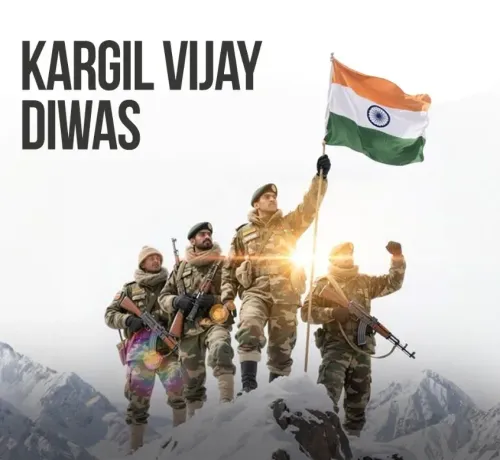
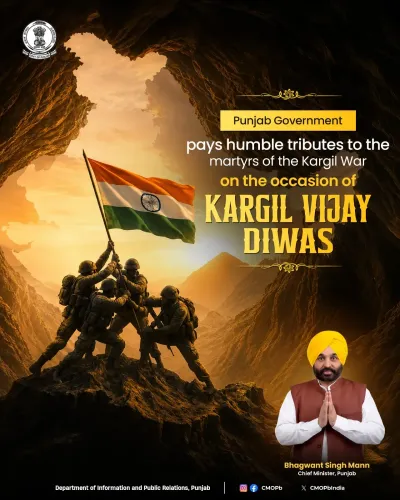
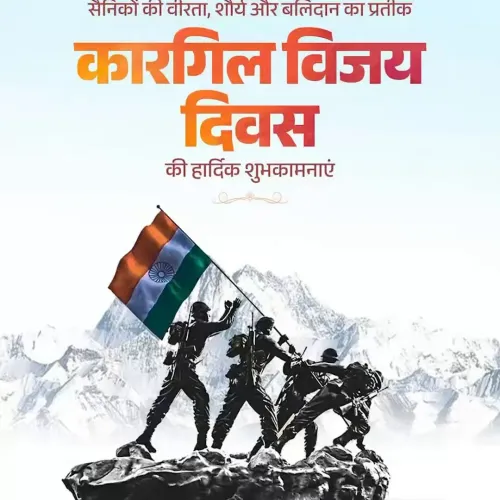
Congress leader Rahul Gandhi marked Kargil Vijay Diwas on 26 July 2026 with a tribute to soldiers who gave their lives defending India's borders in the 1999 conflict, saying the nation will always remain indebted to their courage and sacrifice.
Key Takeaways
Rahul Gandhi posted a tribute on 26 July 2026 to mark Kargil Vijay Diwas .
The post honoured all soldiers who made the 'supreme sacrifice' defending India's borders during the 1999 Kargil War .
Kargil Vijay Diwas is observed annually on 26 July , the day Indian forces completed the recapture of occupied positions in 1999 .
Gandhi stated that 'the nation will always remain indebted' to the courage and valour of the fallen soldiers.
Cross-party tributes on this date form a consistent pattern in Indian political life, reflecting broad consensus on honouring military sacrifice.
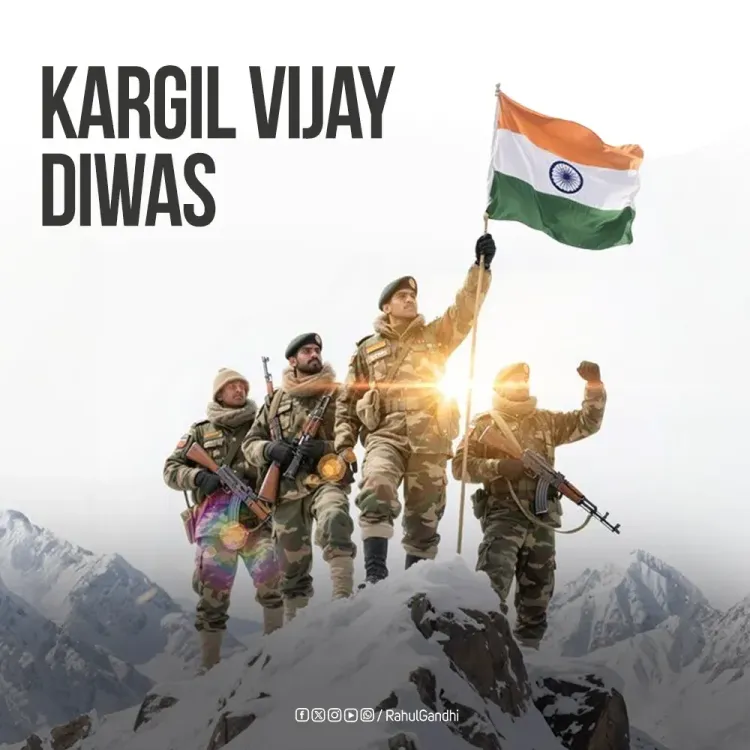
Congress leader Rahul Gandhi, Leader of the Opposition in the Lok Sabha, on Sunday, 26 July 2026, offered his tribute to soldiers who laid down their lives defending India's borders, marking Kargil Vijay Diwas with a post on X.
In his message, Gandhi wrote: 'भारत की सीमा की रक्षा करते हुए अपना सर्वोच्च बलिदान देने वाले सभी वीर जवानों को कारगिल विजय दिवस पर विनम्र श्रद्धांजलि।' — translated as: 'Humble tribute on Kargil Vijay Diwas to all brave soldiers who made the supreme sacrifice while defending India's borders.' He added: 'The nation will always remain indebted to your courage, valour, and supreme sacrifice.'
Context
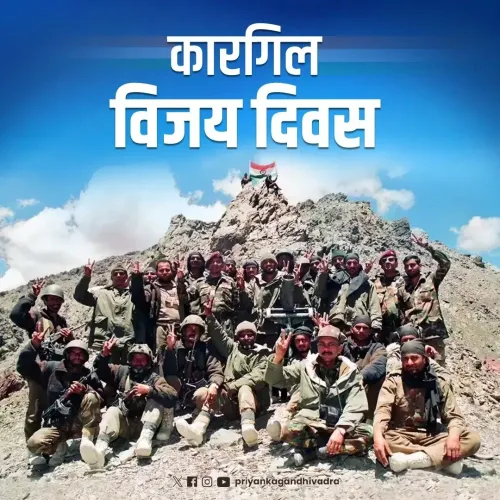
Kargil Vijay Diwas is observed every year on 26 July to mark the day in 1999 when Indian armed forces successfully recaptured strategic heights along the Line of Control in the Kargil sector of Jammu and Kashmir. The conflict, which lasted from May to July 1999, saw Pakistani intruders occupying Indian positions during winter, prompting Operation Vijay — a sustained military campaign to restore territorial integrity.
Hundreds of Indian soldiers lost their lives during the operation. The date has since become a solemn national occasion for remembering those who fell in service of the country.
Policy Backdrop
Tributes on Kargil Vijay Diwas have become a consistent feature of Indian political discourse across party lines. Leaders from the ruling establishment and the opposition alike issue public statements, attend wreath-laying ceremonies, and share messages honouring the armed forces each year on this date.
Gandhi, in his role as Leader of the Opposition in the Lok Sabha and Member of Parliament from Rae Bareli, has regularly participated in such commemorations. The cross-party nature of these tributes reflects a broad political consensus on honouring military sacrifice, particularly in the context of border security.
Stakeholders and Impact
The primary stakeholders of Kargil Vijay Diwas observances are the families of the martyrs who lost their lives in the 1999 conflict, as well as serving personnel of the Indian Armed Forces. For these families, public acknowledgements from national leaders carry symbolic significance, reaffirming that the sacrifices of their kin remain part of the national memory.
Veterans' organisations and defence advocacy groups also track the nature and prominence of tributes offered by political leaders, viewing such statements as indicators of political commitment to the welfare and recognition of military personnel.
What's Next
The Ministry of Defence typically organises official commemorations on 26 July each year, including ceremonies at Dras in Ladakh — the site of some of the fiercest fighting during the 1999 conflict — as well as events at the National War Memorial in New Delhi. Statements from other national party leaders and serving military officials are expected to accompany these formal observances, reinforcing the annual cycle of commemoration that has built up around this date over more than two decades.
Point of View
Gandhi's public acknowledgement carries institutional weight beyond a routine social media post. The consistency of cross-party commemorations on 26 July signals that defence and national sacrifice remain politically unifying themes even amid sharp partisan divides. Over time, the prominence and tone of such tributes have become informal benchmarks by which political leaders are assessed on their relationship with the military establishment and veterans' communities.
NationPress
24 Oct 2026
Frequently Asked Questions
What is Kargil Vijay Diwas and why is it celebrated on 26 July?
Kargil Vijay Diwas is observed on 26 July every year to mark the day in 1999 when Indian armed forces successfully recaptured all positions occupied by Pakistani intruders along the Line of Control in the Kargil sector, concluding Operation Vijay .
What did Rahul Gandhi say on Kargil Vijay Diwas 2026?
Rahul Gandhi offered a 'humble tribute' to all brave soldiers who made the 'supreme sacrifice' defending India's borders, and stated that 'the nation will always remain indebted to your courage, valour, and supreme sacrifice.'
When was the Kargil War fought?
The Kargil War was fought between May and July 1999 in the Kargil district of Jammu and Kashmir , after Pakistani intruders occupied Indian positions during winter. Indian forces launched Operation Vijay to reclaim the territory.
Who is Rahul Gandhi?
Rahul Gandhi is a senior leader of the Indian National Congress , currently serving as Leader of the Opposition in the Lok Sabha and Member of Parliament from Rae Bareli , Uttar Pradesh.
Do all political parties pay tribute on Kargil Vijay Diwas?
Yes, leaders from across the political spectrum — both ruling and opposition parties — issue tributes and attend commemorations on Kargil Vijay Diwas each year, reflecting a broad national consensus on honouring military sacrifice.