Rajasthan CMO backs Modi's 'Virasat Bhi, Vikas Bhi' vision
Synopsis
The Rajasthan Chief Minister's Office on 21 June 2026 invoked PM Modi's 'Virasat Bhi, Vikas Bhi' philosophy, tagging CM Bhajan Lal Sharma under the 'Our Pioneering Rajasthan' hashtag — signalling the state's alignment with the Centre's heritage-linked development agenda.
Key Takeaways
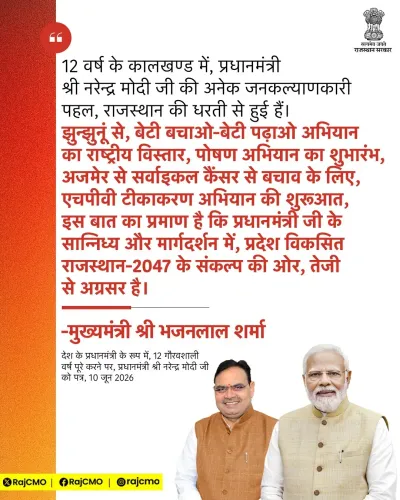
The Chief Minister's Office of Rajasthan posted on 21 June 2026 invoking PM Narendra Modi 's 'Virasat Bhi, Vikas Bhi' ('Heritage too, Development too') guiding philosophy.
CM Bhajan Lal Sharma was tagged in the post, underlining the state government's alignment with the BJP-led Centre's cultural-development framework.
The hashtag #आपणो_अग्रणी_राजस्थान ('Our Pioneering Rajasthan') reflects an ongoing state branding effort positioning Rajasthan as a leader in heritage-linked governance.
The HRIDAY scheme (January 2015) established the policy template of blending heritage conservation with urban civic infrastructure across twelve historic towns in India.
Rajasthan's heritage tourism operators and urban local bodies are the primary stakeholders in schemes that flow from this dual heritage-development mandate.
State budget allocations for 2026-27 and potential MoUs with the Ministry of Tourism will be the next concrete indicators of how this messaging converts to policy.
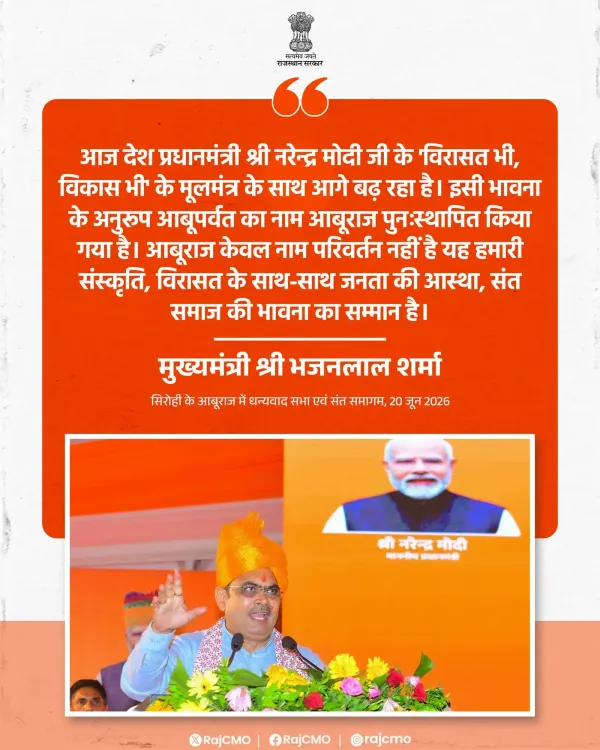
The Chief Minister's Office of Rajasthan on Sunday, 21 June 2026 reaffirmed the state government's alignment with Prime Minister Narendra Modi's guiding philosophy of 'Virasat Bhi, Vikas Bhi' — 'Heritage too, Development too' — tagging Chief Minister Bhajan Lal Sharma in the post under the hashtag #आपणो_अग्रणी_राजस्थान ('Our Pioneering Rajasthan').
Context
The post, shared on the official @RajCMO handle, quotes the Prime Minister's oft-repeated formulation that India must move forward by treating its heritage and its development agenda as complementary, not competing, priorities. The phrase 'Virasat Bhi, Vikas Bhi' has become a signature framing of the BJP-led central government since 2014, appearing regularly in communications from Union ministries and BJP-governed states alike.
By tagging CM Bhajan Lal Sharma — who has led Rajasthan since December 2023 — the CMO signals that the state's governance direction is consciously anchored to this dual mandate at the Centre.
Policy Backdrop
Rajasthan is among India's most heritage-dense states, home to Mughal-era forts, Rajput palaces, and pilgrimage corridors that draw millions of domestic and international tourists annually. The Union government's HRIDAY (Heritage City Development and Augmentation Yojana) scheme, launched in January 2015, had already established a template for channelling central funding into civic infrastructure improvements in twelve historic towns, blending conservation with urban renewal.
Rajasthan's urban local bodies and tourism operators have been among the stakeholders engaging with such central schemes to upgrade heritage precincts while simultaneously expanding road, water, and sanitation infrastructure in and around those sites.
The 'Virasat Bhi, Vikas Bhi' slogan encapsulates this approach — treating forts, temples, and old city quarters not merely as cultural assets to be preserved in isolation, but as economic engines to be developed responsibly alongside modern infrastructure.
Stakeholders and Impact
Heritage tourism operators and artisan communities across Rajasthan stand to benefit most directly when state policy aligns with central heritage-development programmes. Upgraded infrastructure around historic sites improves both visitor experience and local livelihoods, while urban local bodies gain access to central grants tied to conservation-linked development benchmarks.
The hashtag #आपणो_अग्रणी_राजस्थान — 'Our Pioneering Rajasthan' — reflects the state government's broader branding effort to position Rajasthan as a front-runner in implementing the Centre's cultural-development model, particularly ahead of state budget cycles and tourism-sector planning for 2026-27.
What's Next
Observers will watch the Rajasthan state budget allocations for 2026-27 for concrete figures earmarked toward heritage circuits, site restoration, and tourism infrastructure. Any new Memoranda of Understanding between the state and the Ministry of Tourism for specific heritage site development would be a tangible indicator of how this messaging translates into policy action.
As CM Bhajan Lal Sharma's government approaches the mid-point of its term, communications of this kind signal continued ideological alignment with New Delhi — and set the rhetorical stage for announcements that marry Rajasthan's cultural identity with its economic development agenda.
Point of View
Vikas Bhi' is politically deliberate: it allows the Bhajan Lal Sharma administration to claim cultural-nationalist credentials while simultaneously projecting a pro-development image. With Rajasthan's next budget cycle approaching, such messaging typically precedes concrete announcements on heritage circuits or tourism infrastructure. The 'Our Pioneering Rajasthan' branding suggests the state is positioning itself as a model BJP-governed state heading into the second half of its term.
NationPress
21 Jun 2026
Frequently Asked Questions
What does 'Virasat Bhi, Vikas Bhi' mean?
'Virasat Bhi, Vikas Bhi' is a Hindi phrase meaning 'Heritage too, Development too.' It is a guiding philosophy associated with Prime Minister Narendra Modi that frames India's cultural heritage and modern infrastructure development as complementary rather than competing priorities.
Who is the Chief Minister of Rajasthan in 2026?
Bhajan Lal Sharma of the BJP has been the Chief Minister of Rajasthan since December 2023 . He was tagged by the official Rajasthan CMO handle in the 21 June 2026 post.
What is the HRIDAY scheme and how does it relate to Rajasthan?
The HRIDAY (Heritage City Development and Augmentation Yojana) scheme was launched by the Union government in January 2015 to fund heritage conservation alongside civic infrastructure upgrades in twelve historic Indian towns. Rajasthan, with its many heritage cities, is a key beneficiary of such centrally sponsored heritage-development programmes.
What is the significance of the hashtag Aapno Agrani Rajasthan?
#आपणो_अग्रणी_राजस्थान translates to 'Our Pioneering Rajasthan' in English. It is an official branding hashtag used by the Rajasthan state government to position the state as a front-runner in development and governance under the BJP administration.
What should we watch for next from the Rajasthan government on heritage development?
Key indicators to watch include Rajasthan's state budget allocations for 2026-27 for heritage circuits and tourism infrastructure, as well as any new Memoranda of Understanding signed between the state and the Union Ministry of Tourism for specific site development projects.