Rajasthan CMO flags infiltration-driven demographic shifts, vows stronger border mechanism
Synopsis
The Chief Minister's Office of Rajasthan, tagging CM Bhajanlal Sharma, declared on 12 November 2026 that infiltration is causing demographic change in border areas and that a strong mechanism is being built to make India infiltration-free — signalling a fresh push on frontier security.
Key Takeaways
The Rajasthan CMO posted on 12 November 2026 that infiltration is driving demographic change in the state's border areas.
CM Bhajanlal Sharma (BJP, in office since December 2023 ) was directly tagged, indicating the statement carries his authority.
The government says a 'strong mechanism' is under construction to make India infiltration-free — no specific scheme or timeline was named.
Rajasthan shares one of India's longest international borders with Pakistan ; border fencing and surveillance have been periodically upgraded since the 1990s .
The statement aligns with BJP's broader national pattern of linking cross-border movement to demographic shifts and internal security priorities.
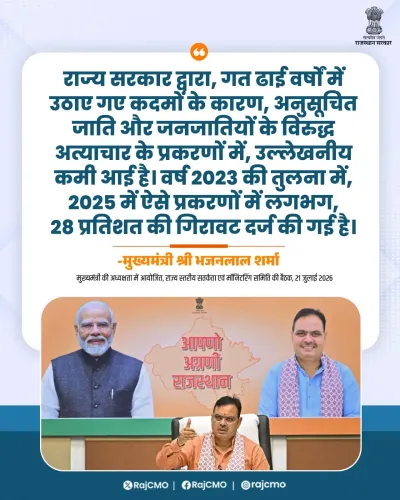
The post was tagged under #आपणो_अग्रणी_राजस्थान , framing border security as part of the state's governance-achievement narrative.
Demographic change along Rajasthan's frontier districts — driven by cross-border infiltration — is now squarely on the state government's radar, and Chief Minister Bhajanlal Sharma's office says a 'strong mechanism' is being built to make the country infiltration-free. The Chief Minister's Office of Rajasthan posted this on X on Thursday, 12 November 2026, tagging CM Bhajanlal Sharma directly under the campaign hashtag #आपणो_अग्रणी_राजस्थान ('Our Pioneering Rajasthan').
What the CMO said — and what it signals
The post, written in Hindi, states: 'घुसपैठ की वजह से, सीमांत क्षेत्रों में जनसांख्यिकीय परिवर्तन हो रहा है' — 'Due to infiltration, demographic change is occurring in border areas.' It goes on to say that a 'robust mechanism' is being constructed to rid the country of infiltration. No specific scheme name, timeline, or demographic statistics were cited in the post itself.
The statement is pointed. By framing the problem as demographic — not merely criminal or tactical — the government is signalling that it views unchecked cross-border movement as a long-term structural threat to frontier communities, not just a law-and-order episode.
Rajasthan's long border and the security architecture behind it
Rajasthan shares one of India's longest international frontiers with Pakistan — a stretch where border fencing and surveillance have been periodically upgraded since the 1990s, with major phases of reinforcement carried out through the 2000s and 2010s. The Border Security Force (BSF) and state police jointly manage security in these sectors, and coordination between the two has historically been a pressure point in any push to tighten border control.
Frontier districts in this belt — sparsely populated, remote, and logistically challenging — have long been flagged by both state and central agencies as vulnerable corridors. Any new 'mechanism' would likely involve a combination of improved physical fencing, sensor-based surveillance, and closer civil-military coordination, though the government has not yet spelled out specifics.
BJP's broader political framing on border demography
The CMO's language fits a well-established pattern among BJP-governed states: linking illegal cross-border movement to demographic shifts in frontier districts, and aligning that messaging with central government priorities on internal security and citizenship verification. CM Bhajanlal Sharma, who took office in December 2023, has consistently positioned his administration as aligned with the Union government's national security posture.
The hashtag #आपणो_अग्रणी_राजस्थान — part of an ongoing state branding campaign — adds a governance-achievement framing to what is, at its core, a security statement. Pairing a border-security message with a 'pioneering Rajasthan' tag is a deliberate signal: that security infrastructure is being presented as a development deliverable, not just a defence imperative.
Watch for follow-up announcements from either the Rajasthan Home Department or the Union Ministry of Home Affairs on specific surveillance systems, fencing contracts, or inter-agency coordination frameworks for border districts — those will be the concrete test of the 'strong mechanism' promised here.
Point of View
The government frames the problem as one with long-term civilisational stakes, raising the political stakes of any delayed action. The vagueness around the 'strong mechanism' leaves the government maximum flexibility to either announce a flagship scheme or absorb credit for existing central programmes. With the Union Ministry of Home Affairs having its own border infrastructure roadmap, the real question is whether Rajasthan secures dedicated funding or simply re-brands ongoing BSF operations — that distinction will determine whether this post is policy or positioning.
NationPress
12 Nov 2026
Frequently Asked Questions
What did the Rajasthan CMO say about infiltration?
On 12 November 2026 , the Rajasthan CMO posted that infiltration is causing demographic change in border areas and that a strong mechanism is being built to make India infiltration-free, tagging CM Bhajanlal Sharma directly.
Which border is Rajasthan concerned about?
Rajasthan shares a long international border with Pakistan , and cross-border infiltration along this frontier has been a recurring security concern for both state and central agencies for decades.
What is the 'strong mechanism' the Rajasthan government is building?
The CMO's post did not name a specific scheme or mechanism; it stated only that a robust system is 'being built.' Likely elements, based on the region's history, include improved fencing, surveillance technology, and state-BSF coordination — but no official details have been announced.
Who is Bhajanlal Sharma and what is his role?
Bhajanlal Sharma is the Chief Minister of Rajasthan from the Bharatiya Janata Party , in office since December 2023 . He was directly tagged in the CMO's post on border infiltration.
What is the hashtag #आपणो_अग्रणी_राजस्थान about?
The hashtag translates to 'Our Pioneering Rajasthan' and is part of the state government's ongoing branding campaign that frames governance achievements — including security initiatives — under a single identity for the Bhajanlal Sharma administration.