Rajasthan CM Office Highlights Scooty Yojana for Girl Students
Synopsis
The Chief Minister's Office of Rajasthan highlighted the state's Scooty Yojana on June 6, 2026, reaffirming the BJP government's commitment to distributing scooters to meritorious girl students to support their education and mobility across the state.
Key Takeaways
The Chief Minister's Office of Rajasthan posted on June 6, 2026 , reaffirming the state's Scooty Yojana for girl students.
The scheme distributes scooters to meritorious girl students to support continued education and mobility.
Chief Minister Bhajanlal Sharma was tagged in the post, which used the hashtag #आपणो_अग्रणी_राजस्थान ('Our Pioneering Rajasthan').
The BJP-led Rajasthan government has been in power since December 25, 2023 , following the November 2023 assembly elections.
Rural families and girl students in areas with limited transport access are among the key beneficiaries.
Budget allocations and beneficiary figures for 2026-27 are expected to shed more light on the scheme's current scale.
The Chief Minister's Office of Rajasthan reaffirmed on Saturday, June 6, 2026, that the state government is actively providing scooters to meritorious girl students under the Scooty Yojana, tagging Chief Minister Bhajanlal Sharma in the post under the hashtag #आपणो_अग्रणी_राजस्थान ('Our Pioneering Rajasthan').
Context
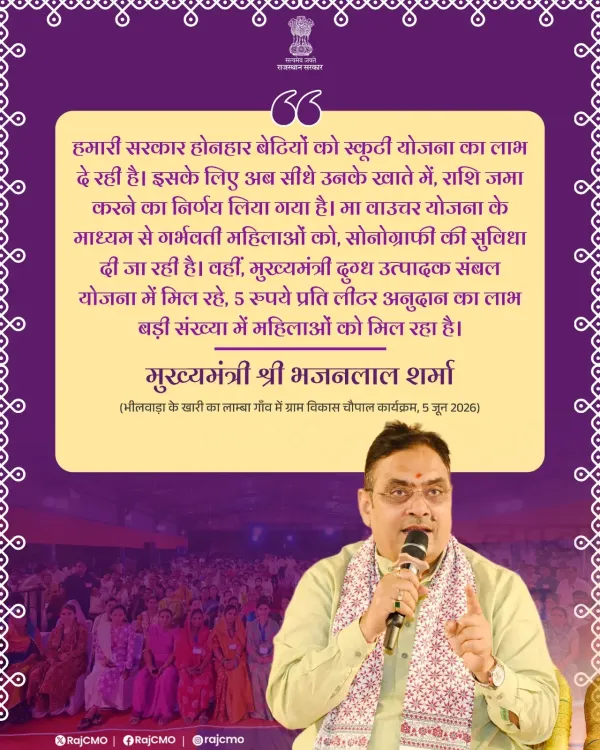
The post, in Hindi, states: 'हमारी सरकार होनहार बेटियों को स्कूटी योजना का लाभ दे रही है' — 'Our government is providing the benefit of the Scooty Yojana to talented daughters.' The message is part of the BJP-led Rajasthan government's ongoing public communication around girl-child welfare schemes, framed under its state-development narrative.
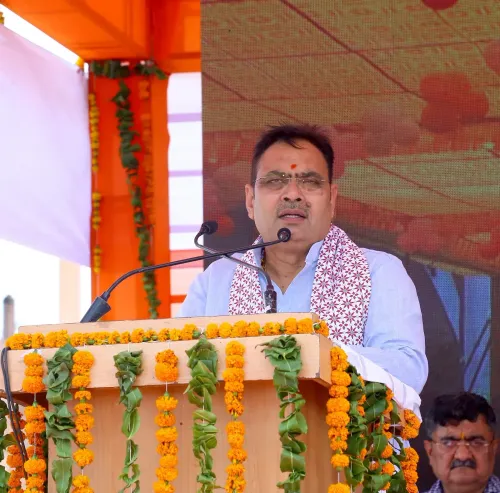
The post is accompanied by an image and is directed at Chief Minister Bhajanlal Sharma, who has led the state since being sworn in on December 25, 2023, following the BJP's victory in the November 2023 Rajasthan assembly elections.
Policy Backdrop
The Scooty Yojana is a Rajasthan state welfare scheme that distributes scooters to girl students who demonstrate academic merit, with the stated aim of supporting continued education and improving mobility — particularly for students in rural and semi-urban areas where transport access is limited.
Across India, state governments have long operated targeted asset-transfer programmes to improve female participation in secondary and higher education. Rajasthan has maintained multiple girl-child incentive schemes across successive administrations, and the current BJP government has continued and publicly highlighted such programmes as part of its governance agenda.
Stakeholders and Impact
The primary beneficiaries of the Scooty Yojana are meritorious girl students, with rural families among the most directly affected. For households in villages and small towns, a scooter can be a critical enabler — reducing dependence on irregular public transport and allowing young women to attend colleges and coaching centres that would otherwise be inaccessible.
Advocates of such schemes argue that asset-transfer programmes address a structural barrier: the last-mile connectivity gap that disproportionately causes girls to drop out after Class 10 or Class 12. The scheme, by linking the benefit to academic performance, also creates an incentive for continued study.
What's Next
Attention will now turn to the 2026-27 Rajasthan state budget and any official announcements on the scheme's allocations, beneficiary targets, or eligibility criteria. The government's decision to publicly amplify the Scooty Yojana at this point in the year signals that further announcements — on beneficiary lists or distribution drives — may follow in the coming weeks.
As Rajasthan continues to position itself as a leader in girl-child welfare under the current administration, the Scooty Yojana will remain a visible benchmark for how the state's education-linked incentive programmes are received on the ground.
Point of View
The post ties the scheme's continuity to his leadership, reinforcing the BJP's positioning on women's empowerment ahead of any future electoral cycle. The framing under 'Our Pioneering Rajasthan' suggests a deliberate branding effort to associate the current administration with development outcomes. Whether the renewed visibility translates into expanded allocations or new beneficiary cohorts will be the real test of intent.
NationPress
21 Oct 2026
Frequently Asked Questions
What is the Rajasthan Scooty Yojana?
The Rajasthan Scooty Yojana is a state government welfare scheme that distributes scooters to meritorious girl students to support their continued education and improve mobility, particularly in rural areas.
Who is eligible for the Scooty Yojana in Rajasthan?
The scheme targets meritorious girl students; however, exact eligibility criteria and beneficiary counts for the current cycle have not been officially confirmed in the June 2026 post.
Who is the Chief Minister of Rajasthan in 2026?
Bhajanlal Sharma of the BJP is the Chief Minister of Rajasthan, having been sworn in on December 25, 2023 after the party's victory in the November 2023 assembly elections.
What is the purpose of scooter schemes for girl students in India?
Scooter schemes aim to address the last-mile transport gap that often causes girls to discontinue education after Class 10 or 12, by giving them independent mobility to reach colleges and coaching centres.
What does #AapnoAgraniRajasthan mean?
#आपणो_अग्रणी_राजस्थान translates to 'Our Pioneering Rajasthan' — a hashtag used by the Rajasthan government's official accounts to promote the state's development narrative under the current BJP administration.