CM Bhajanlal's Rajasthan Roadways turns profit from losses
Synopsis
The Chief Minister's Office of Rajasthan declared on 27 July 2026 that the Rajasthan State Road Transport Corporation has turned profitable, crediting effective management and transparency under CM Bhajanlal Sharma's BJP government since December 2023.
Key Takeaways
The Rajasthan CMO announced on 27 July 2026 that RSRTC has moved from losses to profit.
The turnaround is attributed to 'effective management and transparent working methods' of the BJP state government .
The announcement was tagged to CM Bhajanlal Sharma under the hashtag #आपणो_अग्रणी_राजस्थान .
RSRTC has historically depended on government subsidies due to sustained operational deficits.
Formal verification of the profit claim awaits RSRTC's audited annual accounts in the state assembly.
Beneficiaries include bus commuters , RSRTC employees , and Rajasthan taxpayers .
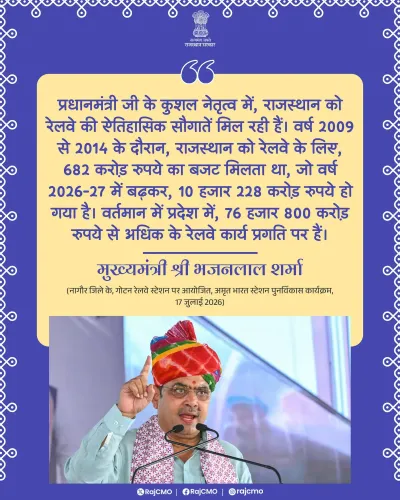
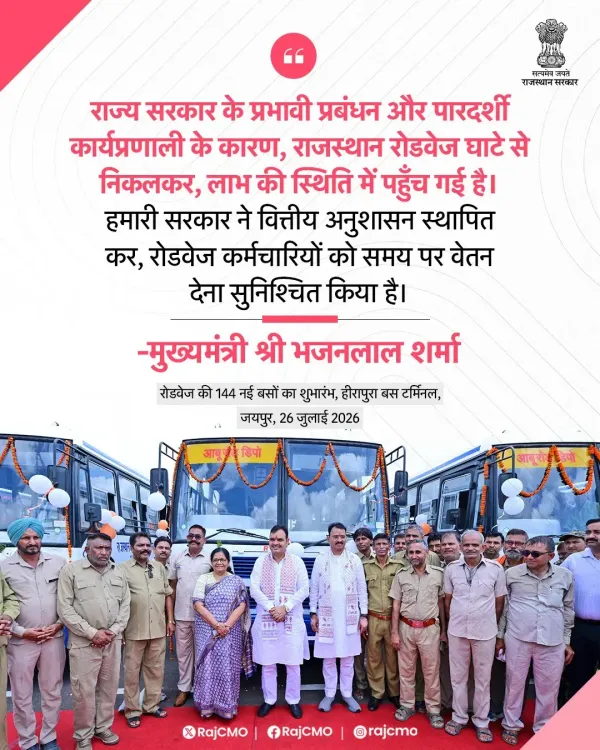
The Chief Minister's Office of Rajasthan announced on Monday, 27 July 2026 that the Rajasthan State Road Transport Corporation (RSRTC) has moved out of losses and into a profit-making position, attributing the turnaround to effective management and transparent functioning under the state government led by Chief Minister Bhajanlal Sharma.
Context
The CMO post, tagged to @BhajanlalBjp and carrying the hashtag #आपणो_अग्रणी_राजस्थान ('Our Pioneering Rajasthan'), states: 'राज्य सरकार के प्रभावी प्रबंधन और पारदर्शी कार्यप्रणाली के कारण, राजस्थान रोडवेज घाटे से निकलकर, लाभ की स्थिति में पहुँच गई है' — meaning, 'Due to the state government's effective management and transparent working methods, Rajasthan Roadways has emerged from losses and reached a position of profit.'
The RSRTC has historically operated under persistent financial strain, relying on government subsidies to sustain fleet operations and employee salaries. A shift to profitability, if confirmed by formal accounts, would mark a significant inflection point for the corporation.
Policy Backdrop
When the BJP government came to power in Rajasthan in December 2023 after winning the state assembly elections, revival of loss-making public sector undertakings — with RSRTC prominently among them — was identified as a fiscal reform priority. The administration framed administrative transparency and operational efficiency as twin levers for turning around state-owned enterprises.
Across several BJP-governed states, similar turnaround narratives in road transport corporations have been backed by measures such as route rationalisation, digital ticketing systems and tighter checks on revenue leakages. The Rajasthan government's claim fits this broader pattern of governance-driven PSU reform.
Stakeholders and Impact
Bus commuters across Rajasthan stand to benefit most directly: a financially stable RSRTC is better placed to expand its fleet, maintain schedules on rural and semi-urban routes, and avoid fare hikes driven by deficit pressures. RSRTC employees, who have in the past faced salary delays during lean periods, would also gain from improved organisational finances.
State taxpayers have a direct stake as well, since subsidy outflows to RSRTC have historically been a recurring line item in Rajasthan's budget. A genuinely profitable corporation could reduce the fiscal burden on the state exchequer.
What's Next
The key test of this turnaround claim will come when RSRTC's annual accounts are tabled in the Rajasthan state assembly and when related expenditure and revenue figures appear in the next state budget. Independent audited financials will determine whether the profit position is structural or a one-time improvement.
Political observers will also watch whether the government follows this announcement with a detailed policy statement or white paper on RSRTC's reform roadmap — a step that would lend institutional weight to what is, at present, a government communication on a social media platform.
Point of View
Arriving roughly two and a half years into its first term — a timeline that suits the political narrative ahead of eventual mid-term assessments. The claim aligns with a well-established BJP template of highlighting PSU revivals as proof of administrative competence, deployed in multiple states. However, until audited accounts corroborate the profit figure, the announcement remains a political communication rather than a verified financial milestone. The real test will be whether this translates into visible service improvements for commuters on rural and semi-urban routes, where RSRTC's social mandate is most consequential.
NationPress
25 Oct 2026
Frequently Asked Questions
Has Rajasthan Roadways really turned profitable?
The Chief Minister's Office of Rajasthan stated on 27 July 2026 that RSRTC has moved from a loss-making to a profit-making position, but the claim is yet to be verified by audited annual accounts.
Why was Rajasthan Roadways in losses?
RSRTC historically faced operational deficits due to high maintenance costs, unviable routes, wage burdens, and revenue leakages, requiring recurring government subsidies to stay functional.
What did CM Bhajanlal Sharma's government do to revive RSRTC?
The BJP government, which took office in December 2023, identified RSRTC revival as a fiscal reform priority and has cited effective management and transparent operations as drivers of the turnaround, though specific measures have not been detailed in the announcement.
Who benefits from RSRTC turning profitable?
Bus commuters across Rajasthan, RSRTC employees who previously faced salary delays, and state taxpayers who fund government subsidies to the corporation all stand to benefit from a financially stable RSRTC.
When will RSRTC's profit be officially confirmed?
The turnaround will be formally verified when RSRTC's audited annual accounts are presented in the Rajasthan state assembly or reflected in the next state budget.