Rajasthan CM touts 4x startup funding surge under Bhajanlal govt

Synopsis
The Chief Minister's Office of Rajasthan says startup investment in the state has surged from ₹250 crore in 2023 to ₹1,054 crore, while startup-linked employment has more than doubled to over 49,000 jobs, crediting CM Bhajan Lal Sharma's entrepreneurship push.
Key Takeaways
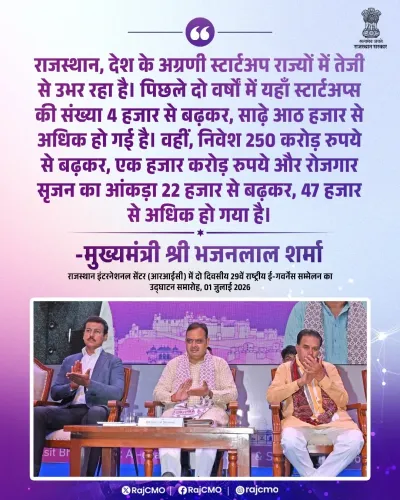
Rajasthan startup investment has grown from ₹250 crore (2023) to ₹1,054 crore , a more than fourfold increase.
Startup-linked employment in the state has risen from 22,000 to over 49,000 jobs , more than doubling.
Chief Minister Bhajan Lal Sharma has made entrepreneurship and tech-sector expansion a stated priority since taking office in December 2023 .
Rajasthan's strategy builds on the central government's Startup India programme launched in 2016, adapted into state-level incentives.
The state is competing with established hubs by targeting sectors such as agritech, edtech, and green energy.
From ₹250 crore to ₹1,054 crore — Rajasthan's startup investment story has quadrupled in under three years, and the state's Chief Minister's Office is making sure everyone knows it. On 14 August 2026, the official CMO account of the Government of Rajasthan posted a striking set of numbers crediting Chief Minister Bhajan Lal Sharma with a dramatic acceleration in the state's entrepreneurial economy.
The numbers: startup funding and jobs both surge
The post states that startup investment in Rajasthan, which stood at roughly ₹250 crore in 2023, has now climbed to ₹1,054 crore — a more than fourfold jump. Employment generated through startups has moved in parallel, rising from 22,000 jobs to over 49,000, more than doubling the number of people drawing livelihoods from the ecosystem. The hashtag #आपणो_अग्रणी_राजस्थान — meaning 'Our Leading Rajasthan' — frames the data as proof of a state on the move.
Bhajan Lal's entrepreneurship push since December 2023
Bhajan Lal Sharma took charge as Chief Minister in December 2023 after the BJP's victory in the state assembly elections, inheriting an economy historically anchored in agriculture, tourism, and mining. Expanding into technology and knowledge sectors was an explicit priority from the outset. The state's approach builds on the central government's Startup India framework — launched in 2016 — which offers tax relief, regulatory easing, and funding pathways that states can adapt into local policies. Rajasthan has used that architecture to position itself as a competitive destination for venture capital alongside more established startup hubs.
Rajasthan enters India's inter-state startup race
The figures land in the middle of a fierce competition among Indian states to attract founders, incubators, and investors. Since the mid-2010s, states across the country have rolled out dedicated startup policies, government-backed funds, and investor summits to pull talent away from the traditional gravity of Bengaluru and Mumbai. Rajasthan's pitch — cheaper real estate, proximity to Delhi's capital networks, and a large youth population — makes it a credible contender in sectors like agritech, edtech, and green energy. Doubling the jobs count to nearly 50,000 in roughly two years, if sustained, would represent a meaningful structural shift in where young Rajasthanis find skilled work.
The next test will come with the state's economic survey and any follow-up announcements on fund disbursement or new incubation centres — moments that will reveal whether the investment numbers translate into durable infrastructure or remain a headline figure.
Point of View
Startup numbers serve a dual purpose: they signal economic modernisation to investors and urban youth while countering any perception that Rajasthan remains a laggard in India's knowledge economy race. The fourfold investment jump, if independently verified, would mark a genuine inflection point; without third-party confirmation, the figures remain the government's own account of its record. Either way, the post signals that entrepreneurship metrics are now a core pillar of the BJP's Rajasthan narrative heading into future electoral cycles.
NationPress
28 Sept 2026
Frequently Asked Questions
How much has startup investment grown in Rajasthan?
According to the Rajasthan Chief Minister's Office, startup investment in the state has grown from approximately ₹250 crore in 2023 to ₹1,054 crore — a more than fourfold increase.
How many jobs have startups created in Rajasthan?
The CMO's post states that startup-linked employment in Rajasthan has risen from 22,000 to over 49,000 jobs, more than doubling in the period under review.
What is Bhajan Lal Sharma's role in Rajasthan's startup growth?
Bhajan Lal Sharma has served as Chief Minister of Rajasthan since December 2023 and has made expanding the state's technology and entrepreneurship sectors a stated policy priority.
What is the Startup India programme and how does Rajasthan use it?
Startup India is a central government initiative launched in 2016 that provides tax benefits, regulatory easing, and funding support. Rajasthan has adapted this framework into local policies to attract investors and founders.
What does #AapnoAgraniRajasthan mean?
The hashtag #आपणो_अग्रणी_राजस्थान translates from Rajasthani/Hindi as 'Our Leading Rajasthan' and is used by the state government to brand its development and progress messaging.