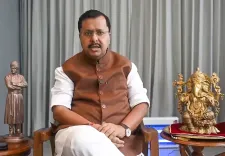
Rajnath Singh: Op Sindoor ends era of diplomatic statements on terror

Synopsis
Rajnath Singh used the National Security Summit to formally frame Operation Sindoor as a doctrinal turning point — India, he argued, has permanently exited the era of diplomatic protests and entered one of calibrated, precision-led military responses. The 'IT' jibe at Pakistan was pointed, but the operational detail about surge capacity and self-determined halt conditions was the real signal.
Key Takeaways
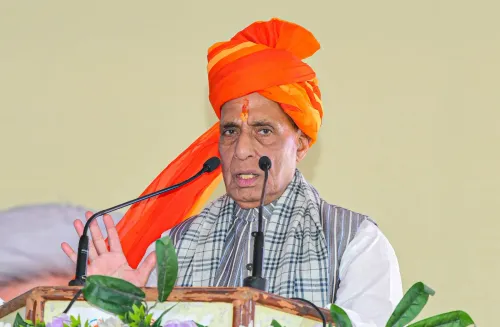
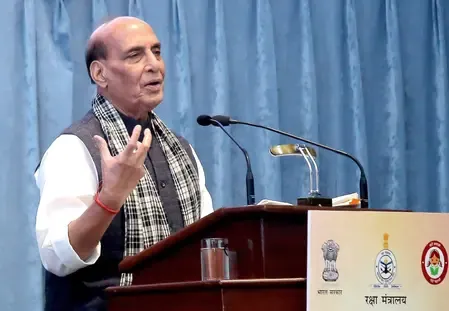
Defence Minister Rajnath Singh addressed a National Security Summit in New Delhi on Thursday, 30 April .
Operation Sindoor was described as India's definitive shift from diplomatic statements to decisive military action against terror.
Singh confirmed India halted the operation entirely on its own terms — not due to any exhaustion of military capability.
The Indian Army , Indian Navy , and Indian Air Force operated under a unified plan, marking a new era of joint military integration.
Singh contrasted India's global identity in Information Technology with Pakistan's reputation as the epicentre of International Terrorism .
Defence Minister Rajnath Singh on Thursday declared that Operation Sindoor has sent an unequivocal global message — India will no longer confine itself to issuing diplomatic statements in response to terror attacks on its soil. Addressing a National Security Summit in New Delhi, Singh said the Prime Minister Narendra Modi-led government has moved decisively from intent and rhetoric to concrete military action.
A Shift in India's Counter-Terror Doctrine
Singh described Operation Sindoor, alongside earlier surgical strikes and airstrikes, as a direct manifestation of the government's resolute stance against terrorism. He emphasised that the Modi government has maintained an unambiguous position: no act of terrorism, under any circumstances, will be tolerated.
"The government has moved beyond mere intent and rhetoric by demonstrating its unwavering commitment through decisive action," Singh stated, underlining what he framed as a structural shift in India's national security posture.
India vs Pakistan: The 'IT' Contrast
Taking a pointed dig at Pakistan's continued support to terrorism, Singh drew a sharp contrast between the two nations' trajectories since independence. "Both India and Pakistan attained independence at the same time. However, today India is recognised globally for IT — 'Information Technology', while Pakistan is regarded as the epicentre of a different IT — 'International Terrorism'," he said.
The remark encapsulated India's long-standing position that Pakistan has functioned as a state sponsor of cross-border terrorism, a charge Islamabad has consistently denied.
Joint Forces, Unified Command
Singh termed Operation Sindoor a shining example of jointness and synergy among India's armed forces. He stated that the Indian Army, Indian Navy, and Indian Air Force acted in concert under a unified operational plan, demonstrating that India's military no longer operates in silos.
"India has emerged as a joint, integrated, and global power," he said, adding that the operation was executed on India's own terms, at a time of India's own choosing, and halted strictly on India's own terms.
India's Surge Capacity and Operational Restraint
Singh was explicit that the cessation of Operation Sindoor was not the result of diminished capability. "We did not halt the operation because our capabilities had been exhausted or diminished. We halted it entirely on our own terms. We were fully prepared to sustain a prolonged conflict. We possess the requisite surge capacity and the inherent strength to rapidly scale up our capabilities in moments of sudden crisis," he said.
He further stated that targets were engaged with "absolute precision" — confined only to those responsible for perpetrating attacks against India, signalling a calibrated rather than indiscriminate military posture.
What This Signals Going Forward
Singh's address at the National Security Summit signals that Operation Sindoor is being formally positioned as a doctrinal benchmark — a template for how India will respond to future terror provocations. With the government consolidating the narrative around jointness, precision, and strategic autonomy, the political and military messaging ahead of any future escalation appears to be firmly set.
Point of View
But it also compresses the space for de-escalation in future crises. The 'IT' quip plays well domestically, yet India's own diplomatic tradition has long preferred calibrated ambiguity over public maximalism. The real test of this doctrine will come not in a summit speech, but in the next provocation — and whether the institutional architecture for joint operations can sustain the tempo Singh is projecting.
NationPress
19 Sept 2026
Frequently Asked Questions
What is Operation Sindoor?
Operation Sindoor is an Indian military operation that Defence Minister Rajnath Singh described as a decisive counter-terror action targeting those responsible for attacks on Indian soil. It involved the Indian Army, Navy, and Air Force operating under a unified command, and was cited as a landmark in India's shift from diplomatic responses to direct military action.
What did Rajnath Singh say about Operation Sindoor at the National Security Summit?
Singh said Operation Sindoor conveyed an unequivocal global message that India will no longer merely issue diplomatic statements after terror attacks. He stated the operation was executed and halted entirely on India's own terms, and that India retains full surge capacity for future conflicts.
Why did Rajnath Singh compare India and Pakistan on 'IT'?
Singh used the 'IT' contrast — Information Technology for India versus International Terrorism for Pakistan — to highlight Pakistan's alleged role as a state sponsor of cross-border terrorism. The remark was made in the context of India's long-standing position on Pakistan's support for terror groups.
What does 'jointness' mean in the context of Operation Sindoor?
Singh described jointness as the Indian Army, Indian Navy, and Indian Air Force acting in concert under a single unified operational plan, rather than functioning independently. He called this a conclusive demonstration that India's military has evolved into a joint, integrated, and globally capable force.
Did India stop Operation Sindoor due to military limitations?
No. Singh explicitly stated that India did not halt Operation Sindoor because its capabilities were exhausted or diminished. He said the operation was stopped entirely on India's own terms, and that India was fully prepared to sustain a prolonged conflict if required.