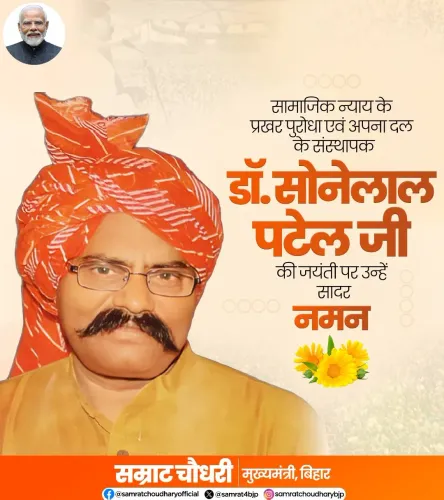
Rajnath Singh pays tribute to Apna Dal founder Dr. Sone Lal Patel
Synopsis
Union Defence Minister Rajnath Singh paid tribute to Apna Dal founder Dr. Sone Lal Patel on his birth anniversary on 2 July 2026, praising his lifelong struggle for social justice and OBC rights in Uttar Pradesh. The gesture underscores the BJP's sustained outreach to caste-based allies in India's most electorally significant state.
Key Takeaways
Rajnath Singh posted a tribute on 2 July 2026 to mark the birth anniversary of Dr.
Sone Lal Patel , founder of Apna Dal .
Sone Lal Patel founded Apna Dal in 1995 to mobilise Kurmi and OBC communities in Uttar Pradesh .
Singh credited Patel with a lifelong struggle for 'social justice, social harmony, and the rights of the deprived and backward classes.' Apna Dal has been a periodic ally of the BJP in Uttar Pradesh since the mid-2010s, making OBC outreach central to the alliance's electoral strategy.
The tribute fits a wider pattern of national parties publicly honouring regional OBC leaders to consolidate backward-class support in Uttar Pradesh .
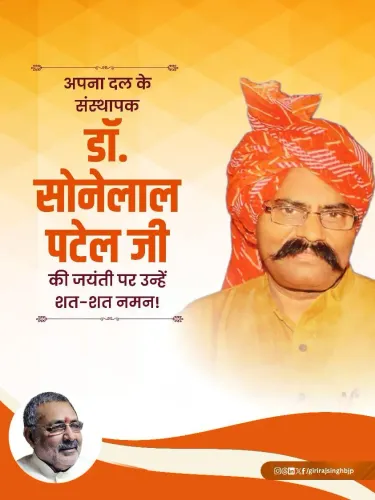
Union Defence Minister Rajnath Singh on Thursday, 2 July 2026, paid tribute to Dr. Sone Lal Patel, founder of the Uttar Pradesh-based party Apna Dal, on the occasion of his birth anniversary, honouring his lifelong work for social justice and the rights of backward and marginalised communities.
Context
Posting on X in Hindi, Rajnath Singh offered what he called a heartfelt tribute — bhavbheeni shraddhanjali — to Dr. Sone Lal Patel. He wrote that Patel 'struggled throughout his life for social justice, social harmony, and the rights of the deprived and backward classes,' and that 'his struggle, his ideas, and his contribution to public life will always be remembered.'
The tribute marks the birth anniversary of one of Uttar Pradesh's most prominent Other Backward Class (OBC) political figures, whose legacy continues to shape caste-based political mobilisation in India's most populous state.
Policy Backdrop
Dr. Sone Lal Patel founded Apna Dal in 1995 with the explicit aim of mobilising Kurmi and other OBC communities in Uttar Pradesh, giving political voice to groups that had long felt underrepresented in the state's dominant party structures. The party focused on securing constitutional rights, reservations, and welfare entitlements for backward classes.
Since the mid-2010s, Apna Dal has periodically aligned with the BJP, making it a significant partner in the broader National Democratic Alliance coalition in Uttar Pradesh. OBC mobilisation in the state has been a decisive factor in electoral outcomes since the 1990s, and smaller caste-based parties such as Apna Dal have played a pivotal role in consolidating that vote share.
Stakeholders and Impact
The tribute carries political weight beyond its ceremonial character. OBC communities, particularly Kurmi voters who form the core constituency of Apna Dal, are a significant electoral bloc in Uttar Pradesh. Public recognition of Dr. Sone Lal Patel's legacy by a senior national leader like Rajnath Singh reinforces the BJP's ongoing effort to sustain goodwill with its caste-based allies in the state.
This gesture fits a broader pattern of competitive outreach to backward classes by both national and regional parties, as each seeks to consolidate OBC support ahead of future electoral contests in Uttar Pradesh.
What's Next
Observers will watch whether this tribute translates into concrete political signals — particularly around seat-sharing arrangements and alliance continuity between the BJP and Apna Dal ahead of the next Uttar Pradesh assembly elections. The durability of such alliances often hinges on sustained symbolic recognition of partner parties' founding figures alongside tangible electoral accommodation.
Point of View
Signalling that the BJP continues to value its partnership with Apna Dal and the OBC constituencies it represents. In Uttar Pradesh, where OBC mobilisation has shaped electoral arithmetic since the 1990s, such public recognition by a senior national leader carries symbolic currency that smaller caste-based allies closely monitor. The timing also reflects a broader competitive dynamic: as multiple national and regional parties court backward-class voters, the BJP is keen to demonstrate that its alliance commitments extend beyond electoral seasons. How Apna Dal's current leadership responds — and whether this goodwill is matched by seat-sharing concessions — will be the real test of the gesture's political depth.
NationPress
30 Sept 2026
Frequently Asked Questions
Who is Dr. Sone Lal Patel?
Dr. Sone Lal Patel was the founder of Apna Dal, a political party he established in 1995 in Uttar Pradesh to advocate for the rights of Kurmi and other Other Backward Class communities.
Why did Rajnath Singh pay tribute to Dr. Sone Lal Patel?
Rajnath Singh paid tribute on 2 July 2026 to mark Dr. Sone Lal Patel's birth anniversary, honouring his lifelong work for social justice and the rights of backward and marginalised communities in Uttar Pradesh.
What is the BJP's relationship with Apna Dal?
Apna Dal has been a periodic electoral ally of the BJP in Uttar Pradesh since the mid-2010s, helping the party consolidate OBC and Kurmi voter support in India's most populous state.
What did Rajnath Singh say about Dr. Sone Lal Patel?
Rajnath Singh said Dr. Sone Lal Patel 'struggled throughout his life for social justice, social harmony, and the rights of the deprived and backward classes,' and that his ideas and contribution to public life 'will always be remembered.'