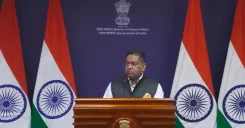
CM Rekha Gupta Hails Navi Pillay's 2026 Nobel Peace Prize
Synopsis
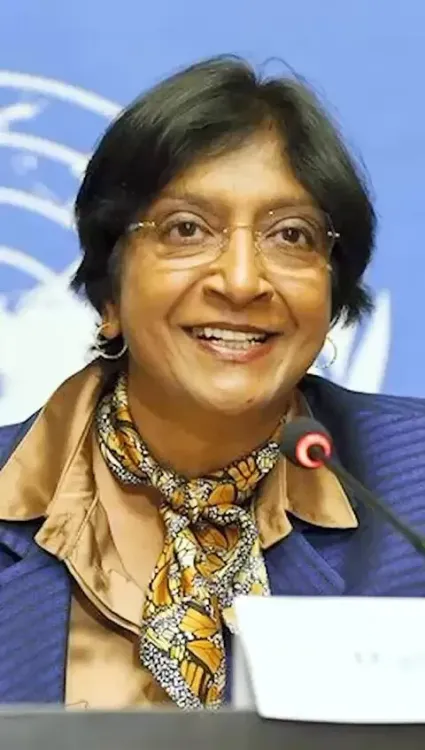
Delhi Chief Minister Rekha Gupta congratulated Indian-origin jurist Navanethem 'Navi' Pillay on winning the 2026 Nobel Peace Prize, praising her lifelong fight against apartheid and defence of human rights as a source of pride for Indians worldwide.
Key Takeaways
Navanethem 'Navi' Pillay has been awarded the 2026 Nobel Peace Prize , announced on 9 October 2026 .
Pillay is of Indian origin , born into South Africa's Indian-heritage community during the apartheid era.
Delhi Chief Minister Rekha Gupta posted a congratulatory tribute on X, calling Pillay's journey 'one of courage and conviction.' Gupta described the award as 'a moment of pride for the global Indian community.' Pillay's career spanned the International Criminal Court and the role of UN High Commissioner for Human Rights .
Her recognition underscores the enduring global influence of the Indian diaspora in international law and human rights.
A daughter of Indian immigrants in apartheid-era South Africa has just been awarded the world's most prestigious peace honour — and Delhi Chief Minister Rekha Gupta wants every Indian to feel that pride. On Friday, 9 October 2026, Gupta took to X to congratulate Navanethem 'Navi' Pillay on being awarded the 2026 Nobel Peace Prize, calling her journey 'one of courage and conviction.'
From Durban to the Nobel stage
Pillay's story begins in the Indian-origin community of South Africa, where she was born into a family with roots tracing back to the Indian subcontinent. She rose through the ranks of international law at a time when apartheid still defined daily life for millions — a system she dedicated herself to dismantling. Her career took her to the highest chambers of global justice, including the International Criminal Court and the office of the United Nations High Commissioner for Human Rights. Gupta's post highlighted the arc of that journey: 'From her Indian roots in South Africa to the highest institutions of international law.' The Chief Minister described Pillay's recognition as 'a moment of pride for the global Indian community and a tribute to the values of equality, compassion and human dignity that transcend borders.'Why this Nobel carries particular weight
Pillay's lifelong body of work spans the dismantling of apartheid, the defence of human rights for the most vulnerable, and the pursuit of accountability through international legal frameworks. She has consistently amplified voices that powerful states have preferred to silence. The Nobel committee's decision to honour her in 2026 lands as a reaffirmation that the architecture of international human-rights law — often under political pressure — still commands global moral authority. For the estimated 30-million-strong global Indian diaspora, her recognition carries a layered significance: it is both a personal triumph and a collective one, a reminder that Indian heritage has shaped some of the most consequential moral battles of the modern era. Gupta's tribute, posted from New Delhi, reflects a broader Indian political consensus that tends to celebrate diaspora achievement across party lines — especially when that achievement is anchored in values of justice and human dignity. The Nobel Peace Prize, awarded each year on 10 October — the anniversary of Alfred Nobel's birth — now carries Pillay's name into history.Point of View
Particularly in international arenas, is routinely claimed as a source of collective national pride across ideological lines. What distinguishes this moment is the specific weight Pillay's Nobel carries — it honours not ceremonial diplomacy but a lifetime of adversarial human-rights work, including against powerful governments. For the BJP-led Delhi administration, extending congratulations aligns with the party's broader 'global Indian' narrative while also signalling respect for international legal institutions. The subtext is significant: in an era when multilateral human-rights mechanisms face growing scepticism, India's political class embracing Pillay's legacy implicitly endorses the values that legacy represents.
NationPress
9 Oct 2026
Frequently Asked Questions
Who is Navi Pillay and why did she win the 2026 Nobel Peace Prize?
Navanethem 'Navi' Pillay is an Indian-origin South African jurist known for her lifelong fight against apartheid, her tenure as a judge on the International Criminal Court, and her role as UN High Commissioner for Human Rights. She was awarded the 2026 Nobel Peace Prize in recognition of her decades-long defence of human rights and pursuit of justice for vulnerable communities.
What did Delhi CM Rekha Gupta say about Navi Pillay's Nobel Prize?
Rekha Gupta posted on X calling Pillay's journey 'one of courage and conviction,' praising her struggle against apartheid and defence of human dignity, and describing the Nobel as 'a moment of pride for the global Indian community.'
What is Navi Pillay's connection to India?
Navi Pillay is of Indian origin — her family roots trace back to the Indian subcontinent, part of the large Indian-heritage community that settled in South Africa generations ago.
When was the 2026 Nobel Peace Prize announced?
The 2026 Nobel Peace Prize was announced on 9 October 2026 , in keeping with the traditional October announcement schedule of the Nobel Committee.
What roles has Navi Pillay held in international law?
Pillay served as a judge and later President of the International Criminal Court, and as the United Nations High Commissioner for Human Rights, making her one of the most senior Indian-origin figures in the history of global legal institutions.