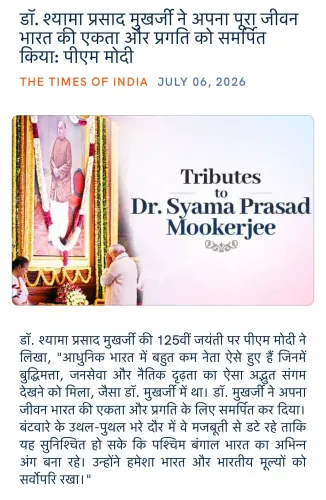
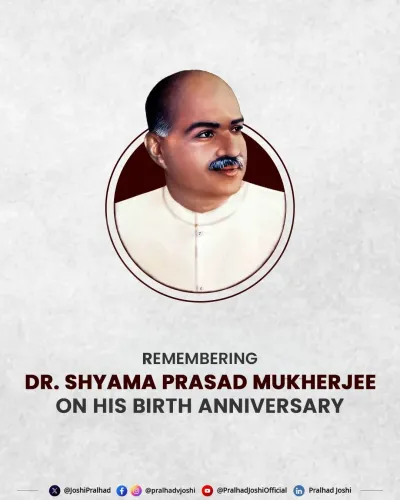
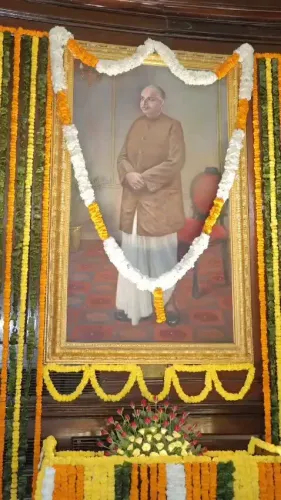
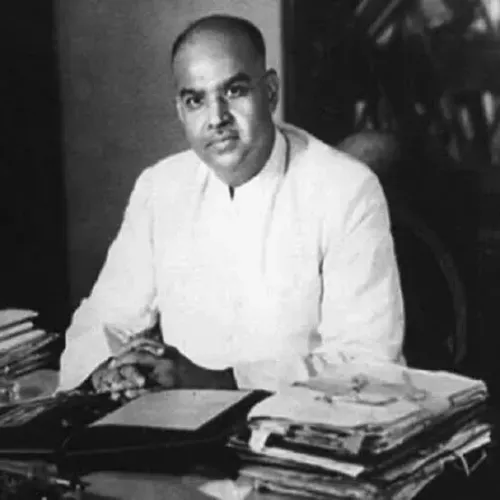
Rijiju pays tribute to Jana Sangh founder Dr. Shyama Prasad Mookerjee
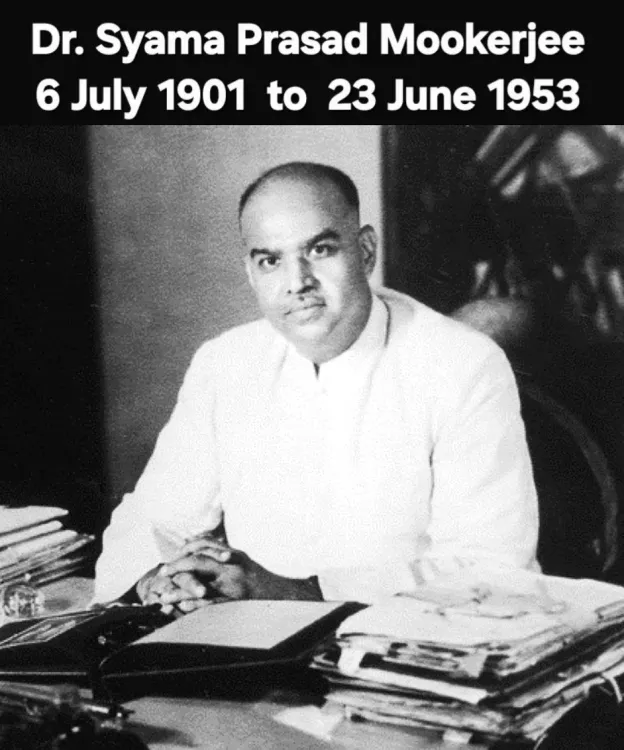
Synopsis
Union Parliamentary Affairs Minister Kiren Rijiju on 6 July 2026 paid tribute to Dr. Shyama Prasad Mookerjee, founder of the Bharatiya Jana Sangh, calling his dedication to national unity and cultural consciousness an invaluable legacy that continues to inspire the building of a self-reliant India.
Key Takeaways
Union Parliamentary Affairs Minister Kiren Rijiju posted a tribute to Dr.
Shyama Prasad Mookerjee on his birth anniversary, 6 July 2026 .
Rijiju described Mookerjee as a 'fervent nationalist thinker and educationist' whose legacy is an 'invaluable heritage of Indian public life.' Dr.
Shyama Prasad Mookerjee founded the Bharatiya Jana Sangh on 21 October 1951 , the ideological predecessor of the BJP.
The tribute invoked Mookerjee's ideas of national unity, cultural consciousness and self-reliance as continuing inspirations for a 'strong, self-reliant and developed India.' Such commemorations are part of the BJP's consistent practice of linking current governance priorities to its founding ideology.
Union Parliamentary Affairs Minister Kiren Rijiju paid homage to Dr. Shyama Prasad Mookerjee on his birth anniversary on Monday, 6 July 2026, hailing the Jana Sangh founder as a 'fervent nationalist thinker, educationist and an invaluable heritage of Indian public life.'
Context
Rijiju's post, written in Hindi, offered 'koti-koti naman' — koti-koti naman (countless salutations) — to Mookerjee on his jayanti. He described Mookerjee's unwavering dedication to 'the unity, integrity and cultural consciousness of the nation' as a priceless legacy. The minister added that Mookerjee's ideas, courage and resolve for national service 'continue to inspire us toward building a strong, self-reliant and developed India.'
The tribute is among several such commemorations posted by senior BJP leaders on 6 July each year, the birth anniversary of one of the party's most cited ideological forebears.
Policy backdrop
Dr. Shyama Prasad Mookerjee founded the Bharatiya Jana Sangh on 21 October 1951, establishing a political platform centred on national integration, cultural nationalism and opposition to separate constitutional arrangements for Jammu and Kashmir. The Jana Sangh is widely regarded as the direct ideological predecessor of the Bharatiya Janata Party.
Beyond politics, Mookerjee was a distinguished educationist who served as Vice-Chancellor of Calcutta University and as a cabinet minister in independent India's first government. His legacy spans both institutional scholarship and nationalist political thought, making him a figure claimed by the broader Hindu nationalist tradition.
Stakeholders and impact
Commemorations of Jana Sangh founders form a consistent thread in the BJP's political communication, linking present-day governance priorities — territorial integrity, self-reliance, cultural identity — to the party's founding ideology. For BJP workers and nationalist thinkers, such tributes reinforce an ideological continuity stretching from 1951 to the current administration's stated goals of an Aatmanirbhar Bharat (self-reliant India) and a Viksit Bharat (developed India).
Rijiju, himself a senior leader from Arunachal Pradesh and a minister holding the twin portfolios of Parliamentary Affairs and Minority Affairs, occupies a prominent platform from which such commemorations carry institutional weight beyond routine social-media activity.
What's next
Parliamentary sessions and BJP organisational events held around 6 July are likely to feature further references to Mookerjee's legacy, particularly in debates touching on national integration and federal policy. The annual cycle of tributes also signals the party's intent to keep its founding figures central to its political identity as it pursues its long-term vision of a developed India by 2047.
Point of View
The tribute also carries a subtle messaging dimension: positioning the BJP's minority governance within a framework of undivided national identity. Such commemorations cumulatively shape the ideological vocabulary available to the party's rank and file ahead of electoral cycles.
NationPress
5 Oct 2026
Frequently Asked Questions
Who was Dr. Shyama Prasad Mookerjee?
Dr. Shyama Prasad Mookerjee was an educationist and politician who founded the Bharatiya Jana Sangh in 1951, championing national unity and the full integration of Jammu and Kashmir. He also served as Vice-Chancellor of Calcutta University and as a cabinet minister in India's first post-independence government.
When was the Bharatiya Jana Sangh founded?
The Bharatiya Jana Sangh was founded on 21 October 1951 by Dr. Shyama Prasad Mookerjee as a nationalist political party focused on cultural unity and national integration.
What is the connection between Jana Sangh and the BJP?
The Bharatiya Jana Sangh is the direct ideological predecessor of the Bharatiya Janata Party. The BJP traces its founding ideology, including emphasis on national integration and cultural nationalism, to the Jana Sangh's principles.
Why did Kiren Rijiju pay tribute to Mookerjee on 6 July?
6 July is the birth anniversary of Dr. Shyama Prasad Mookerjee. Rijiju, a senior BJP leader, paid tribute as part of the party's annual practice of commemorating its ideological forebears on their jayantis.
What did Kiren Rijiju say about Shyama Prasad Mookerjee?
Rijiju described Mookerjee as a fervent nationalist thinker and educationist whose dedication to national unity, integrity and cultural consciousness is an invaluable heritage. He said Mookerjee's ideas continue to inspire the building of a strong, self-reliant and developed India.