RSS Leader Calls for Sanskrit Learning as India’s Core Identity
Synopsis
Mohan Bhagwat, RSS chief, urges the revival of Sanskrit, stating it is integral to India's identity and cultural continuity, during the inauguration of Samskrita Bharati's office in Delhi.
Key Takeaways
Sanskrit is vital to India's cultural identity.
Learning through conversation is more effective than traditional methods.
Samskrita Bharati plays a key role in promoting Sanskrit.
Changing attitudes towards Sanskrit reflect a cultural renaissance.
Immersion in language enhances learning experiences.
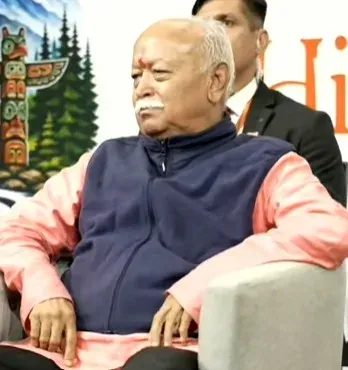
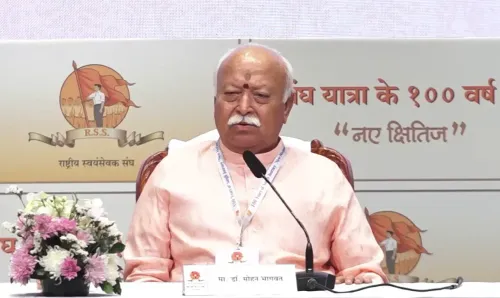
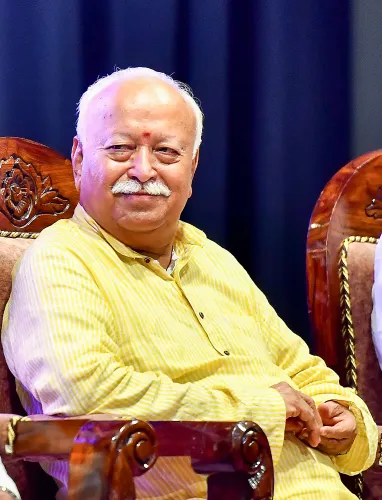
New Delhi, April 20 (NationPress) The chief of Rashtriya Swayamsevak Sangh (RSS), Mohan Bhagwat, highlighted the significance of learning Sanskrit, calling it the “very essence” of India and a vital component of the nation’s civilizational heritage.
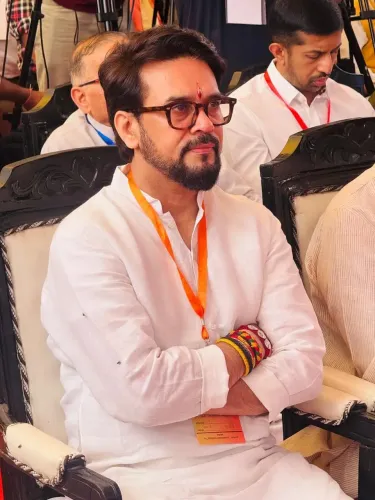
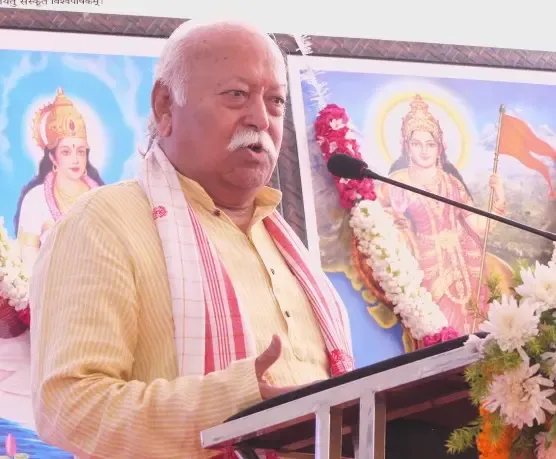
During the inauguration of the central office of Samskrita Bharati in Delhi, an organization focused on promoting Sanskrit as a living language, the event underscored ongoing initiatives to foster the use of Sanskrit in contemporary communication.
While addressing the audience, Bhagwat stated, “Sanskrit is a language, but it represents much more. In India, Sanskrit embodies the very essence of our nation, as it reflects our ancient traditions of thought, life, and culture that remain alive today.”
He expanded on the philosophical concept of India, asserting, “The identity of ‘India’ transcends mere geography. It is not just a political or economic entity; India is a living tradition – the very foundation of life’s continuity.”
Reflecting on his childhood experiences with the language, Bhagwat mentioned, “When I was in school, learning Sanskrit was challenging. The curriculum emphasized memorizing ‘shlokas’, leading to the misconception that Sanskrit was complex. However, when I heard those same verses spoken naturally at home, they felt approachable.”
“This challenge persists today; many students view Sanskrit as daunting. The real question is: why do they find it so hard? The most effective way to learn a language isn’t through textbooks but through conversational practice,” he explained.
He emphasized that immersion and regular usage make language acquisition easier.
“As I travel throughout India, even without knowledge of specific vocabulary in regional languages, I can grasp the underlying emotions and meanings. Through consistent listening and speaking, one can naturally and effortlessly acquire a language. Thus, the best way to learn is to engage with native speakers and practice continuously,” he advised.
Bhagwat also praised Samskrita Bharati for its efforts in rekindling interest in Sanskrit, noting that the organization has successfully generated a renewed enthusiasm for Sanskrit across the nation in a relatively short span.
He remarked that the “transformative change” in societal attitudes towards Sanskrit over the last 15 years is “clearly visible.”
Noticing the changing dynamics that encourage a return to cultural roots, he stated that creating avenues for learning and understanding Sanskrit is an essential mission.
“The establishment of a new office is indeed a source of joy; however, we must understand that an office symbolizes the outcome of our expanded work efforts,” Bhagwat concluded.
Point of View
It's essential to recognize the emphasis placed on Sanskrit by Mohan Bhagwat. His statements reflect a broader trend of cultural revivalism that seeks to reconnect individuals with their heritage. Learning Sanskrit not only preserves ancient traditions but also enriches contemporary discourse.
NationPress
19 Sept 2026
Frequently Asked Questions
Why is Sanskrit considered important by the RSS?
The RSS views Sanskrit as the essence of Indian culture and tradition, essential for maintaining the country's civilizational continuity.
What is Samskrita Bharati?
Samskrita Bharati is an organization dedicated to promoting the use of Sanskrit as a living language in modern communication.
How can one effectively learn Sanskrit?
Mohan Bhagwat suggests that the best way to learn Sanskrit is through conversation and immersion in environments where the language is spoken.
What changes has Bhagwat observed in society regarding Sanskrit?
He noted a transformative shift in societal attitudes towards Sanskrit over the past 15 years, leading to increased interest and engagement.
What role does Bhagwat believe Sanskrit plays in Indian identity?
He believes that Sanskrit is fundamental to India's identity, representing ancient traditions and serving as a cultural foundation.