Amit Shah Plants Agarwood Sapling at Tripura Border Post
Synopsis
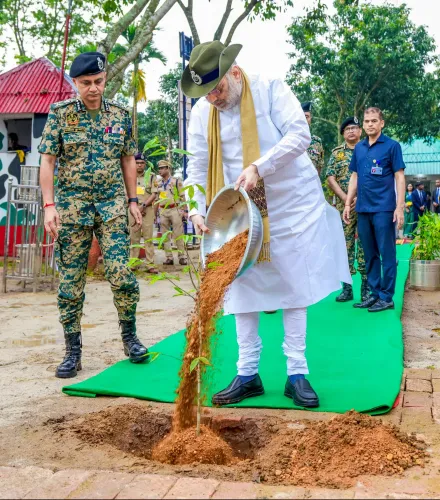
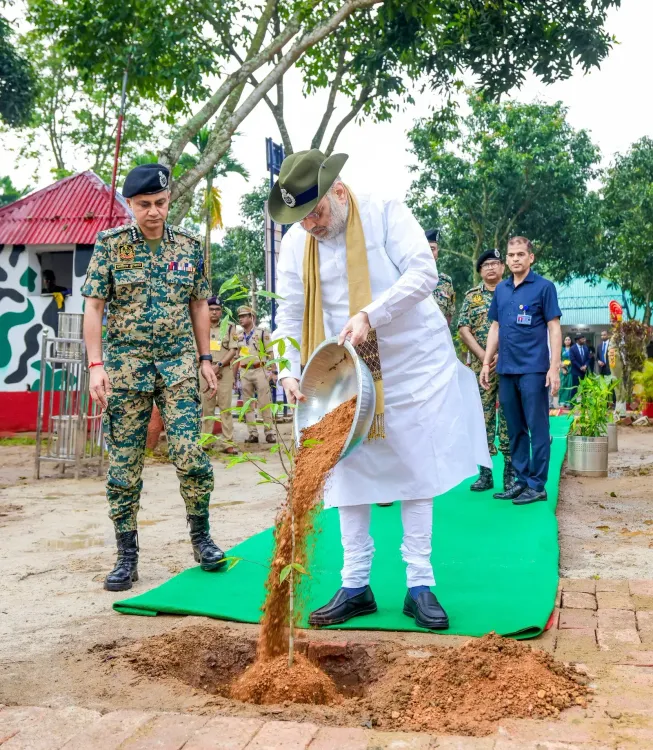
Union Home Minister Amit Shah marked World Environment Day on 5 June 2026 by planting an Agarwood sapling at the Lankamura Border Outpost on the India-Bangladesh border in Tripura, combining environmental symbolism with a visit to a frontier BSF installation.
Key Takeaways
Union Home Minister Amit Shah planted an Agarwood sapling on 5 June 2026 at the Lankamura Border Outpost in Tripura .
The event marked World Environment Day , observed globally on 5 June under a UN framework.
The India-Bangladesh border spans approximately 4,096 km , with the Indian side managed by the BSF .
Agarwood ( Aquilaria malaccensis ) is a commercially high-value species promoted for cultivation across Northeast India .
The venue — a live border outpost — reflects the Ministry of Home Affairs ' growing participation in environmental programmes at security installations.
Union Home Minister Amit Shah marked World Environment Day on 5 June 2026 by planting a sapling of the Agarwood tree at the Lankamura Border Outpost on the India-Bangladesh border in Tripura, combining a symbolic environmental gesture with a visit to a frontier security installation.
Context
Shah posted on X: 'On the occasion of #WorldEnvironmentDay planted a sapling of Agarwood tree at the Lankamura Border Outpost on the India-Bangladesh Border in Tripura.' The visit placed a senior Union Cabinet minister at a Border Security Force (BSF) post along one of India's longest land frontiers, underscoring the dual nature of the occasion — environmental observance and border presence.
World Environment Day, observed every 5 June under the United Nations framework, has been marked in India since 1973 through official tree-plantation drives coordinated by central and state governments. The choice of a border outpost as the venue adds a security-administration dimension to what is typically a ceremonial occasion.
Policy Backdrop
Agarwood (Aquilaria malaccensis) is a high-value resinous tree species that has been actively promoted for cultivation across parts of Northeast India, including Tripura. The species commands significant commercial value for its resin, used in perfumery and traditional medicine, making plantation drives economically relevant beyond their ecological symbolism.
The India-Bangladesh border stretches approximately 4,096 km, with the Indian side managed by the BSF. Tripura shares a long land boundary with Bangladesh, and frontier districts in the Northeast fall within ecologically sensitive zones where afforestation programmes intersect with security operations. Central armed police forces at such postings regularly participate in national plantation targets.
Stakeholders and Impact
BSF personnel stationed at the Lankamura outpost and residents of border communities in Tripura are the immediate stakeholders. For border jawans, a ministerial visit on a national observance day carries both morale and visibility value.
For the broader afforestation agenda, a plantation event led by the Union Home Minister at a border post signals institutional participation from the security establishment — a constituency that controls large tracts of land along India's frontiers. The Agarwood species choice also aligns with state-level efforts in Tripura and neighbouring northeastern states to promote economically viable tree species alongside biodiversity goals.
What's Next
The Ministry of Home Affairs has been increasingly visible in environmental and civic programmes at border installations, and further such initiatives along the India-Bangladesh frontier are likely in the months ahead. Whether this plantation drive expands into a structured BSF-led greening programme for border outposts in the Northeast will be a development worth tracking.
Point of View
A region where border management, ecological sensitivity, and development optics converge. The selection of Agarwood, a commercially valuable species with strong regional identity in the Northeast, signals awareness of economic subtext in what could otherwise be a purely ceremonial gesture. Expect the Ministry of Home Affairs to amplify such dual-purpose events as it seeks to project a broader governance footprint beyond law and order.
NationPress
21 Oct 2026
Frequently Asked Questions
Why did Amit Shah visit Tripura on World Environment Day 2026?
Amit Shah visited the Lankamura Border Outpost in Tripura on 5 June 2026 to plant an Agarwood sapling as part of World Environment Day observances, combining the environmental occasion with a visit to a BSF installation on the India-Bangladesh border.
What is Agarwood and why is it significant in Northeast India?
Agarwood, known scientifically as Aquilaria malaccensis, is a high-value resinous tree prized in perfumery and traditional medicine. It has been promoted for cultivation across Northeast India, including Tripura, for its significant commercial and ecological value.
Where is the Lankamura Border Outpost?
The Lankamura Border Outpost is a BSF post located on the India-Bangladesh international border in Tripura, a northeastern state that shares a long land boundary with Bangladesh.
How long is the India-Bangladesh border?
The India-Bangladesh border stretches approximately 4,096 km, with the Indian side managed by the Border Security Force.
What is World Environment Day?
World Environment Day is a UN-designated annual observance held every 5 June to promote global environmental awareness and action. India has participated in official tree-plantation programmes on this day since 1973.