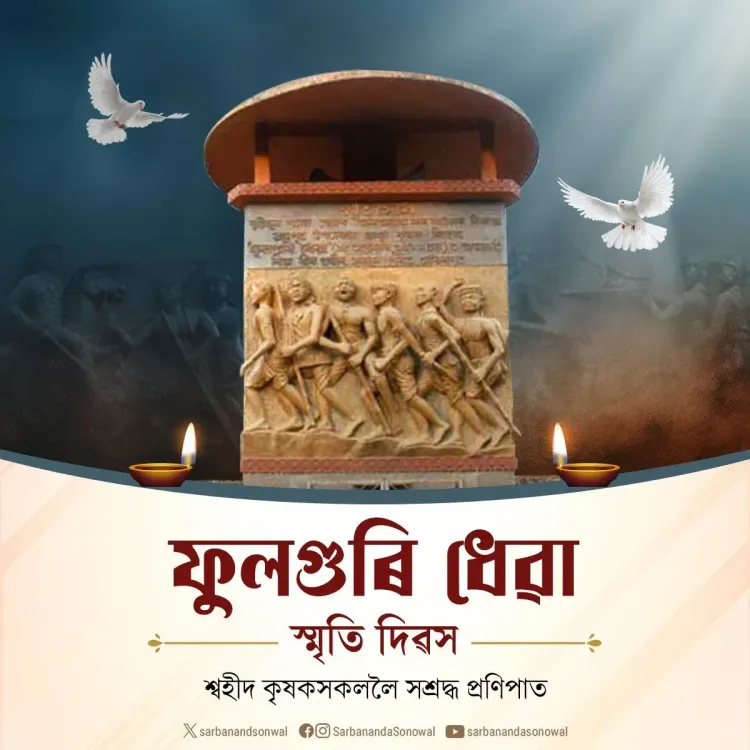
Sonowal honours Phulguri Dhowa martyrs on Smriti Diwas
Synopsis
Union Minister Sarbananda Sonowal marked Phulguri Dhowa Smriti Diwas on 18 October 2026, honouring the Assamese farmers who led a historic resistance against British colonial rule in Nagaon in 1861, calling their sacrifice an invaluable chapter in India's history.
Key Takeaways
Sarbananda Sonowal , Union Minister of Ports, Shipping and Waterways, paid tribute on Phulguri Dhowa Smriti Diwas on 18 October 2026 .
The Phulguri Dhowa was a peasant uprising in 1861 in Phulguri village, Nagaon district, Assam , against British colonial taxes and exploitation.
Sonowal called the revolt 'a glorious chapter in India's history' and honoured the martyred farmers with 'deep reverence.' The uprising is considered one of the earliest organised peasant resistances against British rule in Assam's heartland.
Sonowal, a former Chief Minister of Assam and senior BJP leader, has consistently highlighted Assam's regional anti-colonial history in national discourse.
A peasant revolt that shook Nagaon in 1861 still echoes across Assam — and on Sunday, 18 October 2026, Union Minister of Ports, Shipping and Waterways Sarbananda Sonowal paused to honour its memory, marking Phulguri Dhowa Smriti Diwas with a tribute to the farmers who stood against British colonial rule.
Writing in Assamese, Sonowal called the Phulguri Dhowa a 'glorious chapter in India's history' — ভাৰতৰ ইতিহাসৰ এক গৌৱোজ্জ্বল অধ্যায় — and said the sacrifice of the martyred farmers represents 'an invaluable chapter that will live among us across the ages.' He paid his tribute with 'deep reverence' to those who laid down their lives for rights and self-respect.
What happened at Phulguri in 1861
The Phulguri Dhowa — loosely translated as the 'Phulguri Uprising' — erupted in Phulguri village, Nagaon district, Assam, when local farmers rose against unjust colonial taxes and exploitation by British administrators. It is widely regarded as one of the earliest organised peasant resistances against British rule in the Assamese heartland. The revolt became a symbol of courage, unity, and self-dignity in Assam's collective memory.
The uprising predates the more widely documented peasant movements of the late 19th century and holds a distinctive place in Assam's anti-colonial narrative. For generations of Assamese, the farmers of Phulguri represent the spirit of resistance that would eventually feed into the broader freedom struggle across India.
Northeast voices in national remembrance
Sonowal, a senior BJP leader and former Chief Minister of Assam, has consistently elevated Assam's regional history in national discourse. Union ministers from the Northeast periodically mark anniversaries of 19th-century uprisings — a practice that reinforces the contribution of India's frontier regions to the independence movement, beyond the more commonly cited events in Bengal and western India.
The tribute carries no direct link to his current ministerial portfolio, but its political and cultural weight is clear: for Assam's people, remembering Phulguri is an act of identity as much as history.
The stories of those farmers — their sacrifice, patriotism, and courage — will endure, Sonowal wrote. On a quiet Sunday morning, a minister made sure of it.
Point of View
Pushing back against a history-writing tradition that long centred events in Bengal and western India. For a BJP leader who built his political base in Assam, invoking 19th-century peasant courage serves both cultural affirmation and electoral identity. The Phulguri Dhowa, predating more celebrated uprisings, is a reminder that resistance to empire was never confined to India's better-documented centres. Keeping such anniversaries alive in public discourse is, itself, a form of soft political capital.
NationPress
18 Oct 2026
Frequently Asked Questions
What is Phulguri Dhowa?
Phulguri Dhowa refers to the 1861 peasant uprising in Phulguri village, Nagaon district, Assam, in which local farmers rose against unjust British colonial taxes and exploitation. It is regarded as one of the earliest organised anti-colonial resistances in Assam.
When is Phulguri Dhowa Smriti Diwas observed?
Phulguri Dhowa Smriti Diwas is observed on 18 October each year to commemorate the martyred farmers of the 1861 uprising in Nagaon, Assam.
Why did Sarbananda Sonowal post about Phulguri Dhowa?
Sarbananda Sonowal, a former Chief Minister of Assam and Union Minister, posted a tribute on Phulguri Dhowa Smriti Diwas to honour the Assamese farmers who died resisting British colonial rule in 1861, calling their sacrifice a glorious and invaluable chapter in India's history.
Where did the Phulguri Dhowa uprising take place?
The Phulguri Dhowa took place in Phulguri village in the Nagaon district of Assam in 1861.
What was the significance of the 1861 Phulguri peasant revolt?
The 1861 Phulguri revolt is historically significant as one of the earliest examples of organised peasant resistance against British colonial rule in Assam, symbolising courage, unity, and self-dignity for the Assamese people.