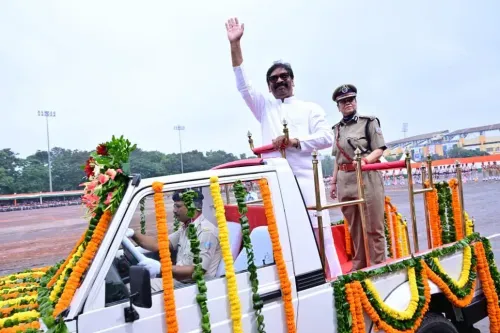
CM Hemant Soren Greets President Murmu on Her Birthday
Synopsis
Jharkhand Chief Minister Hemant Soren wished President Droupadi Murmu on her birthday on 20 June 2026, using the Santhal greeting Johar and invoking Marang Buru — underscoring the shared tribal heritage between two of India's most prominent Adivasi public figures.
Key Takeaways
Hemant Soren , Chief Minister of Jharkhand and JMM executive president, posted birthday greetings to President Droupadi Murmu on 20 June 2026 .
Soren used Johar , a traditional Adivasi salutation, and invoked Marang Buru — the supreme deity in Santhal belief — in his message.
Droupadi Murmu became the 15th President of India in July 2022 , the first tribal person and second woman to hold the office.
Murmu previously served as Governor of Jharkhand , giving her direct institutional ties to the state.
The message reflects the JMM's long-standing emphasis on tribal cultural identity as a political and social cornerstone.
Any follow-up engagement between the Jharkhand government and Rashtrapati Bhavan on tribal-welfare matters will be closely watched.
Jharkhand Chief Minister Hemant Soren on Saturday, 20 June 2026, extended birthday greetings to President of India Droupadi Murmu, invoking a shared tribal cultural heritage in his message posted on X. Soren, who heads the Jharkhand Mukti Morcha (JMM), addressed the President with the Santhal salutation Johar and sought blessings of Marang Buru — the supreme deity in Santhal cosmology — for her health and long life.
Context
Soren's post, written in Hindi, reads: 'Desh ki Mananiya Rashtrapati aadaraniya Shrimati Draupadi Murmu ji ko janmadivas ki anek-anek badhai, shubhkamnayein evam Johar' — translated as: 'Many, many congratulations, good wishes, and Johar to the honourable and respected President of India, Smt. Droupadi Murmu, on her birthday.' He added a prayer to Marang Buru to grant her excellent health and a long life.
The use of Johar — a traditional Adivasi greeting of respect — and the invocation of Marang Buru are deliberate cultural markers that go beyond routine political courtesy, foregrounding a shared tribal identity between two prominent public figures from the Jharkhand-Odisha tribal belt.
Policy Backdrop
Droupadi Murmu was elected the 15th President of India in July 2022 as the National Democratic Alliance (NDA) candidate, becoming the first person from a tribal community and the second woman to occupy Rashtrapati Bhavan. Before her ascent to the highest constitutional office, she served as Governor of Jharkhand — a role that brought her into direct institutional contact with the state's tribal polity and administration.
The Jharkhand Mukti Morcha, which Soren leads as executive president, was founded on the principle of tribal autonomy and rights in the Chotanagpur region. The party's political identity is deeply intertwined with Adivasi cultural assertion, making the cultural register of Soren's birthday message consistent with JMM's broader ideological posture.
Stakeholders and Impact
The message carries significance beyond the personal. Tribal communities across Jharkhand, Odisha, West Bengal, and other states with Santhal populations are likely to note the public affirmation of shared identity between the state's chief minister and the country's constitutional head. Murmu's presidency has itself been seen as a symbolic milestone for Adivasi representation in Indian governance.
For JMM and allied tribal-rights constituencies, such messaging reinforces the party's claim to being the authentic political voice of Jharkhand's indigenous communities, even as it maintains an opposition stance toward the central government led by the NDA.
What's Next
Observers will watch for any follow-up engagement between the Jharkhand government and Rashtrapati Bhavan on pending tribal-welfare proposals or state-specific constitutional matters. Birthday greetings of this nature, particularly those laced with cultural symbolism, occasionally precede formal communication or meetings between state and central constitutional authorities.
As President Murmu continues her term, her role as a constitutional symbol for tribal India keeps the spotlight on how both ruling and opposition leaders at the state level frame their relationship with the office — and with the communities it represents.
Point of View
Yet loaded with Santhal cultural signifiers that serve a dual audience — the constitutional head of state and the tribal voter base back home. The invocation of Marang Buru and Johar is not incidental; it is a deliberate assertion that tribal identity has arrived at the apex of Indian constitutional life. For Soren, whose party's legitimacy rests on Adivasi representation, publicly affirming kinship with the first tribal President is both courteous and strategically resonant. This pattern of cultural diplomacy — bridging state-level opposition politics with constitutional deference — is increasingly common among regional leaders navigating coalition-era India.
NationPress
18 Sept 2026
Frequently Asked Questions
When is President Droupadi Murmu's birthday?
President Droupadi Murmu's birthday falls on 20 June , as marked by the greetings extended by Jharkhand Chief Minister Hemant Soren on 20 June 2026.
What does Johar mean?
Johar is a traditional greeting of respect used by Adivasi communities, particularly Santhals, in Jharkhand, Odisha, and neighbouring states. It expresses reverence and solidarity.
What is Droupadi Murmu's connection to Jharkhand?
Before becoming President of India in July 2022 , Droupadi Murmu served as Governor of Jharkhand , giving her direct administrative ties to the state and its tribal communities.
Why did Hemant Soren use Santhal cultural references in his birthday message to the President?
Soren's use of Johar and Marang Buru reflects the JMM's political identity rooted in Adivasi rights and culture, and underscores the shared tribal heritage between himself and President Murmu, who is the first tribal person to hold India's highest constitutional office.