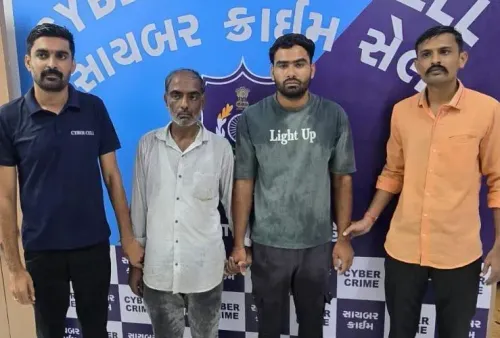
Surat APK fraud: 4 held in Morena over ₹9.02 lakh loss

Synopsis
Four people, including two Class 12 students, were arrested in Morena after police traced part of an alleged ₹9,02,802 cyber fraud involving an elderly Gujarat resident. Investigators suspect unknown APK files found on his phone enabled unauthorised transfers.
Key Takeaways
Four people , including two Class 12 students , were arrested in Morena district , police said.
An elderly Gujarat resident allegedly lost ₹9,02,802 through UPI transfers between 31 August and 9 September .
The man found four unknown APK files on his phone; police suspect they enabled access to the device or banking applications.
Police traced six transactions involving ₹2.38 lakh to three IndusInd Bank accounts .
The Cyber Crime Branch urged financial fraud victims to call 1930 immediately.
Surat APK fraud investigators have arrested four people, including two students, in Morena district, Madhya Pradesh, after an elderly Gujarat resident allegedly lost ₹9,02,802 from his bank accounts, police said on 24 November. Police suspect unauthorised APK files found on the man’s phone were used to enable the transfers.
The Surat City Cyber Crime Branch said it traced part of the money trail to three IndusInd Bank accounts in Morena. Those arrested allegedly facilitated access to accounts and linked phones for associates who remain absconding, according to police.
Transfers and suspected APK files
Police said the money left the elderly man’s two accounts through multiple UPI transactions between 31 August and 9 September, without his knowledge or consent. Of the total, ₹5,92,800 was debited from his Bank of Baroda account and ₹3,10,002 from his Bank of India account.
When the man later checked his phone, he found four unknown APK files installed on it, police said. Investigators suspect the files were used to access the phone or banking applications and carry out the transactions; the precise role of the files remains a matter for investigation.
Police examined bank records and complaints on the National Cyber Crime Reporting Portal (NCCRP). They said six transactions linked to the complaint, involving ₹2.38 lakh, had reached the three IndusInd Bank accounts.
Four arrested after money trail leads to Morena
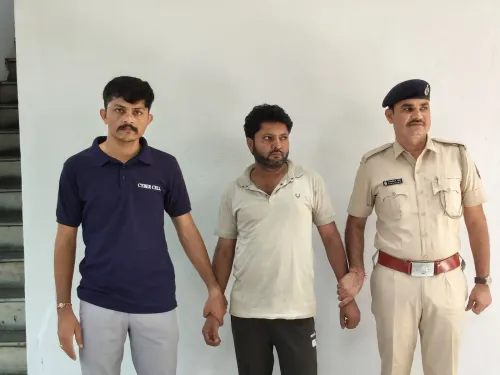
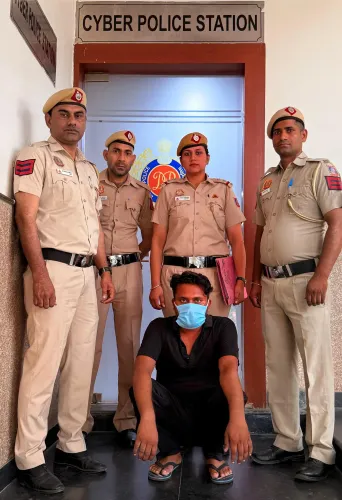
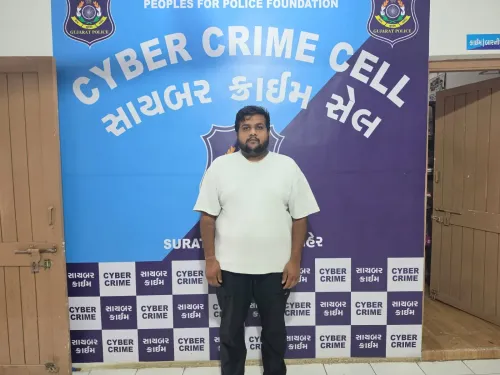
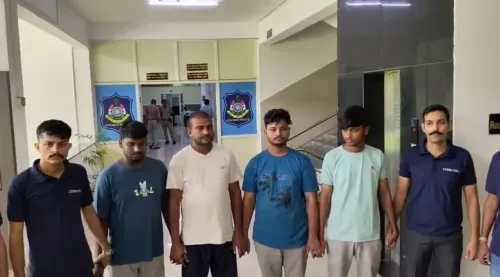
A team led by Police Inspector N R Patel carried out a technical investigation that led officers to Morena, police said. The arrested residents of the district were identified as Rahul Mathur, 18; Prashant Sharma, 19; Banwari Rathod, 27; and Avadhesh Gurjar, 30.
Mathur and Sharma are students pursuing Class 12. Police allege that they gave associates access to phones linked to their bank accounts for two hours and three hours, respectively.
Mathur reportedly received ₹5,000 and Sharma ₹2,000 as commissions. Police said Mathur had opened a savings account in his own name, while Sharma allegedly allowed an absconding associate to use his phone and access his account in a similar arrangement.
Rathod, who works at a Common Service Centre, allegedly opened an IndusInd Bank account in an acquaintance’s name and registered his own mobile number against it. Police accuse him of handing over his phone for three days to Gurjar and an absconding associate in return for a promised ₹10,000 commission.
Gurjar allegedly contacted Rathod and arranged access to the account and phone in coordination with his absconding brother. Police said the phone was subsequently handed to the brother, who used the account to transfer proceeds of cyber fraud.
Other complaints and account activity
Further scrutiny of the three accounts showed 21 credit transactions totalling ₹3,16,170, police said. The ₹2.38 lakh in six transactions linked to the Surat complaint was part of that activity; the complaint amounts reported on the portal are separate figures.
Police said the portal listed two complaints against Mathur’s account: the Surat complaint involving ₹9,02,802 and an Uttar Pradesh complaint involving ₹13,000. Together, the reported complaint amounts were ₹9,15,802; police also identified cyber fraud-related transactions worth ₹1,03,996 in the account between 1 January 2025 and 20 September.
The account allegedly used by Rathod and Gurjar had two complaints, involving ₹9,02,800 and ₹58,970 in West Bengal, police said. Their combined reported value was ₹9,61,770, while transactions of ₹1,04,172 were recorded during the same period.
Police said Sharma’s account had one complaint involving an alleged ₹9,02,800 fraud without an OTP. Transactions worth ₹1,08,002 were found in that account between 1 January 2025 and 20 September.
Case registered and police advice
The Surat Cyber Crime Police Station registered a case under Sections 318(4), 336(2), 338, 336(3), 340(2), 61(2) and 3(5) of the Bharatiya Nyaya Sanhita, 2023, and Sections 66(C) and 66(D) of the Information Technology Act, 2000, as amended in 2008.
Police described an alleged arrangement in which people were offered commissions to open accounts in their own names or those of acquaintances and hand over linked phones. Other members of the network then allegedly used the accounts to transfer money obtained through cyber fraud.
The Cyber Crime Branch advised people not to install APK files received through unknown links or messages, or hand over bank accounts and phones used for banking in exchange for commissions. It urged victims of financial cyber fraud to call the national cybercrime helpline 1930 immediately to improve the chances of freezing transferred funds.
The investigation remains focused on the alleged account network and associates who are still absconding.
Point of View
But the investigation’s next test is whether it identifies the absconding associates and establishes how the suspected APK files were used.
NationPress
24 Nov 2026
Frequently Asked Questions
What happened in the Surat APK fraud case?
An elderly Gujarat resident allegedly lost ₹9,02,802 through unauthorised UPI transfers from two bank accounts, police said. Investigators found four unknown APK files on his phone and suspect they enabled the fraud.
Who was arrested in the Surat cyber fraud investigation?
Police arrested Rahul Mathur, Prashant Sharma, Banwari Rathod and Avadhesh Gurjar in Morena district, Madhya Pradesh. Mathur and Sharma are Class 12 students aged 18 and 19, respectively.
How did police trace the alleged fraud to Morena?
Police said bank records and National Cyber Crime Reporting Portal data linked six transactions worth ₹2.38 lakh to three IndusInd Bank accounts in Morena. A technical investigation then led to the arrests.
What should victims of financial cyber fraud do?
The Cyber Crime Branch has urged victims to call the national cybercrime helpline, 1930, immediately. Police said prompt reporting can improve the chances of freezing transferred funds.
What happens next in the APK fraud case?
Police are investigating the alleged account network and associates who remain absconding. They also suspect that the unknown APK files were used to access the victim’s phone or banking applications.