Tejashwi meets RJD council poll candidates, claims ruling side rattled
Synopsis
Tejashwi Yadav met all RJD candidates contesting Bihar's Graduate and Teacher Constituency elections, reviewed count-day preparations, and claimed the ruling alliance is 'frustrated and dejected' by RJD's strong electoral showing.
Key Takeaways
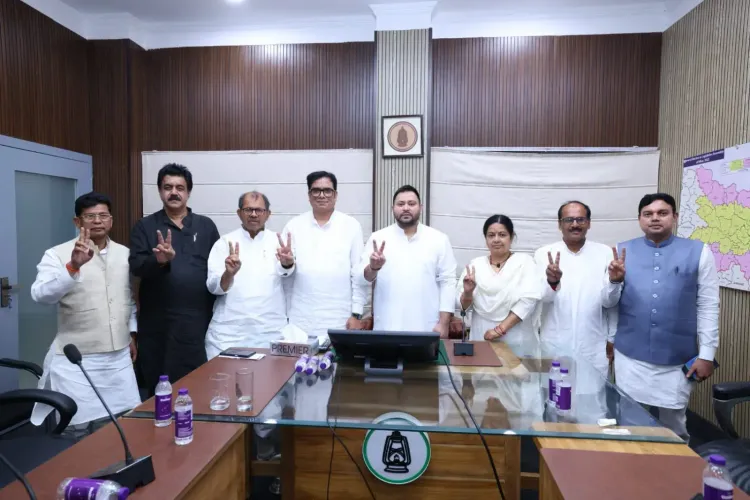
Tejashwi Yadav met all RJD candidates contesting Graduate and Teacher Constituency elections to the Bihar Legislative Council on 24 October 2026 .
The meeting focused on collecting candidate feedback and coordinating preparations for the upcoming vote count.
Tejashwi claimed RJD's electoral performance has left the ruling side 'frustrated and dejected.' He asserted directly: 'Our candidates are winning' — a pre-count confidence statement targeting the Nitish Kumar -led alliance.
Graduate and Teacher Constituencies are limited-franchise seats to the Bihar Legislative Council with symbolic importance as indicators of educated voter opinion.
Official counting results will confirm or contest RJD's claims of momentum.
With vote-counting day approaching, RJD leader Tejashwi Yadav sat down with every Rashtriya Janata Dal candidate contesting the Graduate and Teacher Constituency elections to the Bihar Legislative Council on Saturday, 24 October 2026 — and emerged projecting unmistakable confidence.
Posting after the meeting, Tejashwi wrote in Hindi: 'Snatak aur shikshak nirvachan kshetra ke sabhi RJD pratyashiyon se aaj mulaqat mein feedback liya tatha matganana ki taiyariyon ke sandarbh mein charcha hui.' — 'Today I met all RJD candidates from the Graduate and Teacher constituencies, took their feedback, and discussed preparations for the vote count.' He then sharpened the attack: 'RJD's outstanding electoral performance has left the ruling side frustrated and dejected. Our candidates are winning.'
What Graduate and Teacher seats mean for Bihar's upper house
The Bihar Legislative Council draws members from several functional constituencies, among them graduates and teachers — voters who register separately and elect their own representatives under constitutional provisions. These seats carry symbolic heft beyond their numbers: parties treat them as a barometer of educated, locally influential opinion, and a strong showing in council polls feeds the larger political narrative heading into assembly cycles.
For RJD — Bihar's principal opposition party built on a coalition of backward-caste and minority voters — performing well in teacher and graduate seats would signal a broadening of its appeal beyond its traditional base.
Pre-count psychology and the rival coalition
Tejashwi's move fits a well-worn Bihar playbook: before counting day, opposition leaders convene candidate gatherings, project momentum, and frame any ruling-coalition anxiety as evidence of impending defeat. The target is Chief Minister Nitish Kumar's alliance, which has dominated Bihar's administrative apparatus, and whose electoral machinery Bihar opposition leaders routinely describe as a structural challenge.
By meeting all candidates in one session, Tejashwi also performs a coordination function — aligning count-day agents, reviewing booth-level data, and signalling to party workers that the leadership is fully invested in the result.
What the count will decide
Until official results are declared, the claim that 'our candidates are winning' remains exactly that — a pre-count claim designed to energise RJD's ground machinery and unsettle opponents. The actual tallies from these limited-franchise constituencies, where registered graduates and teachers vote in pools far smaller than general constituencies, will either validate or deflate the confidence on display today.
Either outcome will land fast: council counts are typically brisk, and post-result statements from both RJD and the ruling alliance are expected to sharpen Bihar's opposition-versus-government narrative in the weeks ahead.
Point of View
It strengthens RJD's positioning ahead of future Bihar assembly cycles; if they do not, the ruling alliance will use the gap between the rhetoric and the reality as a counter-narrative. The episode underscores how even low-stakes council polls in Bihar are fully embedded in the state's high-voltage, near-permanent electoral contest.
NationPress
24 Oct 2026
Frequently Asked Questions
What are Graduate and Teacher Constituencies in Bihar?
These are functional constituencies for the Bihar Legislative Council where registered graduates and school teachers vote separately to elect their own representatives, as provided under Indian constitutional provisions for state upper houses.
Why did Tejashwi Yadav meet RJD candidates before vote counting?
Tejashwi met all RJD candidates contesting the Graduate and Teacher Constituency elections to collect pre-count feedback, coordinate counting-day preparations, and project electoral confidence — a standard Opposition strategy in Bihar to energise party workers.
What did Tejashwi Yadav say about RJD's election performance?
He said RJD's 'outstanding electoral performance' has left the ruling side 'frustrated and dejected,' and directly claimed 'Our candidates are winning' — though official results are still pending.
What is the Bihar Legislative Council?
The Bihar Legislative Council is the upper house of the Bihar state legislature. It draws members through various routes including elections from Graduate, Teacher, and Local Authority constituencies, as well as nominations and indirect elections.
Who is the ruling alliance in Bihar that RJD is contesting against?
The ruling alliance in Bihar is led by Chief Minister Nitish Kumar's Janata Dal (United), which governs in coalition with the Bharatiya Janata Party. RJD, led by the Yadav family, is the principal opposition party.