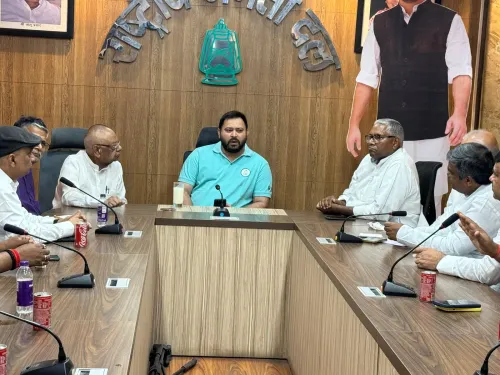
Tejashwi writes to Bihar CM for language professor hiring

Synopsis
RJD leader Tejashwi Yadav has written to the Bihar Chief Minister demanding an immediate recruitment notification for assistant professors of Urdu, Persian, Arabic, Maithili, and Sanskrit in state degree colleges, spotlighting a long-running faculty vacancy crisis in Bihar's language departments.
Key Takeaways
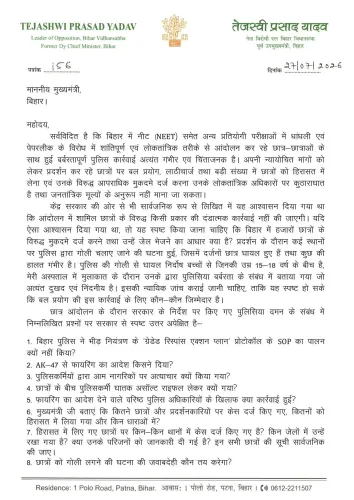
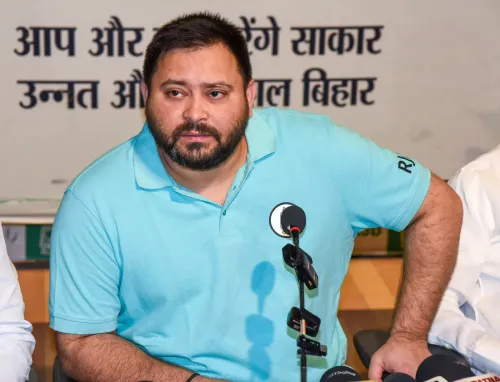
Tejashwi Yadav , Leader of the Opposition in Bihar, wrote to the Chief Minister on 26 September 2026 seeking urgent action on faculty recruitment.
The demand covers five language subjects : Urdu, Persian, Arabic, Maithili, and Sanskrit — taught in state-run degree colleges across Bihar.
Maithili is a constitutionally recognised language under the Eighth Schedule, underlining the cultural significance of the recruitment push.
Bihar's degree colleges have long relied on temporary faculty for language departments owing to delays in formal notification and recruitment cycles.
The letter is a public-pressure tactic; the next step requires a government gazette notification followed by a state commission-led recruitment process.
A formal letter, a pointed demand, and five languages at stake — RJD leader Tejashwi Yadav has written to Bihar Chief Minister urging the immediate issuance of a notification to begin the recruitment process for assistant professors of Urdu, Persian, Arabic, Maithili, and Sanskrit in the state's degree colleges.
The five languages and the vacant chairs
The subjects Tejashwi has flagged are not peripheral — they sit at the heart of Bihar's linguistic and cultural identity. Maithili, spoken across the Mithila belt, holds a place in the Eighth Schedule of the Indian Constitution. Sanskrit and the classical Islamic languages — Urdu, Persian, and Arabic — have been taught in Bihar's state-run undergraduate colleges for decades, and their departments depend critically on a steady supply of qualified faculty. When those chairs go vacant, students suffer the most direct consequence.
In his post, Tejashwi wrote: 'डिग्री कॉलेजों में उर्दू, फारसी, अरबी, मैथिली एवं संस्कृत विषयों के असिस्टेंट प्रोफेसरों की नियुक्ति हेतु अविलंब अधिसूचना जारी कर बहाली प्रक्रिया प्रारंभ करने के संबंध में माननीय मुख्यमंत्री, बिहार को पत्र लिखा।' — ('Wrote a letter to the honourable Chief Minister of Bihar regarding the immediate issuance of a notification and initiation of the recruitment process for assistant professors of Urdu, Persian, Arabic, Maithili, and Sanskrit in degree colleges.')
A familiar pressure tactic with real stakes
Opposition leaders in Bihar have a well-worn playbook: write an open letter, post it publicly, and force the government to respond — or be seen ignoring it. Tejashwi, as Leader of the Opposition in the Bihar Legislative Assembly, has used this tool before on education and employment, two issues that resonate sharply with the state's large population of educated, job-seeking youth.
Higher-education faculty shortages in Bihar are a documented structural problem. State degree colleges routinely run language departments on guest or temporary faculty for extended periods while formal notification and recruitment cycles — typically routed through a university or state commission process — move slowly. The gap between a student enrolling in an Urdu or Maithili honours course and finding a permanent professor on the other side of that classroom can span years.
What the government does next
The ball is now in the state government's court. A formal recruitment cycle for assistant professors requires a gazette notification, followed by an application window, eligibility screening, and selection through the relevant commission. Whether the government chooses to act swiftly — or file the letter away — will tell aspiring language scholars and their future professors everything they need to know about the administration's priorities heading into the academic season.
Point of View
He simultaneously appeals to distinct linguistic communities — Muslim voters (Urdu, Persian, Arabic), Maithili-speaking communities of the Mithila belt, and Sanskrit scholars — without appearing to privilege any one group. The move puts the ruling government in a reactive position: act on the notification and validate the opposition's pressure, or ignore it and risk a sharper political attack as the academic year deepens.
NationPress
26 Sept 2026
Frequently Asked Questions
Why did Tejashwi Yadav write to the Bihar Chief Minister about professor recruitment?
Tejashwi Yadav wrote to demand an immediate official notification to begin hiring assistant professors for Urdu, Persian, Arabic, Maithili, and Sanskrit in Bihar's degree colleges, flagging a longstanding vacancy problem in these language departments.
Which subjects are covered in Tejashwi's professor recruitment demand?
The demand covers five subjects: Urdu, Persian, Arabic, Maithili, and Sanskrit — all taught in state-run undergraduate degree colleges in Bihar.
How does assistant professor recruitment work in Bihar degree colleges?
Recruitment typically requires the state government to issue a gazette notification, after which a relevant university commission opens applications, screens candidates, and conducts a selection process before appointments are made.
Is Maithili a recognised language in India?
Yes. Maithili is listed in the Eighth Schedule of the Indian Constitution, making it one of India's officially recognised languages and underlining the importance of qualified Maithili faculty in Bihar colleges.
Has the Bihar government responded to Tejashwi's letter on language professor vacancies?
As of 26 September 2026, no official government response to the letter has been confirmed; the demand is pending state action.