Shashi Tharoor Sounds Alarm Over Delimitation as Political Demonization
Synopsis
In a compelling speech, Congress leader Shashi Tharoor cautioned that the upcoming delimitation process could undermine democracy and women's rights, urging for immediate implementation of women's reservation without tying it to this contentious exercise.
Key Takeaways
Delimitation linked to women's reservation poses risks for democracy.
Immediate implementation of women's reservation is essential.
Regional disparities could worsen with new delimitation.
Political power dynamics may shift unfavorably.
Tharoor emphasizes the need for broader consultation.
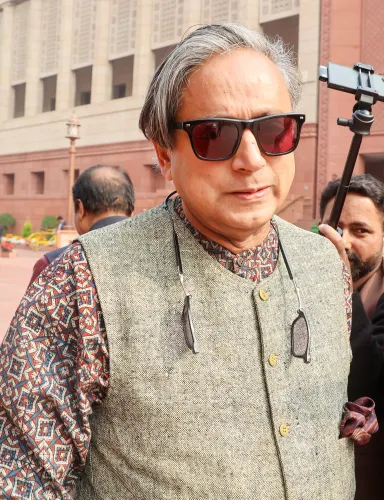
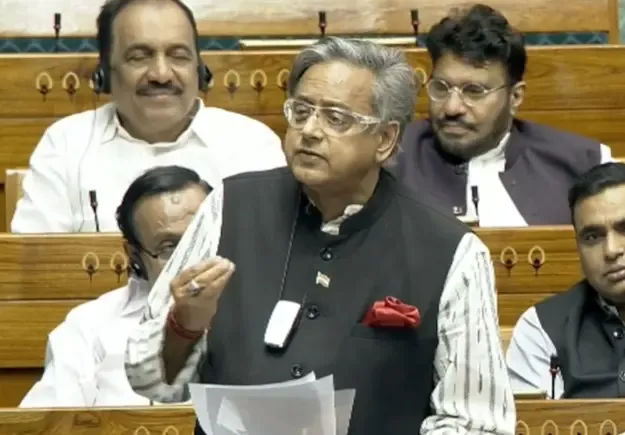
New Delhi, April 17 (NationPress) Congress leader Shashi Tharoor expressed his concerns in the Lok Sabha on Friday, asserting that the impending delimitation process could be perceived as a form of political demonetisation. He urged against its association with women’s reservation, emphasizing that it touches upon the very essence of our democracy.
While addressing the assembly, Tharoor remarked, “This issue is fundamental to the core of our democracy.”
“For numerous years, the concept of women’s reservation has been promised, debated, and frequently postponed. We are now at a pivotal moment where there exists a significant political agreement on the necessity for women’s reservation. Every significant party in the House acknowledges that the time for mere tokenism has passed, and the period of true equal partnership is at hand. However, I find us deeply troubled by this legislative endeavor,” he stated.
Tharoor referenced the government's stance, saying, “The Prime Minister announced that the government has delivered Nari Shakti a gift of justice, but he has tied the enactment of women’s reservation to the expansion of Parliament based on the 2011 Census and the delimitation process.”
He contended that this provision could be enacted immediately without the need for such a convoluted process.
“Women’s reservation is ready for implementation; it can and should be enacted immediately based on our current parliamentary strength. To link it to delimitation is to hold the dreams of Indian women hostage to one of the most contentious and intricate administrative processes in our nation’s history. Delimitation is not merely a bureaucratic reorganization of boundaries; it signifies a substantial shift in political authority,” Tharoor articulated.
“By connecting women’s reservation to this process, we effectively imprison the aspirations of Indian women to one of the most contentious political exercises in our history. This carries risks that could jeopardize the integrity of our federal structure,” he warned.
In a pointed comment, Tharoor stated, “You have proposed delimitation with the same urgency as that shown during demonetisation, and regrettably, we are all aware of the damage that caused to the nation. Delimitation will emerge as a form of political demonetisation. Please reconsider this.”
Tharoor underscored the importance of broader consultation, saying, “We must be forthright about what is at stake. Constituencies are redefined based on either current population estimates or the 2011 Census. Delimitation calls for serious deliberation.”
He highlighted regional disparities, stating, “The equilibrium between states, especially southern states like Tamil Nadu and Kerala, which have diligently pursued national objectives of population control and invested in inclusive human development, and northern states that have not, would shift under future delimitation. States that have failed to manage population growth would gain greater political influence. We must question if this is the message we want to convey: that governance excellence leads to political marginalization.”
“Additionally, we must consider the balance between states that drive our economy, contributing more to the national treasury than they receive, versus those that are net beneficiaries of central funding. Delimitation could further diminish the voices of those productive states,” he added.
“We risk fostering a tyranny of the democratic majority,” he concluded.
Point of View
Shashi Tharoor's remarks underscore the profound implications of linking delimitation with women's reservation. He articulates a pressing need for immediate action on women's rights while highlighting the risks of political upheaval stemming from this administrative exercise.
NationPress
19 Sept 2026
Frequently Asked Questions
What did Shashi Tharoor say about delimitation?
Shashi Tharoor warned that the delimitation process could be akin to political demonetisation, stressing the need to separate it from women's reservation.
Why is women's reservation important?
Women's reservation is crucial for achieving gender equality and ensuring women's voices are represented in political decision-making.
What are the risks associated with delimitation?
Linking delimitation to women's reservation could politicize women's rights and create disparities among states, undermining the democratic process.
How does delimitation affect political power?
Delimitation can significantly alter the political landscape by redistributing representation based on population changes, which could favor certain states over others.
What was the response to the Prime Minister's comments?
Tharoor criticized the Prime Minister for linking the implementation of women's reservation to the delimitation process, arguing it complicates and delays necessary reforms.