UAE exit from OPEC driven by oil quota frustration, says ex-envoy Navdeep Suri
Synopsis
India's former Ambassador to the UAE, Navdeep Suri, has revealed that the UAE's OPEC exit was years in the making — rooted in a quota that capped its ambitions at 3.4 million barrels while it builds toward 5 million. With oil at $125 and the Strait of Hormuz blocked, the fallout carries direct consequences for India's energy bill and import strategy.
Key Takeaways
UAE had been considering leaving OPEC for nearly five years over insufficient production quotas, according to former Ambassador Navdeep Singh Suri .
UAE's quota was raised from 2.7 million to 3.4 million barrels per day , but the country is targeting 5 million barrels per day by next year.
Oil prices have crossed $125 per barrel amid the current Strait of Hormuz blockade.
Suri warned that a weaker OPEC could increase global oil price volatility , even as UAE's added output may eventually moderate prices.
Suri called both Iran's and the US's blockage of the Strait of Hormuz legally illegal , flagging direct impact on the Indian economy .
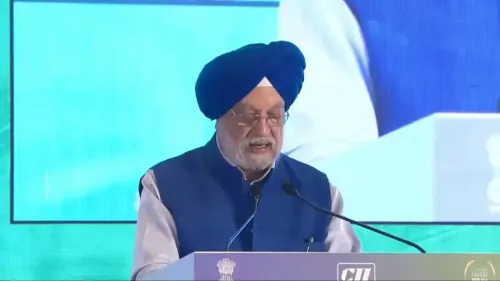
The United Arab Emirates (UAE) had been contemplating an exit from the Organisation of Petroleum Exporting Countries (OPEC) for nearly five years, primarily because the oil production quota assigned by the Saudi Arabia-dominated cartel was deemed insufficient, according to Navdeep Singh Suri, India's former Ambassador to the UAE and Egypt. Suri made the remarks in an exclusive interview with IANS on 30 April.
The Quota Dispute That Triggered the Exit
Suri pointed to early warning signs dating back to mid-2021. "There were indications as early as July 2021 that they were not happy with the quota that was allocated to them, about 2.7 million barrels per day. And they had said that if the quota is not raised, they might consider leaving," he said.
The quota was subsequently raised to 3.4 million barrels per day, but that concession has since been overtaken by the UAE's expanding production ambitions. According to Suri, the UAE has invested heavily in its upstream capacity in recent years and is on track to produce approximately 5 million barrels per day by next year — a target fundamentally incompatible with OPEC's output ceilings.
Impact on Global Oil Markets
Suri was careful to contextualise his outlook against the current geopolitical backdrop. He noted that the Strait of Hormuz is presently blocked and that oil prices have crossed $125 per barrel, creating what he described as "an energy scarcity scenario."
"Whatever I'm saying in terms of looking forward is predicated on the reopening of the Strait of Hormuz and normal flows of oil and gas being restored," he said. Once normalcy returns, Suri argued, additional UAE output could help moderate global oil prices — a development that would directly benefit India as one of the world's largest energy importers.
However, he flagged a second-order risk: a weakened OPEC could mean greater price volatility. "OPEC, to an extent, over the years has managed to balance demand and supply of oil and tried at least to some extent to control volatility in oil prices. A weaker OPEC and more countries operating on their own might increase volatility in oil prices," he observed.
India's Concerns Over the Iran-US Conflict
Addressing the ongoing Iran-US conflict, Suri said New Delhi is closely monitoring developments given their direct economic consequences. "We are obviously very concerned about the developments. We are seeing that they have a direct impact on the Indian economy," he said.
He took a notably firm legal position on the blockade, stating that Iran's retaliatory attacks on its neighbours were illegal, that Iran's blockage of the Strait of Hormuz was illegal, and that the US blockage was illegal too. The assessment underscores India's vulnerability as a nation heavily dependent on Persian Gulf energy routes.
What This Means for India Going Forward
India imports over 85% of its crude oil requirements, with a significant share sourced from OPEC members, including the UAE and Saudi Arabia. A structural realignment within OPEC — accelerated by the UAE's departure — could reshape the pricing dynamics that Indian refiners have long navigated. Notably, this development comes at a moment when New Delhi is already managing elevated energy import bills amid the Hormuz disruption. How quickly the strait reopens and whether the UAE ramps production freely will be among the most consequential energy variables for India in the near term.
Point of View
But whether a fragmented cartel produces more volatility than the current managed-supply regime. For a country that imports over 85% of its crude, price unpredictability is arguably more damaging than high prices — at least budgets can plan for the latter. New Delhi's silence on the legality question, even as its own ex-envoy calls both sides' blockades illegal, reflects the diplomatic tightrope India continues to walk in the Gulf.
NationPress
16 Sept 2026
Frequently Asked Questions
Why did the UAE leave OPEC?
The UAE left OPEC primarily because its assigned production quota — raised to 3.4 million barrels per day — was seen as insufficient given the country's expanded capacity targeting 5 million barrels per day. According to former Indian Ambassador Navdeep Singh Suri, the UAE had been unhappy with its quota since at least July 2021.
What impact will UAE's OPEC exit have on global oil prices?
Former Ambassador Suri said UAE's additional output, once the Strait of Hormuz reopens, could help moderate global oil prices. However, he also warned that a weakened OPEC could increase price volatility, as the cartel has historically helped balance supply and demand.
How does the UAE's OPEC exit affect India?
India, which imports over 85% of its crude oil, could benefit from lower prices if UAE increases output freely. However, greater price volatility from a weakened OPEC poses a risk for Indian refiners and energy planners who depend on relative price stability.
What is India's position on the Iran-US conflict and the Strait of Hormuz blockade?
India has expressed concern about the conflict's direct impact on its economy. Former Ambassador Navdeep Suri stated that both Iran's and the US's blockage of the Strait of Hormuz are illegal, reflecting New Delhi's vulnerability to disruptions in Persian Gulf energy routes.
What is the current status of oil prices amid the Strait of Hormuz blockade?
Oil prices have crossed $125 per barrel as of the time of Suri's interview on 30 April, driven by the ongoing Strait of Hormuz blockade which has created what he described as an energy scarcity scenario globally.