Uttarakhand approves Agniveers' absorption into state services

Synopsis
The Uttarakhand government has approved the absorption of Agniveers into state services, offering a formal employment pathway to short-tenure military recruits completing their four-year Agnipath contracts — a major relief for families in a state with deep army recruitment roots.
Key Takeaways
The Chief Minister's Office of Uttarakhand announced formal approval for Agniveers' absorption into state services on October 23, 2026 .
The move targets recruits under the Agnipath scheme , launched by the Union Government in June 2022 , who serve a mandatory four-year tenure .
Only about 25 per cent of Agniveers are retained in permanent military service; the approval addresses the remaining majority.
Uttarakhand has one of India's strongest military recruitment traditions, making this policy especially consequential for its hill districts.
Multiple states have already introduced similar preferential absorption or age-relaxation policies for ex-Agniveers.
Detailed eligibility criteria, department-wise posts, and absorption guidelines are yet to be released.
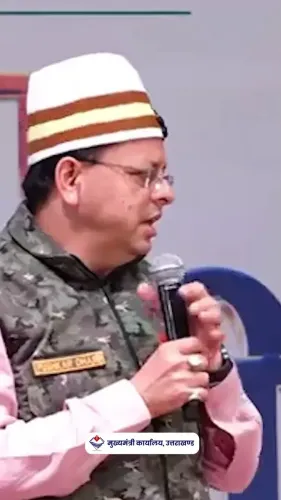
Uttarakhand has cleared a path for its Agniveers — soldiers who served the nation on short-term contracts — to find a second uniform at home. The Chief Minister's Office of Uttarakhand announced on Friday, October 23, 2026, that the state government has formally approved the absorption of Agniveers into provincial services.
What the approval means for Uttarakhand's Agniveers
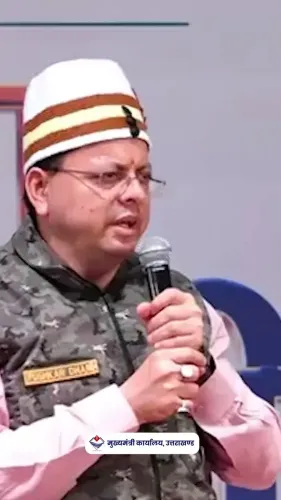
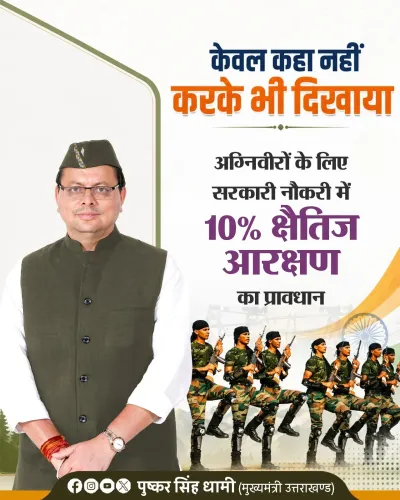
The post, in Hindi, states plainly: 'Uttarakhand mein Agniveearon ko Pradesh Seva mein Samayojan ko mili Manjuri' — 'Approval granted for integration of Agniveers into state services in Uttarakhand.' That single sentence carries significant weight for young men and women from the state who enlisted under the Agnipath scheme — the Union Government's landmark June 2022 military recruitment reform — and are now completing or have completed their mandatory four-year tenure.
Under Agnipath, recruits known as Agniveers serve for four years, after which only about 25 per cent are retained in permanent service. The remaining 75 per cent exit the armed forces as trained, disciplined, but formally unemployed young adults. Uttarakhand — a Himalayan state with one of India's deepest military recruitment traditions — has now signalled it will not let that talent pool disperse without a plan.
Uttarakhand's military heritage and why this matters here
Few states feel the Agnipath debate as acutely as Uttarakhand. The state has historically supplied a disproportionately large share of recruits to the Indian Army, particularly to Garhwal and Kumaon regiments. Families across the hills have built livelihoods around army pensions and canteen rights — benefits that the short-term Agnipath model does not guarantee. The absorption approval addresses a live anxiety in thousands of households.
The announcement fits a broader national pattern. Several states — including Haryana, Uttar Pradesh, and others — have introduced preferential recruitment or age relaxation for ex-Agniveers in state police, forest departments, and allied services. Uttarakhand's formal approval now places it firmly in that column.
Details still to come: eligibility, scale, and which posts
The announcement confirms political will; the administrative machinery must follow. What remains to be released are the detailed absorption guidelines — specifically, which state service departments are covered, how many posts are earmarked, and what eligibility thresholds apply. These granular rules will determine whether the approval translates into real opportunity or stays a headline.
For now, the signal from Dehradun is unmistakable: Uttarakhand intends to treat its Agniveers not as liabilities of a central policy, but as assets the state is willing to deploy.
Point of View
And offering state-service absorption is a way for BJP-governed Uttarakhand to cushion local discontent without challenging the Union policy directly. The move also accelerates a quiet national consensus: that the central government's short-tenure military model only works if states absorb the exit pipeline. Whether Uttarakhand delivers substantive posts at scale — or a symbolic gesture — will be the real test of this approval's worth.
NationPress
23 Oct 2026
Frequently Asked Questions
What is the Uttarakhand Agniveer state service absorption approval?
The Uttarakhand government has formally approved a policy to absorb Agniveers — soldiers who complete their four-year tenure under the central Agnipath scheme — into state government services, giving them a second employment pathway within the state.
What is the Agnipath scheme and who are Agniveers?
Agnipath is a Union Government military recruitment reform launched in June 2022. Recruits, called Agniveers, serve for four years, after which only about 25 per cent are retained in permanent service; the rest exit with training but no guaranteed job.
Which state services will Uttarakhand Agniveers be absorbed into?
The specific departments, post categories, and eligibility criteria have not yet been announced. The October 23, 2026 approval establishes intent; detailed guidelines are expected to follow.
Have other states also given jobs to Agniveers?
Yes. Several Indian states, including Haryana and Uttar Pradesh, have introduced preferential recruitment or age relaxation for ex-Agniveers in state police, forest departments, and other services.
Why is the Agnipath policy especially significant in Uttarakhand?
Uttarakhand has one of India's highest rates of military recruitment per capita, with communities in its Garhwal and Kumaon regions historically dependent on army service and pensions. The shift to short-term contracts under Agnipath directly affects household livelihoods across the state.