Uttarakhand Cabinet approves 20+ reforms: Kumbh infra, excise hike, education push
Synopsis
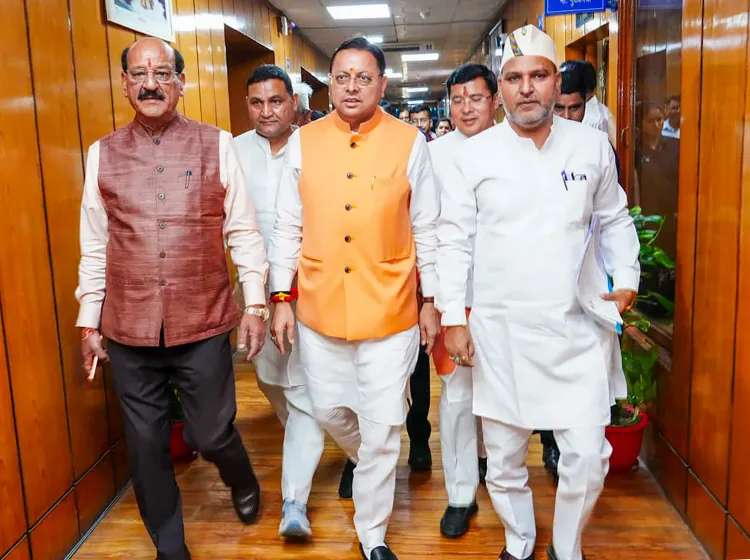
In a sweeping single-session move, the Uttarakhand Cabinet under CM Pushkar Singh Dhami cleared over 20 decisions on 30 April — from ₹31 crore Kumbh Mela infrastructure in Haridwar to a VAT hike on excise items and a school education campaign. The breadth signals a governance sprint ahead of the 2027 Kumbh deadline.
Key Takeaways
Uttarakhand Cabinet approved over 20 decisions on 30 April 2026 under CM Pushkar Singh Dhami . ₹31 crore sanctioned for Kumbh Mela-2027 infrastructure in Haridwar , with ₹5 crore in the first phase.
VAT on excise items raised from 60% to 65% ; liquor duty on domestic grain liquor hiked from ₹20 to ₹21 per bulk litre .
Uttarakhand School Education Campaign 2025 approved — each school to receive ₹12 lakh ; 117 guest teacher posts cleared under Shiksha Mitra.
250 Forest Department posts and 107 Cane Development Department posts approved for recruitment.
GST composition scheme threshold doubled from ₹1 crore to ₹2 crore ; 28% Dearness Allowance approved under the Seventh Pay Commission .
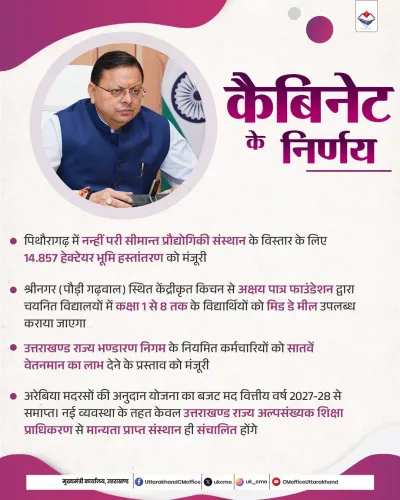
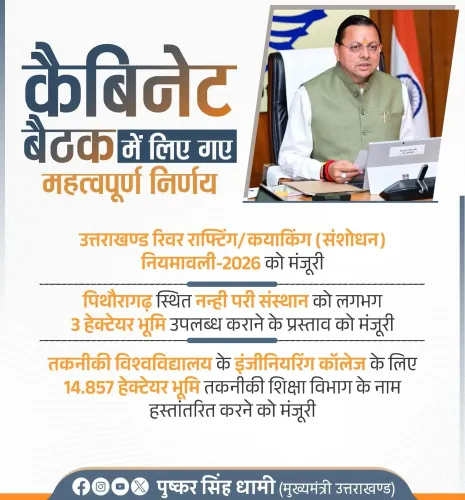
The Uttarakhand Cabinet on Thursday, 30 April 2026, approved over 20 wide-ranging decisions spanning transport regulation, infrastructure development, education reforms, excise policy, and administrative restructuring, aimed at boosting governance efficiency and accelerating development in the hill state. The decisions, taken under Chief Minister Pushkar Singh Dhami in Dehradun, cover everything from Kumbh Mela-2027 preparedness to forest boundary demarcation.
Kumbh Mela 2027 Infrastructure and Transport Reforms
In preparation for the Kumbh Mela-2027, the Cabinet sanctioned infrastructure development works in Haridwar, including roads and related civic amenities. An initial allocation of ₹31 crore has been approved, with ₹5 crore earmarked under the first phase and an additional ₹5 crore allocated for pending works from the previous state government's tenure.
Separately, the Cabinet approved the Uttarakhand Motor Vehicle (Amendment) Rules, 2026, paving the way for the implementation of parking charges across the state — a move aimed at easing congestion in the hill state's tourist-heavy towns.
Excise Policy Changes and Revenue Measures
A significant revenue-related decision involves increasing VAT on excise items from 60 to 65 per cent. Under the revised excise policy, duty on liquor made from domestic grains has been raised from ₹20 to ₹21 per bulk litre. Notably, the minimum age for consuming low-alcohol beverages has been fixed at 18 years — a regulatory clarification that had been pending.
In taxation reforms, the minimum turnover threshold under the GST composition scheme has been doubled from ₹1 crore to ₹2 crore, offering relief to smaller businesses in the state.
Education, Recruitment and Administrative Overhaul
The Cabinet approved the Uttarakhand School Education Campaign 2025, aimed at strengthening government schools and improving quality in private institutions. Under the scheme, each school will receive ₹12 lakh, with provisions for hostel facilities in remote areas. The state also outlined measures for the regulation and recognition of madrasas, including mandatory approvals for higher classes.
Funds have been approved under the Finance Department for school safety infrastructure, covering boundary walls, electrification, and fire safety systems. The Cabinet also cleared 117 guest teacher posts under the Shiksha Mitra scheme and approved the Uttarakhand Sanskrit Education (Teachers' Cadre) Service Rules, 2025, enabling recruitment to 62 posts that had remained vacant due to the absence of formal rules.
On the administrative front, the Cabinet approved filling 250 vacant posts in the Forest Department and increased sanctioned posts in the Disaster Management Department from 100 to 109, citing rising workload. Approval was also granted to make the Uttarakhand Emergency Services department fully operational. Recruitment for 107 long-pending vacant posts in the Cane Development Department was also cleared.
Industrial Growth, Sports Incentives and Forest Policy
Amendments to the Industrial Development Policy, 2023, were cleared, with financial assistance ranging between ₹7 crore and ₹8 crore to be provided under the scheme. The Cabinet also approved amendments to the Uttarakhand Public Service Commission Rules, 2026, introducing changes in the selection process for certain posts, aligning recruitment procedures with state government policies.
Promoting sports, the Cabinet approved incentives and government jobs for medal-winning athletes and extended financial assistance of ₹2,000 per month to emerging players, including women athletes, under a state scheme.
Addressing long-standing land disputes, the Cabinet approved a
Point of View
Excise, education, forests, disaster management, sports, GST — points to a government trying to compress a legislative sprint ahead of the Kumbh Mela-2027 deadline and what could be an election cycle. The VAT hike on excise items and the doubling of the GST composition threshold send mixed signals: one squeezes consumers, the other eases small business compliance. The forest 'No Man Policy' for boundary demarcation, if implemented rigorously, could resolve disputes that have festered for decades — but similar promises in hill states have historically stalled at the demarcation stage. The real test will be execution speed, not announcement volume.
NationPress
17 Sept 2026
Frequently Asked Questions
What major decisions did the Uttarakhand Cabinet take on 30 April 2026?
The Uttarakhand Cabinet approved over 20 decisions including ₹31 crore for Kumbh Mela-2027 infrastructure in Haridwar, a VAT hike on excise items from 60% to 65%, the Uttarakhand School Education Campaign 2025, and recruitment to 250 Forest Department posts. The decisions span transport, education, excise policy, industrial growth, and administrative restructuring.
How much has been allocated for Kumbh Mela 2027 infrastructure in Haridwar?
The Cabinet sanctioned a total initial allocation of ₹31 crore for infrastructure works in Haridwar ahead of Kumbh Mela-2027, with ₹5 crore earmarked under the first phase and an additional ₹5 crore for pending works from the previous government's tenure.
What changes were made to Uttarakhand's excise policy?
VAT on excise items has been increased from 60% to 65%, and duty on liquor made from domestic grains has been raised from ₹20 to ₹21 per bulk litre. The minimum age for consuming low-alcohol beverages has been fixed at 18 years under the revised excise policy.
What is the Uttarakhand School Education Campaign 2025?
It is a state scheme approved by the Cabinet to strengthen government schools and improve education quality in private institutions. Each school will receive ₹12 lakh under the campaign, with provisions for hostel facilities in remote areas and measures for madrasa regulation.
What is the 'No Man Policy' approved by the Uttarakhand Cabinet?
The 'No Man Policy' is a forest boundary demarcation approach based on natural features, approved by the Cabinet to resolve long-standing land disputes. It is expected to bring clarity to nearly 70% of forest areas in the state.